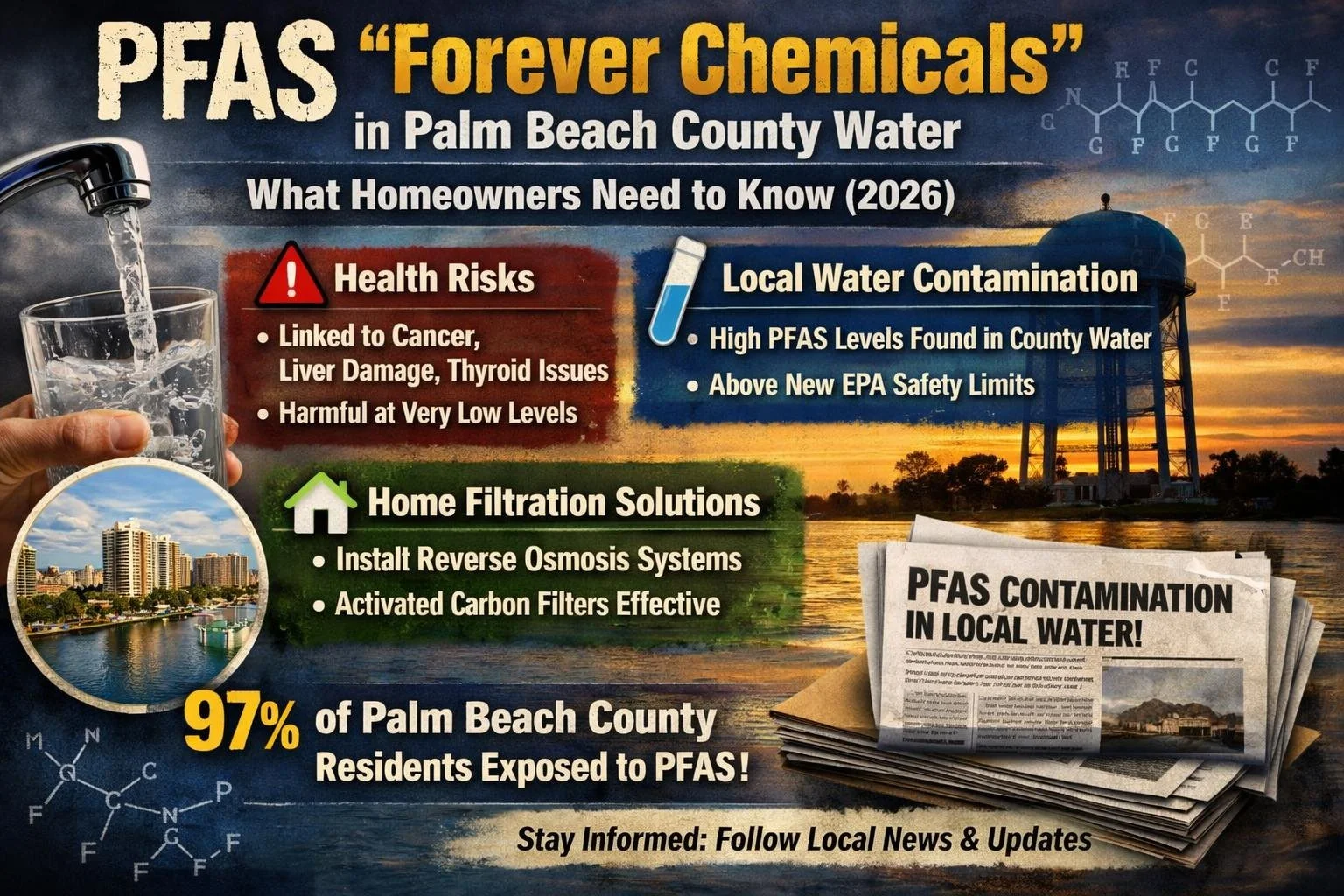
PFAS "Forever Chemicals" in Palm Beach County Water: What Homeowners Need to Know (2026)
By Jared Beviano | Water Wizards Filtration | Delray Beach, FL
I grew up in South Florida. Drank the tap water for years without a second thought. Then a few years ago a customer in Boynton Beach handed me a printout — a law firm's summary of EPA test data — and pointed to a line that said PFAS had been detected in Palm Beach County Water Utilities samples.
She wasn't panicking. She was just done waiting for someone to explain it to her in plain English.
That's what this article is. Plain English. Not fearmongering, not false reassurance — just the actual picture of what PFAS are, what the data says about Palm Beach County specifically, what these chemicals do in the body over time, and what you can do about it right now in your own home.
First: What Even Are PFAS?
PFAS stands for per- and polyfluoroalkyl substances. It's a family of over 12,000 synthetic chemicals — not one chemical, thousands — that were engineered starting in the 1940s to be extraordinarily resistant to heat, water, and oil. They were used in everything: non-stick cookware, waterproof jackets, stain-resistant carpeting, fast food wrappers, firefighting foam, dental floss, pizza boxes, ski wax.
The property that made them so useful — an almost unbreakable carbon-fluorine bond — is the same property that makes them dangerous. They don't break down. Not in the environment. Not in your body. That's why scientists started calling them "forever chemicals." It's not a metaphor. It's chemistry.
PFAS can linger in outdoor environments for decades. Once inside the human body, some have estimated half-lives — the time for your body to eliminate half of the accumulated amount — of several years. Others accumulate faster than the body can clear them. The result is bioaccumulation: the longer you're exposed, the more builds up in your blood, liver, kidneys, and other tissues.
The CDC has found PFAS in the blood of the vast majority of Americans tested. This isn't a Palm Beach County problem or a Florida problem. It's a national one. But Palm Beach County has specific, documented sources of contamination that make it worth understanding in local terms.
Where Is the PFAS Coming From in Palm Beach County?
This is the question most people ask first, and it has a specific answer.
The primary documented source of PFAS contamination in South Florida groundwater is firefighting foam — specifically, a type called AFFF (aqueous film-forming foam) that was used extensively at airports and military facilities for decades. AFFF contains concentrated PFAS compounds that were designed to suppress fuel fires rapidly. Every time it was used — in training drills, in actual emergencies, in routine testing — those chemicals soaked into the ground.
Palm Beach International Airport is the most significant local source. The airport has used AFFF for years, and PFAS compounds have migrated from the airport grounds into the surrounding groundwater. Since South Florida draws its drinking water from the Biscayne Aquifer — a shallow, highly permeable limestone formation directly beneath our feet — what enters the ground can move into drinking water sources relatively quickly.
Researchers at Florida International University who tested tap water across the region found that PFAS concentrations were highest in samples collected near major airports. West Palm Beach, Lake Worth, and Boynton Beach tap water samples showed a combined average total PFAS concentration of around 40 parts per trillion across the compounds tested. The most predominant PFAS detected in South Florida tap water was PFBA — a compound currently regulated only in Minnesota despite being found throughout the region.
Additional sources include dry-cleaning facilities (many of which have leaked chemical solvents into the ground over decades), industrial sites, and the broader atmospheric deposition of PFAS — which has become so pervasive that researchers at FIU have literally measured PFAS falling from the sky in South Florida rainfall.
Some municipal wells in Palm Beach County have been taken offline specifically due to PFAS contamination. Your utility doesn't necessarily advertise this, but it's in the public record.
What the EPA Rules Actually Say — and Why 2026 Matters
In April 2024, the EPA finalized the first-ever national drinking water standards for PFAS. This was a major regulatory event — decades in the making. The rules set Maximum Contaminant Levels (MCLs) of:
4 parts per trillion (ppt) for PFOA and PFOS — the two most studied and most commonly detected PFAS
10 ppt for PFHxS, PFNA, and GenX chemicals
To understand how small 4 parts per trillion is: it's equivalent to four drops of water dissolved in a billion liters. The EPA set the limit that low because the research on PFAS health effects — which we'll get to next — kept pointing toward harm at very low concentrations.
Water utilities have until 2027 to complete initial compliance monitoring, and until 2031 to implement full treatment solutions if they're over the limit. So even if your utility is currently exceeding the new EPA standard, they're not technically in violation yet — they have years to comply.
In May 2025, the EPA announced it would retain the PFOA and PFOS limits while reconsidering regulatory determinations for some of the other PFAS compounds. The core protections for the two most common compounds remain in place.
Here's the frustrating reality for Palm Beach County homeowners right now: your water utility may be working toward compliance, but compliance deadlines are years away. In the meantime, the water coming out of your tap may contain PFAS at levels that exceed both the new EPA standards and whatever your most recent consumer confidence report disclosed.
What PFAS Actually Do to the Human Body
I want to be careful here — not to overstate, and not to minimize. The research on PFAS health effects is extensive, but it's also complex and still evolving. Here's what the scientific consensus actually says as of 2026.
Bioaccumulation is real. PFAS compounds build up in human tissues over time — particularly in blood, liver, and kidneys. The longer and higher the exposure, the greater the accumulation. This isn't disputed.
Immune system effects are among the most consistently documented. Multiple studies have found that PFAS exposure is associated with reduced vaccine effectiveness and suppressed immune response. Research published in peer-reviewed literature has linked PFAS exposure to altered immune and thyroid function, liver disease, and adverse reproductive outcomes. A 2025 review found that PFAS compounds are associated with endocrine disruption, immune suppression, elevated cholesterol, and cancer risk.
Thyroid disruption is a significant concern. PFAS compounds can interfere with thyroid hormone production and metabolism — they can mimic natural hormones and bind to thyroid receptors, and they interfere with iodine uptake. Research published through 2024 consistently finds associations between PFAS exposure and altered thyroid hormone levels. The thyroid regulates metabolism, body temperature, heart rate, and a host of other functions. Disrupting it has cascading effects.
Cancer associations are real but still being studied. A scientific panel that reviewed PFOA exposure in Ohio and West Virginia found probable links between PFOA and kidney cancer, testicular cancer, and thyroid disease. The International Agency for Research on Cancer now classifies PFOA as possibly carcinogenic to humans (Group 2B). Testicular cancer associations appear particularly strong in the research literature. A 2025 study in Toxicology Letters found that higher PFOS levels were associated with a 56% increased rate of thyroid cancer diagnosis.
Elevated cholesterol is consistently observed. PFAS exposure interferes with lipid metabolism. Studies consistently find associations between higher PFAS exposure and elevated total cholesterol — a condition called dyslipidemia — as well as markers for insulin dysregulation.
Reproductive and developmental effects are documented. PFAS exposure has been associated with reduced birth weight, developmental delays, decreased fertility, and effects on fetal development.
One important caveat: the science on PFAS is moving fast, and not every association means proven causation. Some researchers have noted that while associations are consistent, establishing clear causal links for specific health outcomes is challenging given the complexity of PFAS mixtures and the difficulty of isolating exposure. What's not in dispute is that these chemicals accumulate, and that the accumulation is associated with a wide range of biological disruptions.
The most vulnerable populations are pregnant women, developing fetuses, infants and young children, and anyone with preexisting thyroid or immune conditions.
"But My Water Meets Federal Standards" — The Gap Nobody Explains
Here's the part of this conversation that frustrates me most, because it creates a false sense of security.
Your Palm Beach County water utility sends you an annual Consumer Confidence Report. It shows whether your water is in compliance with federal standards. For many utilities, it will say that PFAS levels are within acceptable limits — or that no exceedances were detected.
But there are multiple layers of complexity here that the report doesn't explain:
Layer 1: The legal limits just changed. The new 4 ppt standard for PFOA and PFOS only became final in April 2024. Many utilities were not being measured against that standard before then. Testing data from 2022 or 2023 was measured against older thresholds.
Layer 2: There are thousands of PFAS compounds, and only 29 are currently required to be tested. The UCMR5 rule — the EPA's Fifth Unregulated Contaminant Monitoring Rule — requires utilities to test for 29 specific PFAS. But PFAS is a family of over 12,000 chemicals. What isn't tested isn't reported. The FIU researchers who found 30 different PFAS in South Florida tap water were specifically looking for them. Routine utility testing may not be.
Layer 3: Compliance deadlines are years out. Even utilities that are currently over the new EPA limits have until 2031 to implement treatment solutions. "Working toward compliance" is not the same as "your water is currently within the new standards."
Layer 4: Meeting the standard ≠ zero risk. The EPA set the 4 ppt limit as the lowest feasible level for monitoring purposes, while acknowledging that even below that limit, PFAS can pose health risks. There is no truly "safe" level of PFAS — there's just a regulatory threshold.
None of this means your water utility is being negligent. It means the system is slow, PFAS is pervasive, and the gap between "legal" and "protective" is still significant.
The Regulatory Whiplash of 2025 — What Happened
It's worth mentioning because it was in the news and caused genuine confusion.
In May 2025, the EPA announced it would roll back standards for four of the six regulated PFAS compounds — specifically PFHxS, PFNA, GenX, and a mixture provision — while retaining the PFOA and PFOS limits. Environmental groups and public health advocates called it a "public health betrayal." The Trump administration framed it as ensuring compliance was "achievable" for water utilities.
By March 2026, new EPA data from UCMR5 testing showed that approximately 176 million Americans drink water contaminated with detectable levels of PFAS — four million more than previous estimates. The total number of known contaminated public water sites reached 9,728 nationally, with Florida among the states with the highest number of detections.
The PFOA and PFOS limits — the most health-critical ones — remain in place as of this writing. But the regulatory landscape around the other compounds is in flux.
→ See also:West Palm Beach Water Problems: How RO Systems Solve PFAS, Chlorine & Hard Water This is exactly the situation where waiting for government protection to be complete before acting on your own home's water is a questionable strategy.
How Much PFAS Is Actually in Palm Beach County Water?
Let me give you the specific numbers that have been publicly documented.
FIU researchers found that tap water samples from the West Palm Beach, Lake Worth, Boynton Beach, and Boca Raton area had a combined average total PFAS concentration of 40.3 parts per trillion across the compounds they tested. Samples from areas closer to Miami International Airport averaged higher — 57.7 ppt in the Key Biscayne and Kendall area.
The most predominant compound found throughout South Florida was PFBA — a short-chain PFAS that has been found to accumulate in lung tissue and affect immune function, and that remains unregulated federally outside of Minnesota.
A law firm that reviewed UCMR5 data specifically for Palm Beach County Water Utilities documented detectable PFAS levels in the utility's test results submitted to the EPA. That data is public — you can look it up on the EPA's UCMR5 database.
Do these levels cause immediate harm? Probably not. The research on PFAS health effects is about long-term accumulation and chronic exposure, not acute poisoning from a single glass of water. The concern is what happens over years and decades of daily exposure — in a region where most people drink the same tap water their entire lives.
What Actually Removes PFAS From Your Water
This is the practical part. And here the science is clear.
| Filtration Method | PFAS Removal Rate | Notes |
|---|---|---|
| Reverse Osmosis (RO) | 90–99% | Most effective home method. Removes long-chain and short-chain PFAS. Standard under-sink or whole-house RO. |
| Activated Carbon (granular or block) | 50–90% | Effective for long-chain PFAS (PFOA, PFOS). Less effective for short-chain PFAS like PFBA. Requires regular replacement. |
| Pitcher Filters (Brita, PUR, etc.) | Variable / Low | Not certified for PFAS removal. May reduce some compounds slightly. Not a reliable solution for PFAS. |
| Standard Water Softener | Minimal | Designed for hardness minerals, not PFAS. Does not meaningfully remove forever chemicals. |
| Boiling Water | None | Does not remove PFAS. May actually concentrate them as water evaporates. |
| NSF/ANSI 58-certified RO system | Certified removal | Look for this certification specifically. NSF 58 certification for PFOA/PFOS means the system has been independently tested and verified. |
The bottom line on filtration: Reverse osmosis is the most reliable home treatment for PFAS. A standard under-sink RO system — professionally installed — handles your drinking and cooking water at 90–99% removal efficiency. If you want whole-home protection (relevant for shower exposure and inhalation), a point-of-entry RO system addresses that too, though it's a more significant investment.
When shopping for a system, look for NSF/ANSI Standard 58 certification specifically for PFOA and PFOS removal. That certification means independent testing has verified the performance claim — not just the manufacturer's word.
What won't work: boiling your water (PFAS don't evaporate — they concentrate), standard pitcher filters (not designed or tested for PFAS), or water softeners (designed for mineral hardness, not synthetic chemicals).
What About Children and Pregnant Women?
I want to address this specifically because the stakes are different.
Developing fetuses and young children are more vulnerable to PFAS effects because their bodies are still forming. The same PFAS exposure that might have minimal impact on a healthy adult can affect fetal development, immune system formation, and early childhood growth in ways that compound over a lifetime.
Research has found associations between prenatal PFAS exposure and reduced birth weight, developmental delays, and altered immune function in children. The earlier and longer the exposure, the more opportunity for accumulation.
If you have young children, if you're pregnant, or if you're trying to conceive — PFAS in your drinking water isn't something to monitor casually. It's something to address now. An under-sink RO system at the kitchen tap — the one you use for drinking, cooking, and making baby formula — is the most direct and cost-effective intervention.
→ Related reading:What's Actually in Your South Florida Tap Water? A Homeowner's Honest Guide → And:Fort Lauderdale Drinking Water Quality: Do You Need a Reverse Osmosis System?
"Should I Stop Drinking the Tap Water?"
Here's my honest answer, which is probably more nuanced than you were hoping for.
No, I don't think the situation requires you to stop drinking Palm Beach County tap water immediately and switch to bottled water. The current PFAS levels that have been publicly documented are not at emergency-level acute toxicity thresholds.
But I do think:
You should know what's in your water, specifically, using current test data for your utility
You should understand that "legal" and "safe" are not synonyms in this context
If you have young children or are pregnant, the calculus shifts toward acting sooner
Bottled water is not the long-term answer — most bottled water also contains detectable PFAS, and single-use plastic is its own environmental problem
A properly certified home filtration system is a more reliable, more sustainable, and ultimately cheaper solution than bottled water for a household that drinks water every day
The math on this is actually straightforward. A quality under-sink RO system professionally installed runs roughly $400–$700. Annual filter changes run $80–$120. A family of four that currently buys bottled water spends $800–$1,500 per year on that habit. The filtration system pays for itself in one to two years — and delivers measurably cleaner water from a system you can verify and maintain.
→ See also:Is Florida Tap Water Safe to Drink? → See also:The $500 vs $5,000 Water System: What Florida Homeowners Actually Need
→ And:Reverse Osmosis Installation in Boca Raton: Why Your Tap Water Needs Treatment
How to Find Out What's in Your Specific Water
Two resources are worth your time:
1. Your annual Consumer Confidence Report (CCR). Every public water utility in the US is required to publish this annually. Search "[your city] water quality report 2025" or find it on your utility's website. It will show you what was tested and what levels were found.
2. The EPA's UCMR5 database. This is publicly searchable. You can look up your specific water system and see the PFAS testing results that your utility submitted to the EPA as part of the federal monitoring program.
→ Learn more:Well Water vs. City Water in Palm Beach County: Different Challenges, Different Solutions
3. A home water test. If you want specific data on what's coming out of your tap — today, at your address — a comprehensive water test is the most direct answer. Some parameters require a certified lab, which we can arrange.
We offer a free in-home water test that gives you a baseline picture of your water quality: hardness, pH, chloramine levels, iron, TDS, and more. For PFAS specifically, we can arrange a certified laboratory panel. It takes one conversation to get started.
Schedule Your Free Water Test → Call 561-352-9989 or Book Online
Frequently Asked Questions
Is there PFAS in Palm Beach County tap water? Yes. Research from Florida International University detected PFAS in tap water samples from the West Palm Beach, Lake Worth, Boynton Beach, and Boca Raton area, with an average combined concentration of approximately 40 parts per trillion across compounds tested. PFAS compounds have also been detected in Palm Beach County Water Utilities data submitted to the EPA under the UCMR5 testing program.
Where is the PFAS coming from in Palm Beach County water? The primary documented local source is Palm Beach International Airport, which used PFAS-containing firefighting foam (AFFF) for decades. Those chemicals migrated into the shallow Biscayne Aquifer, which supplies drinking water to Palm Beach County. Additional sources include former industrial sites, dry-cleaning operations, and atmospheric deposition.
What is the EPA limit for PFAS in drinking water? As of April 2024, the EPA set Maximum Contaminant Levels of 4 parts per trillion (ppt) for PFOA and PFOS — the two most commonly detected PFAS compounds. Additional limits apply to other PFAS. Water utilities have until 2027 to complete monitoring and 2031 to implement treatment solutions.
Does boiling water remove PFAS? No. Boiling does not remove PFAS. It may actually concentrate them as water evaporates. The only effective home treatment for PFAS is a properly certified reverse osmosis system or, to a lesser extent, activated carbon filtration.
Do Brita filters remove PFAS? Standard pitcher filters like Brita are not certified for PFAS removal and should not be relied upon for this purpose. Some activated carbon filters with specific certifications (NSF 58) can reduce PFAS, but standard pitcher filters are primarily designed for chlorine and taste, not PFAS.
How much does a PFAS-removing water filter cost? A quality under-sink reverse osmosis system professionally installed in South Florida typically runs $400–$700, with annual maintenance (filter replacement) of $80–$120. This is the most cost-effective long-term solution compared to ongoing bottled water purchases. For whole-home PFAS treatment, point-of-entry RO systems are a larger investment — typically $2,500–$5,000 installed.
Is bottled water safer than Palm Beach County tap water for PFAS? Not necessarily. Studies have found PFAS in many bottled water brands — the source water and the plastic packaging itself can both contribute to PFAS content. A certified home RO system is generally a more reliable and verifiable solution than bottled water.
Should pregnant women in Palm Beach County worry about PFAS in tap water? Prenatal PFAS exposure is an area of active research concern. Studies have found associations between PFAS exposure during pregnancy and reduced birth weight, altered fetal development, and immune system effects in children. For pregnant women and those trying to conceive, filtering drinking and cooking water with a certified RO system is a reasonable, practical precaution.
The Practical Summary
PFAS are in Palm Beach County water. The sources are documented and specific — primarily airport firefighting foam and industrial contamination that has migrated into the Biscayne Aquifer.
The health research points to real concerns with long-term accumulation: thyroid disruption, immune suppression, elevated cholesterol, and cancer associations. The science is still evolving, and not every association represents established causation — but the weight of evidence is sufficient that the EPA set near-zero regulatory limits for a reason.
Your utility is working toward compliance. That process takes years. In the meantime, the most reliable thing you can do for your household is install a certified reverse osmosis system on your drinking water supply.
It won't solve the broader contamination problem in South Florida's water supply. But it will significantly reduce what enters your body every day.
That's the part you can control.
Want to know specifically what's in your water?
Schedule Your Free Water Test → Call 561-352-9989
Water Wizards serves Palm Beach, Broward, and Martin County with same-day installation, free water testing, and a 5-year warranty. Based in Delray Beach, FL.
Sources: Florida International University Institute of Environment, PFAS research (2021, 2024); U.S. EPA National Primary Drinking Water Regulations for PFAS (April 2024); EPA UCMR5 testing data (2023–2026); Environmental Working Group PFAS contamination database (March 2026); National Institute of Environmental Health Sciences PFAS health overview; PMC peer-reviewed literature on PFAS toxicity and health effects; Florida DEP PFAS Dynamic Plan (2022); Marin & Murphy Law Firm UCMR5 analysis for Palm Beach County Water Utilities.