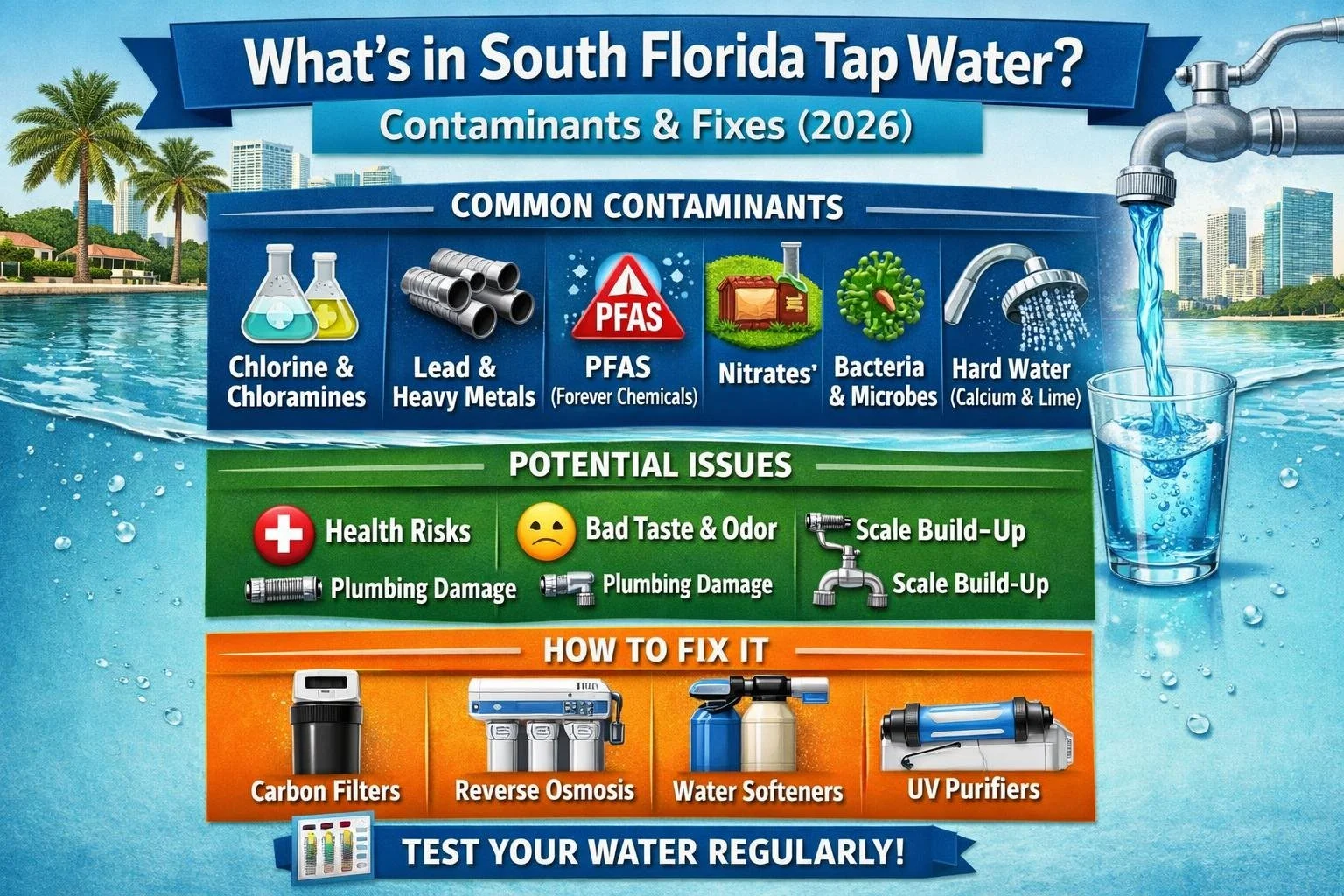
What's in South Florida Tap Water? Contaminants & Fixes (2026)
My neighbor called me a few months ago — retired guy, sharp as a tack, lived in Boynton Beach for over twenty years. He said his water had started tasting "off." Not bad, exactly. Just... different. Like something had changed in the pipes or the treatment plant or the aquifer. He wasn't sure. He just knew the water tasted the way a swimming pool smells.
I told him what I tell everyone: that feeling you get when you hold a glass of water up to the light and still aren't sure if you should drink it? That's not paranoia. That's instinct. And in South Florida, it's usually pointing at something real.
This guide is for anyone who's asked — even quietly, even just to themselves — what exactly is coming out of my tap? Not the official answer. The honest one.
The Problem With "It Meets Federal Standards"
Here's the thing they don't put on the water bill: your water meeting federal standards doesn't mean it's clean. It means it falls within legal limits — limits that, in many cases, haven't been updated in nearly 20 years.
The Environmental Working Group (EWG), which independently analyzes water utility data across the country, has consistently found that Palm Beach and Broward County water contains multiple contaminants at levels above their health-based guidelines — while still technically passing all federal tests. That's not a contradiction. That's just how the system works right now.
So what are we actually dealing with here?
Contaminant #1: PFAS — "Forever Chemicals"
Let's start with the one that's been getting the most attention, and for good reason.
PFAS are a family of thousands of synthetic chemicals — perfluoroalkyl and polyfluoroalkyl substances — that were used for decades in everything from non-stick cookware to firefighting foam to food packaging. They don't break down in the environment. They don't break down in the human body. That's why scientists call them "forever chemicals."
Researchers at Florida International University's Institute of Environment were among the first to measure PFAS distribution across South Florida's tap water and surface water. They found around 30 different PFAS in Miami, Broward, and Palm Beach tap water, with the highest concentrations detected in samples collected near Miami International and Fort Lauderdale-Hollywood International airports.
That's not a surprise to anyone who understands the geography. Both of those airports have used PFAS-containing firefighting foams (called AFFF) for decades. The Biscayne Aquifer — the shallow limestone formation that supplies drinking water to millions of South Florida residents — is highly permeable. Water moves through it fast. And what goes in tends to stay in.
South Florida's Biscayne Aquifer serves as the primary drinking water supply for millions of residents in Miami-Dade and Palm Beach counties, and its close hydrological connection to the Everglades emphasizes its vulnerability to contamination from urban and industrial activities.
In April 2024, the EPA finally set the first-ever national drinking water standards for PFAS — a Maximum Contaminant Level of 4 parts per trillion (ppt) for PFOA and PFOS, two of the most common compounds. That's an almost unimaginably small number. For context: one part per trillion is equivalent to one drop of water in 20 Olympic swimming pools.
The fact that regulators set the limit that low tells you something about how seriously they're taking this.
What PFAS exposure has been linked to: thyroid disruption, immune system effects, elevated cholesterol, kidney and testicular cancer with long-term exposure, and developmental issues in children. Research is ongoing — and scientists keep finding new connections.
What removes PFAS: Reverse osmosis systems remove 90–99% of PFAS. Standard carbon filters help but don't fully address them. If PFAS is a concern for your household, an RO system under the sink or a whole-house RO setup is the most reliable solution.
→ Read more:West Palm Beach Water Problems: How RO Systems Solve PFAS, Chlorine & Hard Water
Contaminant #2: Chloramines — The Disinfectant You Can Taste
If your water smells faintly like a public pool, you're probably detecting chloramines.
Most South Florida utilities — including Palm Beach County Water Utilities and Broward County Water and Wastewater Services — use chloramines as their primary disinfectant. Chloramines are formed by combining chlorine with ammonia. They're more stable than free chlorine, which means they last longer as water travels through distribution lines. The City of Hollywood, for example, treats its groundwater with lime and ferric chloride to reduce hardness and color, and then disinfects with chlorine and ammonia — otherwise known as chloramines.
That's industry standard. It's not reckless. But there are trade-offs most residents don't know about.
Chloramines are harder to remove than plain chlorine. Standard pitcher filters — Brita, PUR, the ones you buy at the grocery store — are designed primarily for chlorine. They're less effective against chloramines. This is something a lot of people discover after they've bought the filter, when their water still tastes chemical and they can't figure out why.
The other issue is what chloramines can turn into. When chloramines interact with organic matter in the water — leaves, algae, decaying material that found its way into the source — they form disinfection byproducts (DBPs), including trihalomethanes and haloacetic acids. Which brings us to the next one.
Note: Palm Beach County Water Utilities briefly switches to free chlorine for a few weeks each winter — they announced this for January 2025 — as a maintenance flush of the distribution system. If your water tastes or smells different in that window, that's why.
Contaminant #3: Trihalomethanes (TTHMs) and Haloacetic Acids (HAAs)
I want to be honest here: these are the contaminants I've seen homeowners react to most strongly once they understand what they are.
Trihalomethanes (TTHMs) — which include chloroform, bromodichloromethane, dibromochloromethane, and bromoform — are formed when disinfectants like chlorine and chloramines react with organic matter in source water. They're classified as probable human carcinogens. Long-term exposure has been linked to bladder cancer, colon cancer, and adverse reproductive outcomes.
Haloacetic acids (HAAs) form through a similar process and carry similar health concerns.
EWG's drinking water data shows that while Palm Beach County water meets federal legal limits for TTHMs and HAAs, levels detected have exceeded the EWG's health-based guidelines — guidelines set at a one-in-one-million lifetime cancer risk level.
The same pattern appears in Broward County data. EWG's tap water database for Broward County Water and Wastewater Services found trihalomethanes and haloacetic acids among contaminants that exceed EWG-selected health guidelines, even while meeting federal legal standards.
This is the gap people don't talk about enough: legal doesn't mean safe. The EPA legal limit for TTHMs is 80 parts per billion. EWG's health guideline — based on a one-in-a-million cancer risk — is 0.15 ppb. That's more than a 500x difference between "you won't get fined" and "this is actually safe."
I'm not saying this to frighten you. I'm saying it because you deserve to know what the numbers actually mean.
What removes TTHMs and HAAs: Activated carbon filters (whole-house or under-sink) are effective. Reverse osmosis removes 85–95% of both. If you have a whole-house carbon system, you're already ahead of most households on this front.
→ Related:Is Florida Tap Water Safe to Drink?
Contaminant #4: Hard Water — The One Destroying Your Appliances Right Now
Hard water isn't technically a health contaminant. Nobody's going to get sick from drinking water with high mineral content. But in South Florida, hardness is the contaminant that causes the most daily, visible, expensive damage to your home — and most people don't connect it to their water until something breaks.
Palm Beach Gardens water, for example, has an average hardness of 317 parts per million (ppm) or 19 grains per gallon (gpg). Experts agree that water becomes problematic when hardness exceeds 170 ppm (10.5 gpg) — Palm Beach Gardens is nearly double that threshold.
West Palm Beach water comes in around 317 ppm as well. Much of the rest of Palm Beach and Broward County sits in similar territory — ranging from moderately hard (7–10 gpg) in treated municipal water to extremely hard (15–25+ gpg) in areas drawing from older parts of the Biscayne Aquifer.
Where does all that hardness come from? The limestone. South Florida is essentially built on top of ancient coral reef, and water filtering through that limestone picks up calcium and magnesium along the way. It's geology doing what geology does.
The consequences show up everywhere:
Water heaters: Scale buildup forces them to work 15–30% harder, cutting lifespan in half in some cases. I've talked to homeowners in Lake Worth who've replaced two water heaters in eight years.
Washing machines and dishwashers: Hard water reacts with soap to form soap scum — the gray film on your dishes and laundry isn't dirty dishes, it's mineral deposits.
Plumbing and fixtures: The white crusty buildup around your faucets and showerheads? That's calcium scale. Inside your pipes, it's doing the same thing — slowly narrowing flow.
Skin and hair: Hard water doesn't lather well with soap, leaves mineral residue on skin, and — according to a lot of dermatologists and a lot of frustrated South Florida residents — makes dry skin and eczema significantly worse.
What fixes hard water: A water softener. That's it, really. Ion-exchange softeners replace calcium and magnesium ions with sodium ions, leaving water that's genuinely soft. If you're dealing with 15+ gpg, a softener isn't a luxury — it's a practical investment that pays for itself in appliance life and reduced soap usage.
→ Read more:Hard Water vs. Soft Water: What's the Difference and Do You Need a Softener?
→ And:Signs Your Water Softener Isn't Working (And What to Do About It)
Contaminant #5: Hydrogen Sulfide — Why Your Water Smells Like Rotten Eggs
This one you don't need a lab test to identify.
Hydrogen sulfide in water has a very specific, very unmistakable smell: rotten eggs. Sulfur. The smell hits you when you turn on the hot tap, especially in the morning when water has been sitting in the pipes.
It's common throughout South Florida, particularly in well-water systems and in municipal water drawn from deeper parts of the aquifer. Anaerobic bacteria — bacteria that thrive without oxygen — produce hydrogen sulfide as a byproduct as they break down organic matter underground. It's a natural process. That doesn't make it pleasant.
At low concentrations, hydrogen sulfide in drinking water isn't typically a health risk. At higher concentrations — which you'd detect immediately by smell — it becomes a problem worth addressing. Beyond the smell, it can corrode copper and silver plumbing components and can indicate other biological contamination.
→ We wrote a full guide on this:Why Does My Florida Water Smell Like Rotten Eggs?
Contaminant #6: Iron — The One That Stains Everything Orange
The Biscayne Aquifer, which underlies Miami-Dade, Broward, and Palm Beach Counties and supplies drinking water to millions of South Florida residents, locally contains large concentrations of iron — particularly in southern Broward County and parts of Miami-Dade.
If you've got rust-orange or brown stains around your toilet bowl, your shower drain, or your sinks — and you've been scrubbing at them for months wondering what the problem is — you're probably dealing with iron in your water.
There are two kinds:
Ferrous iron (dissolved): Invisible in the water until it oxidizes and turns your fixtures that characteristic orange-brown color. Also ruins laundry.
Ferric iron (particulate): Visible as orange or reddish particles in the water itself. Usually filtered out at the treatment plant but can appear in well water or older plumbing.
Iron staining is cosmetic but persistent, and it accelerates wear on your appliances and fixtures. It's also a sign that your water has a mineral content worth treating — especially if you're on well water in western Palm Beach or Broward County.
What removes iron: A whole-house iron filter (also called an iron removal filter or air injection system) is the most effective solution. A well-maintained water softener will also reduce iron to some extent, but dedicated iron filtration handles higher concentrations better.
Contaminant #7: Hexavalent Chromium (Chromium-6)
This one flies under the radar in most conversations about Florida water, but the EWG data puts it in the mix for Broward County.
EWG's tap water database for Broward County found hexavalent chromium — a known carcinogen — as one of the contaminants detected in the water system. Chromium-6 is the contaminant made famous by the Erin Brockovich case in Hinkley, California. It occurs naturally in some rock formations and can also result from industrial contamination.
The federal government does not currently have a specific Maximum Contaminant Level for chromium-6 (only for total chromium). California and some other states have proposed stricter standards. EWG's health guideline is 0.02 parts per billion — a level designed to represent a one-in-one-million cancer risk.
Is it at crisis levels in Broward tap water? Based on current data, no. But it's detectable. And detectable is worth knowing.
What removes chromium-6: Reverse osmosis, removing 95–99%. Strong-base ion exchange also works. Standard carbon filtration does not effectively remove hexavalent chromium.
What About Lead?
Lead in South Florida municipal water is a slightly different conversation than it is in, say, older Midwest cities with aging infrastructure.
The primary risk for lead exposure in Florida isn't the treatment plant — it's old plumbing. Homes built before 1986 may have lead solder or lead-containing fixtures. While South Florida's aggressive growth means a lot of the housing stock is relatively recent, there are older neighborhoods — parts of Fort Lauderdale, Hollywood, older sections of West Palm Beach — where lead in plumbing is a real possibility.
Here's the frustrating part: you can't see lead in water. You can't smell it. You can't taste it. The only way to know is to test.
If your home was built before 1986 and you have young children or are pregnant, this is worth testing for specifically. A simple in-home test kit or a lab water test will tell you what you need to know.
What removes lead: Reverse osmosis (95–99% removal), NSF-certified activated carbon filters certified for lead (like most under-sink systems), and water softeners to some extent. Replacing lead-containing plumbing is the permanent solution.
The Well Water Question
If you're on well water — and there are significant areas of western Palm Beach County (Loxahatchee, Wellington, Jupiter Farms) and parts of Broward where residents draw from private wells — this conversation is different.
Private wells aren't regulated by the EPA. They're your responsibility. Nobody is testing them on your behalf. Nobody is sending you an annual water quality report.
Research on the Biscayne Aquifer found that its high permeability and shallow water table make groundwater vulnerable to contamination by human activities — including pesticide runoff from agricultural areas in Miami-Dade and southern Palm Beach County.
Western Palm Beach County has significant agricultural activity — sugar cane, citrus, winter vegetables. Nitrate contamination from fertilizer runoff is a genuine concern in some well-water areas. So is bacterial contamination, especially after heavy rain events when the shallow aquifer can be impacted by surface runoff.
If you're on a private well and haven't had it tested recently — at all, really — that's the first step. A comprehensive well water test will look at bacteria (coliform, E. coli), nitrates, pH, hardness, iron, hydrogen sulfide, and a panel of other parameters.
→ More on this:Well Water vs. City Water in Palm Beach County: Different Challenges, Different Solutions
"But My Water Passed All the Tests"
I hear this a lot. And I want to address it directly.
Passing federal water quality tests means your utility is operating within the law. It does not mean your water is free of contaminants. It means the contaminants that are in it fall below legal limits — limits that are, in many cases, decades old and not reflective of current health science.
The EWG makes this point consistently: legal limits for contaminants in tap water have not been updated in almost 20 years. Getting a passing grade from the federal government does not mean the water meets the latest health guidelines.
That's not a critique of your local water utility. In most cases, South Florida utilities are doing a competent job of treating a genuinely difficult water supply. The Biscayne Aquifer is shallow, highly permeable, and surrounded by millions of people, agricultural runoff, military installations, and two major international airports. Producing clean municipal water from that source is not a small feat.
But "they're doing their best" and "you should still filter your water" are both true simultaneously.
| Contaminant | Where Found | Concern Level | Best Removal Method |
|---|---|---|---|
| PFAS (Forever Chemicals) | Miami-Dade, Broward, Palm Beach municipal & well water | High | Reverse Osmosis (90–99%) |
| Chloramines | All South Florida municipal systems | Medium | Catalytic carbon whole-house filter |
| Trihalomethanes (TTHMs) | Palm Beach & Broward county tap water | High | Activated carbon + RO |
| Haloacetic Acids (HAAs) | Palm Beach & Broward county tap water | Medium | Activated carbon filter |
| Hard Water (Calcium/Magnesium) | Region-wide — 15–20+ GPG in most areas | High | Ion-exchange water softener |
| Hydrogen Sulfide | Well water, older municipal zones | Medium | Aeration filter / oxidizing filter |
| Iron | Biscayne Aquifer areas — Broward & Miami-Dade | Medium | Iron removal filter / softener |
| Hexavalent Chromium (Cr-6) | Broward County — detected at trace levels | Medium | Reverse Osmosis (95–99%) |
| Lead | Older homes with pre-1986 plumbing | Medium | RO or NSF-certified carbon filter |
| Nitrates | Well water in agricultural western areas | Medium | Reverse Osmosis (85–95%) |
So What Do You Actually Do About It?
Here's where I want to be practical, because the whole point of knowing what's in your water is knowing what to do about it.
There's no single system that solves every problem. The right answer for your home depends on:
Whether you're on city water or a private well
Your specific county and water source
Which contaminants show up most prominently in your area
Your household size and water usage
Whether your concern is primarily drinking water or whole-house protection
That said, here's how most South Florida households approach this:
For drinking and cooking water: A reverse osmosis system under the kitchen sink is the gold standard. It removes PFAS, TTHMs, chloramines, lead, chromium-6, nitrates, and most other dissolved contaminants at 90%+ efficiency. Typical cost for a good system professionally installed: $300–$600. Annual filter changes run $50–$100.
For hard water damage: A whole-house water softener addresses the scale buildup on your pipes, appliances, fixtures, skin, and laundry. This is separate from drinking water filtration — they serve different purposes. If you're in Palm Beach or Broward County and not using a softener, your appliances are aging faster than they should.
For chloramines, taste, and whole-house filtration: A whole-house carbon filter — typically installed at the main line entry point — treats all the water entering your home, not just what comes from the kitchen tap. This is especially relevant if you're concerned about chloramine exposure during showers (skin and inhalation absorption are real exposure pathways).
For well water: Start with a comprehensive water test. Then build a treatment system around what the test finds. This is not a situation where guessing is acceptable.
→ Read:DIY vs Professional Water Filter Installation: The Hidden Costs Nobody Talks About
→ And:The $500 vs $5,000 Water System: What Florida Homeowners Actually Need
The Free Water Test — What We Do First
At Water Wizards, we don't sell you a system before we know what's in your water. We start with a free in-home water test — it takes about 20 minutes and tells us your hardness, pH, chloramine levels, iron content, and TDS (total dissolved solids). For well water, we recommend a more comprehensive lab panel.
The test costs you nothing. The call to schedule it costs you two minutes. What you get is an actual picture of what's coming out of your tap — not a guess, not a sales pitch built on fear.
Schedule Your Free Water Test → Call 561-352-9989 or Book Online
Frequently Asked Questions
Is South Florida tap water safe to drink? Technically, yes — it meets all federal standards. But meeting legal limits and being free of health-relevant contaminants are two different things. Many South Florida water systems contain PFAS, trihalomethanes, and chloramines at levels that exceed independent health guidelines even while passing regulatory tests.
Does Brita filter chloramines out of South Florida water? Standard pitcher filters (Brita, PUR, etc.) are primarily designed for chlorine. They're much less effective against chloramines, which are the primary disinfectant used in most South Florida municipal water. A catalytic carbon filter or reverse osmosis system is more appropriate for chloramine removal.
How hard is water in Palm Beach County? Very. Palm Beach County water hardness typically runs 15–20 grains per gallon (gpg) or more — well above the 10.5 gpg threshold at which hardness begins causing visible damage to appliances and plumbing. A water softener is strongly recommended for most Palm Beach County homes.
What is the best water filter for South Florida? For drinking water: a reverse osmosis system removes the widest range of South Florida contaminants including PFAS, chloramines, TTHMs, and heavy metals. For whole-home protection: a combination of a water softener (hardness) and a whole-house carbon filter (chloramines, taste, odor) covers the most ground. The right combination depends on your specific water test results.
Does South Florida water have PFAS? Yes. Research from Florida International University detected approximately 30 different PFAS compounds in Miami, Broward, and Palm Beach tap water. Concentrations varied by location, with the highest levels found near major airports. Reverse osmosis is the most effective home treatment for PFAS removal.
Should I worry about lead in my South Florida water? If your home was built before 1986, it may have lead solder or lead-containing fixtures — and lead can leach into water that sits in those pipes. The treatment plant is unlikely to be the source, but your home's plumbing may be. Testing is the only way to know for sure.
Why does my South Florida water taste like a swimming pool? That's the chloramines. All South Florida municipal systems use chloramine disinfection, and many residents find the taste and smell unpleasant. A catalytic carbon filter or reverse osmosis system will remove it effectively. The taste also sometimes intensifies when utilities briefly switch to free chlorine for system maintenance (usually a few weeks in winter).
The Bottom Line
Your South Florida tap water isn't poison. I want to be clear about that. The people running these utilities work hard to deliver safe water from a genuinely challenging source.
But "safe" has a legal definition and a scientific one, and right now those two definitions are quite far apart in some areas.
PFAS that may accumulate in the body over time. Disinfection byproducts formed during treatment. Hardness that's silently destroying your appliances. An aquifer that's shallow, permeable, and surrounded by 8 million people's daily activity.
You're not powerless in this. A water test tells you where you stand. A good filtration system — matched to what's actually in your water — changes the equation completely.
The question isn't whether to treat your water. It's what to treat it for.
Ready to find out what's actually in your water?
Get Your Free Water Test — We Come to You → 561-352-9989
Water Wizards serves Palm Beach, Broward, and Martin County with same-day installation, free water testing, and a 5-year warranty. Based in Delray Beach, FL.
Sources: Florida International University Institute of Environment (FIU PFAS research, 2021, 2024); Environmental Working Group Tap Water Database (Palm Beach County, Broward County data, 2021–2024); U.S. Geological Survey Biscayne Aquifer studies; EPA National Primary Drinking Water Regulations for PFAS (2024); Palm Beach County Water Utilities Department; Broward County Water and Wastewater Services 2025 Water Quality Report.