
Drinking Water Filtration
Drinking Water Filtration Systems, Florida
Clean, crisp, and contaminant-free water from every tap. Advanced point-of-use filtration removes chlorine, sediment, chemicals, and impurities — delivering refreshing, great-tasting water for your family.
Get Free Water Analysis99% Chlorine Removal
Eliminates unpleasant taste & odor from every drop
Multi-Stage Filtration
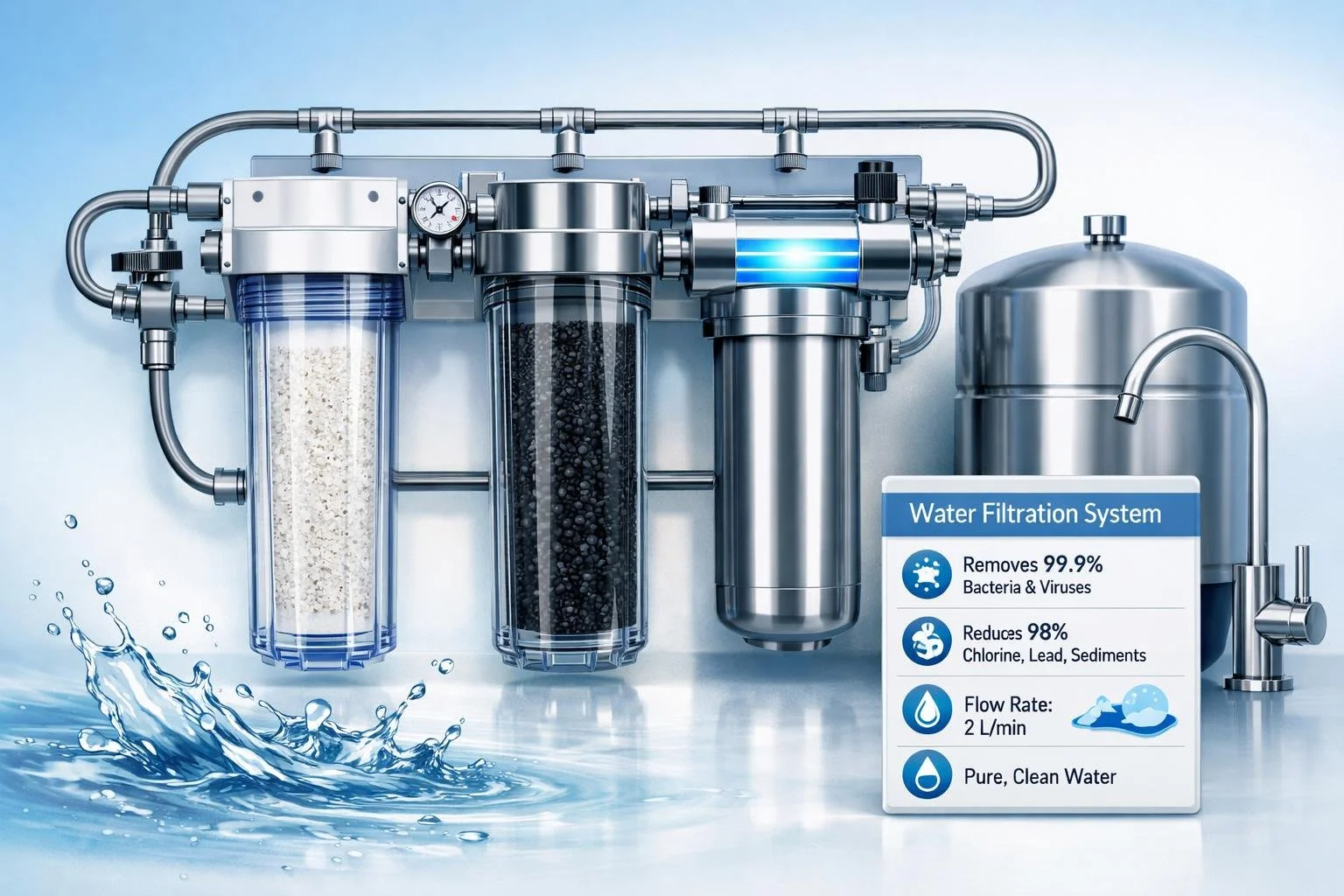
Sediment + Carbon + Catalytic + Polishing stages
NSF/ANSI Certified
Independently verified quality — tested to the highest standard
Professional Installation
Expert setup in 1–2 hours with lifetime support included
Drinking Water Filtration
Pure Drinking Water for Your Family
Advanced filtration technology for the cleanest, best-tasting water — installed at your sink and ready the same day.
What is a Drinking Water Filtration System?
A drinking water filtration system is a point-of-use treatment solution installed directly at your kitchen sink or refrigerator to provide clean, filtered water specifically for drinking and cooking.
Unlike whole house systems that treat all water entering your home, drinking water filters target the water you consume — removing chlorine, sediment, chemicals, and contaminants that affect taste, odor, and safety at a fraction of the cost.
- Removes 99% of chlorine & chloramines
- Filters lead, mercury & heavy metals
- Eliminates VOCs, pesticides & herbicides
- Saves $500–$1,200 vs bottled water annually
- NSF/ANSI certified — independently verified
Drinking Water vs Whole House — Key Difference
Whole House Filtration
Drinking Water Filtration
Why Choose Us
Why Choose Drinking Water Filtration?
Six compelling reasons why a dedicated drinking water filter is one of the best investments for your family's health and budget.
Eliminate Chlorine Taste & Odor
Remove 99% of chlorine and chloramines that make tap water taste and smell like a swimming pool. Enjoy pure, refreshing water straight from your faucet — every single time.
99% removalSave Money on Bottled Water
Eliminate $500–$1,200 in annual bottled water costs. Get unlimited filtered water for pennies per gallon — the system pays for itself within months.
$500–$1,200 saved/yrBetter Tasting Food & Drinks
Coffee, tea, soups, and recipes taste noticeably better with purified water free from chemical interference. Your morning cup will never be the same.
Immediate differenceRemove Harmful Contaminants
Filter out lead, mercury, pesticides, herbicides, VOCs, and industrial chemicals that basic faucet screens and pitcher filters consistently miss.
Lead & VOC removalEnvironmentally Friendly
Reduce plastic waste by eliminating thousands of single-use water bottles from your household every year. Great for your family and the planet.
Zero plastic wasteInstant Clean Water On Demand
No waiting for pitchers to filter, no trips to the store. Get clean, filtered water instantly from your dedicated faucet — available 24/7 at home.
Always readyFiltration Technology
Advanced Drinking Water Filtration Technologies
Six filtration stages working together for maximum purity — each stage removes what the previous one cannot.
Sediment Pre-Filtration
Initial stage captures particles, rust, sand, silt, and debris down to 5 microns, protecting downstream filters from clogging.
Dirt, rust, sand, silt, scale particles, suspended solids, pipe debris
Activated Carbon Filtration
Granular or block carbon media removes chemicals through adsorption across millions of microscopic pores, trapping contaminants on contact.
Chlorine, chloramines, VOCs, pesticides, herbicides, industrial chemicals, taste/odor compounds, THMs
Catalytic Carbon Filtration
Enhanced carbon specially treated to break down chloramines (chlorine + ammonia) used in modern municipal water treatment.
Chloramines, hydrogen sulfide, chlorine, organic compounds
Carbon Block Polishing
Compressed carbon block with sub-micron pores captures any remaining fine particles, cysts, and trace contaminants missed by earlier stages.
Calcium, magnesium, trace minerals, balanced pH 7.5–9.0
Alkaline Remineralization
Adds beneficial minerals (calcium, magnesium) and raises pH for alkaline water enthusiasts who prefer mineral-enriched drinking water.
Calcium, magnesium, trace minerals for taste and health benefits
Final Polishing
Post-carbon filter removes any remaining taste/odor compounds and ensures water stays perfectly fresh in the storage tank.
Perfect taste, no odors, bacteria-free storage
Water flow through all 6 stages
Technology Comparison
Drinking Water Filtration Methods Compared
Understanding how each method performs — and why a professional multi-stage system outperforms every alternative.
| Contaminant Type | Pitcher FilterBasic / slow | Faucet MountEntry level | Under-Sink CarbonMid range | Multi-Stage SystemProfessional install |
|---|---|---|---|---|
| Chlorine | 70% | 85% | 95% | 99% |
| Chloramines | 20% | 40% | 70% | 95% |
| Lead | 50% | 80% | 95% | 99% |
| Mercury | 30% | 70% | 90% | 95% |
| VOCs & Chemicals | 40% | 60% | 85% | 95% |
| Sediment & Particles | 80% | 90% | 95% | 99% |
| Taste & Odor | 70% | 85% | 95% | 99% |
| Pesticides & Herbicides | 30% | 50% | 80% | 95% |
| Flow Rate | Slow | Medium | High | High |
| Filter Life | 2 months | 3 months | 6–12 months | 6–12 months |
| Installation | DIY | DIY | DIY / Pro | Professional |
| Overall Effectiveness | ~60% | ~72% | ~87% | 99%+ |
Installation Process
Our Drinking Water Filtration Installation Process
From first water test to clean water flowing from your kitchen faucet — completed in as little as one day.
Free Water Testing & Consultation
We test your tap water on-site for chlorine, TDS, pH, lead, and common contaminants — completely free. This tells us exactly what your water contains and which filtration system will deliver the best results.
Free — no obligationSystem Selection & Quote
Based on your water test results, household size, and budget, our experts recommend the best filtration system for you — with transparent, upfront pricing and zero hidden fees.
Transparent pricingProfessional Installation
Our certified technicians install your system under the sink or at the countertop with precision — dedicated faucet, proper connections, and leak-tested fittings. Most installations are completed in just 1–2 hours.
1–2 hours totalPerformance Verification
We test your filtered water on-site to confirm contaminant removal and document the results for your records. You'll taste the difference — and see the before and after numbers with your own eyes.
Before & after resultsOngoing Support & Filter Delivery
Scheduled filter change reminders, convenient filter delivery service straight to your door, and expert lifetime support — we make sure your system keeps performing at its best, year after year.
Lifetime support includedCustomer Reviews
What Our Customers Say
Real results from real South Florida families who switched to clean, filtered drinking water.
We were spending over $100 a month on bottled water because our tap water tasted like chlorine. Water Wizards installed an under-sink filtration system and now our water tastes better than any bottled brand. The kids actually drink water now!
Our old home has lead pipes and we were worried about our baby. The drinking water filter gives us peace of mind knowing the water in her bottles is completely safe. Installation took less than an hour.
I'm a coffee enthusiast and the difference in my espresso is incredible. No more chlorine aftertaste, just pure coffee flavor. Best investment for my kitchen!
FAQs
-
A drinking water filtration system is a point-of-use water treatment solution designed specifically to improve the quality, taste, and safety of water used for drinking and cooking. Unlike whole house systems that treat all water entering your home, drinking water filters are installed at a single location—typically under your kitchen sink—and provide filtered water through a dedicated faucet.
Drinking water filtration systems work through multiple treatment stages, each targeting different contaminants. The typical process begins with sediment pre-filtration using a 5-micron filter that captures particles, rust, sand, and debris that could clog downstream filters or affect water clarity. Next, activated carbon filtration removes chlorine, chloramines, volatile organic compounds (VOCs), pesticides, herbicides, and chemicals through a process called adsorption—contaminants stick to the carbon's massive surface area (one gram of activated carbon has approximately 3,000 square meters of surface area). Many systems include catalytic carbon specifically designed to break down chloramines, which standard carbon cannot fully remove. Advanced multi-stage systems may also incorporate KDF (copper-zinc) media for heavy metal reduction, additional carbon block polishing for final taste/odor improvement, and optional remineralization to add back beneficial minerals.
The filtered water flows on-demand when you turn on the dedicated faucet, providing instant access to clean water without the wait time associated with pitcher filters. Flow rates typically range from 0.5 to 2 gallons per minute depending on system type and filter condition. These systems connect to your cold water supply line under the sink and discharge filtered water through either an existing faucet (faucet-mount units) or a separate dedicated faucet installed alongside your main faucet (under-sink units). Installation is straightforward for professionals and typically takes 1-2 hours including testing and setup.
-
Drinking water filtration systems effectively remove a wide range of contaminants depending on the filtration technology and number of stages. Multi-stage carbon-based systems typically remove: chlorine (95-99% reduction) eliminating the swimming pool taste and smell common in municipal water, chloramines (80-95% with catalytic carbon) which are chlorine-ammonia compounds increasingly used by water utilities, volatile organic compounds/VOCs (85-95%) including industrial solvents and fuel additives, trihalomethanes/THMs (80-95%) which are disinfection byproducts linked to health concerns, pesticides and herbicides (80-95%) from agricultural runoff, lead (95-99% with appropriate media) critical for older homes with lead pipes or solder, mercury (90-95%) a neurotoxic heavy metal, sediment and particulates (99%+) including rust, sand, and pipe debris, taste and odor compounds (95-99%) for noticeably better-tasting water, pharmaceutical residues (70-90%) including hormones and medications, and PFAS/forever chemicals (60-80% with carbon, though RO is more effective at 90%+).
It's important to understand that standard carbon filtration does NOT effectively remove: dissolved minerals and salts (TDS), fluoride, nitrates, arsenic, bacteria and viruses, or sodium. For these contaminants, reverse osmosis or specialized media is required. If your water test reveals these concerns, we may recommend upgrading to an RO system or adding specialized treatment stages.
The specific contaminants removed depend on your chosen system's certification. Look for NSF/ANSI certifications: Standard 42 certifies aesthetic improvements (chlorine, taste, odor), Standard 53 certifies health contaminant reduction (lead, VOCs, cysts), and Standard 401 certifies emerging contaminant reduction (pharmaceuticals, PFAS). Water Wizards only installs certified systems with documented removal rates, and we test your water before and after installation to verify performance.
-
Drinking water filtration system costs vary based on technology, capacity, and features. Basic faucet-mount filters cost $20-75 for the unit with $30-60 annual filter replacement costs—these provide entry-level chlorine and sediment reduction but have limited contaminant removal and slow flow rates. Countertop filtration systems range from $50-300 with $40-100 annual filter costs, offering better filtration without permanent installation. Under-sink carbon filtration systems cost $150-400 for the unit plus $150-300 professional installation, with annual filter costs of $50-100—these provide excellent chlorine and chemical removal with high flow rates. Premium multi-stage under-sink systems range from $300-800 for equipment plus $200-400 professional installation, with annual filter costs of $75-150—these offer the most comprehensive carbon-based filtration with multiple treatment stages.
Our professional drinking water filtration installation packages include: Single-stage carbon system ($299-450 installed) ideal for basic chlorine and taste improvement, dual-stage carbon system ($450-600 installed) adding sediment pre-filtration for better filter life and performance, triple-stage premium system ($600-800 installed) with sediment, catalytic carbon, and polishing stages for comprehensive treatment, and multi-stage with specialty media ($800-1,200 installed) adding KDF or other targeted treatment for specific contaminants like lead or heavy metals.
Installation costs include: professional water testing, system selection consultation, all hardware and fittings, dedicated faucet installation (standard chrome or upgraded brushed nickel/oil-rubbed bronze options), leak testing and performance verification, owner education on filter replacement, and first-year filter set. Operating costs are minimal: replacement filters every 6-12 months ($50-150 depending on system), no electricity required, and no water waste. Compared to bottled water costs of $500-1,200 annually for average families, drinking water filtration pays for itself within 6-18 months while providing unlimited clean water.
-
Drinking water filtration and reverse osmosis (RO) represent different levels of water treatment with distinct advantages for different needs. Standard drinking water filtration uses carbon-based media to remove chlorine, chemicals, taste/odor compounds, and some heavy metals through adsorption—contaminants stick to the filter media. Reverse osmosis uses a semi-permeable membrane with microscopic pores (0.0001 microns) that physically block dissolved solids, creating near-pure water.
Key differences between drinking water filtration vs RO include: contaminant removal—carbon filtration removes 80-95% of targeted chemicals while RO removes 95-99% of virtually everything including dissolved solids. TDS reduction—carbon filters don't significantly reduce total dissolved solids while RO reduces TDS by 95-99%, achieving levels below 20 ppm. Fluoride and nitrates—carbon cannot remove these contaminants while RO removes 85-95% of fluoride and 90-95% of nitrates. Bacteria and viruses—standard carbon provides no microbiological protection while RO membranes block 95-99% of microorganisms (though UV is more effective at 99.99%). Water waste—carbon filtration produces no waste water while RO systems waste 3-4 gallons for every gallon produced. Flow rate—carbon filters provide high flow (1-2 GPM) while RO systems produce water slowly (50-100 gallons per day), requiring storage tanks. Cost—carbon systems cost $300-800 installed while RO systems cost $800-1,500 installed.
Choose drinking water filtration when: your water tastes like chlorine and you want better flavor, you're primarily concerned about chemicals and taste, your TDS is acceptable (under 300 ppm), you don't need fluoride or nitrate removal, you want higher flow rates without storage tanks, and budget is a consideration. Choose reverse osmosis when: you want maximum contaminant removal including dissolved solids, your water has high TDS (over 500 ppm), you need to remove fluoride, nitrates, or arsenic, you have well water with potential contamination, family members are immune-compromised, or you want bottled-water quality from your tap.
Many customers choose both: a whole house carbon filter for general household use plus point-of-use RO for drinking water—this combination provides comprehensive protection at reasonable cost.
-
While municipal water meets EPA minimum standards, drinking water filtration provides important benefits beyond basic safety compliance. City water treatment removes dangerous pathogens and regulates some contaminants, but many factors between the treatment plant and your tap can affect your water quality.
Reasons to filter city drinking water include: Chlorine and chloramines are intentionally added for disinfection but create unpleasant taste and odor—filtration removes 95-99% of these chemicals while maintaining safety. Disinfection byproducts (DBPs) like trihalomethanes form when chlorine reacts with organic matter—these are regulated but still present at low levels and linked to health concerns in some studies. Aging infrastructure can leach contaminants—water mains, service lines, and home plumbing (especially pre-1986 construction) may introduce lead, copper, rust, and sediment between treatment and tap. Emerging contaminants including pharmaceuticals, hormones, PFAS "forever chemicals," and microplastics are increasingly detected in municipal supplies—most water treatment plants weren't designed to remove these compounds. Taste and odor issues—even "safe" water can taste unpleasant due to minerals, chlorine, or pipe interactions.
When city water filtration is especially recommended: Homes built before 1986 (lead solder and pipes), older neighborhoods with aging water mains, areas with frequent boil water advisories, households with taste or odor complaints, families with infants, pregnant women, or immune-compromised members, and anyone wanting better-than-minimum water quality.
When city water filtration may be unnecessary: New construction with modern plumbing and your water tastes fine, low TDS and contaminant levels confirmed by testing, and you're comfortable with municipal treatment meeting minimum EPA standards. The best approach is testing your specific tap water—not just city reports. Municipal reports measure water leaving the treatment plant, not water from your tap. We provide free water testing that reveals your actual tap water quality, then recommend filtration only if testing indicates benefit. Most city water customers see meaningful improvement from basic carbon filtration for chlorine/taste, while some benefit from more comprehensive treatment based on specific test results.
Typical replacement schedules by filter type: Sediment pre-filters (5 micron) require replacement every 6-12 months depending on particle load in your water—well water or older plumbing may require every 3-6 months while clean municipal water allows 9-12 month intervals. Carbon block filters typically last 6-12 months or 1,000-2,000 gallons depending on chlorine levels and chemical content—higher chlorine requires more frequent changes. Catalytic carbon filters for chloramine removal last 6-9 months as chloramine breakdown is more demanding than chlorine removal. KDF media filters typically last 12-18 months as the metal alloy has longer effective life. Post-carbon polishing filters last 6-12 months, typically replaced when the main carbon filter is changed.
Signs your drinking water filter needs replacement include: return of chlorine taste or odor (most obvious indicator), reduced water flow rate (more than 50% reduction suggests clogging), water appears cloudy or discolored, filter usage indicator light (if equipped), and elapsed time since last replacement regardless of other symptoms.
What happens if you don't replace filters on time: Filter effectiveness drops significantly past recommended life—a 12-month carbon filter may only provide 50% chlorine removal by month 18. Clogged sediment filters reduce flow dramatically and can cause pressure spikes. Bacterial growth can occur in exhausted carbon media if water sits stagnant. In extreme cases, heavily loaded filters can release captured contaminants back into water.
Water Wizards provides automatic filter replacement reminders based on your installation date and estimated usage. We offer convenient filter subscription service delivering replacement filters to your door on schedule, plus professional filter change service if you prefer technician installation. Proper maintenance ensures your drinking water filtration system continues delivering 95%+ contaminant removal throughout its 10-15 year lifespan.
-
Lead contamination requires specific filtration technology, as standard carbon filters alone may not provide adequate protection. The best drinking water filtration systems for lead removal use specialized media designed specifically to capture lead particles and dissolved lead ions.
Most effective lead removal technologies: NSF 53 certified carbon block filters can remove 95-99% of lead when specifically designed and tested for lead reduction—not all carbon filters are equal, and only those with NSF 53 lead certification should be trusted. KDF-55 media (copper-zinc alloy) removes lead through electrochemical reaction, achieving 95-99% reduction when properly sized with adequate contact time. Ion exchange resins can capture dissolved lead through ion exchange process. Reverse osmosis provides 95-99% lead removal through physical membrane rejection—RO is often recommended as the most reliable lead removal technology. Combination systems using sediment + carbon block (NSF 53 certified) + KDF provide multiple barriers for maximum protection.
Important considerations for lead filtration: Particulate vs dissolved lead—older systems with lead pipes or solder can release both particulate lead (which carbon blocks remove easily) and dissolved lead ions (which require specialized media or RO). First-draw water—lead levels are highest in water that's been sitting in pipes overnight; filtration protects all water regardless of standing time. Flow rate affects performance—lead removal media requires adequate contact time, so high-flow systems may provide less protection than rated. Certification matters—only use filters with NSF/ANSI Standard 53 certification specifically listing lead reduction.
Our lead protection packages: Basic lead protection ($450-650 installed) uses dual-stage carbon with NSF 53 lead-certified filter for 95%+ particulate lead removal. Enhanced lead protection ($650-900 installed) uses triple-stage with KDF media for comprehensive lead removal including dissolved lead. Maximum lead protection ($900-1,500 installed) uses reverse osmosis system providing 95-99% removal of all lead forms plus comprehensive contaminant protection.
If your home was built before 1986 or testing reveals elevated lead levels, we strongly recommend professional water testing and appropriate filtration. Lead exposure is especially dangerous for children under 6 and pregnant women—there is no safe level of lead in drinking water, and filtration provides the most practical protection for homes with lead plumbing that cannot be immediately replaced.
-
DIY installation is possible for some drinking water filters, but professional installation is recommended for optimal performance, warranty protection, and avoiding common mistakes.
DIY-friendly options: Pitcher filters require no installation—just fill and use. Faucet-mount filters typically screw onto existing faucets in minutes with no tools—good for renters or temporary solutions. Countertop filters connect to faucet aerator threads with included diverter valve—requires no permanent modification.
Professional installation recommended for: Under-sink filtration systems requiring connection to cold water supply line—involves cutting into plumbing, installing shut-off valve, and ensuring leak-free connections. Dedicated faucet installation requiring drilling through sink or countertop—improper technique can crack surfaces or create leaks. Multi-stage systems with multiple filter housings and connections—complexity increases leak potential. Any system installed in homes with limited shut-off access—water damage from failed DIY installation can be costly.
Common DIY installation mistakes: Improper shut-off valve installation causing slow leaks behind cabinet walls, cross-threading fittings leading to drips and eventual water damage, failure to flush new filters properly (carbon fines in first water), installing filters backward (flow direction matters), overtightening plastic fittings causing cracks, not properly supporting heavy filter assemblies, and drilling dedicated faucet hole incorrectly, damaging sink.
Professional installation benefits ($150-300): Guaranteed leak-free connections, proper system sizing and placement, correct filter orientation and initial flush, dedicated faucet installation with proper sealing, performance testing before completion, filter baseline documentation, warranty protection (many manufacturers require professional installation), and homeowner education on maintenance.
Our recommendation: For faucet-mount or countertop systems, DIY is reasonable if you're comfortable following instructions. For under-sink systems, professional installation is worth the $150-300 investment to protect your cabinets from water damage, ensure optimal performance, and maintain warranty coverage. Water Wizards installation includes everything needed: water testing, system selection, professional installation, performance verification, and first-year filter supply.
-
Drinking water filtration provides significant advantages over bottled water in cost, convenience, quality, and environmental impact.
Cost comparison: Average bottled water cost is $1-2 per gallon (branded) or $0.80-1.50 per gallon (store brand). Average household using 3-5 gallons daily spends $1,000-3,000+ annually on bottled water. Drinking water filtration costs $300-800 for system installation plus $50-150 annual filter replacement—total 10-year cost of $800-2,300 versus $10,000-30,000 for bottled water. Filtered tap water costs approximately $0.02-0.05 per gallon including filter replacement—a savings of 95%+ compared to bottled water.
Quality comparison: Bottled water is regulated by FDA with less stringent testing requirements than EPA municipal water standards—some bottled water is simply filtered tap water from another city. Drinking water filtration treats YOUR tap water, which you can test before and after installation to verify performance—you know exactly what's in your water. Home filtration provides fresh water on demand while bottled water may sit in plastic for months, potentially absorbing chemicals from containers. NSF-certified home filters have documented removal rates; bottled water quality varies by brand without standardized testing disclosure.
Convenience comparison: No more carrying heavy bottles from store to home, no storage space needed for bottle inventory, no running out of water and making emergency store trips, instant access to filtered water 24/7, and filtered water for cooking, coffee, tea, ice—uses where bottled water is impractical.
Environmental comparison: Average household using bottled water discards 1,000-2,500+ plastic bottles annually. Less than 30% of plastic bottles are recycled; most end up in landfills or oceans. Drinking water filtration eliminates this plastic waste entirely—filters are replaceable but represent fraction of plastic volume. Carbon footprint of bottled water includes: petroleum extraction for plastic, manufacturing, filling, transportation, refrigeration, and disposal—versus minimal environmental impact of home filtration.
The only advantage of bottled water is portability—but reusable bottles filled with filtered water solve this completely. For home use, drinking water filtration is superior in every meaningful way: cost, quality, convenience, and environmental responsibility.
-
Drinking water filtration systems have minimal impact on your overall home water pressure because they're installed at a single point-of-use location and don't affect water flow to other fixtures.
Point-of-use pressure dynamics: Under-sink filters connect to a dedicated faucet separate from your main faucet—your main faucet pressure remains completely unchanged. The filtered water faucet will have slightly lower flow rate (typically 0.5-2 GPM versus 2-3 GPM unfiltered) due to water passing through filter media, but this is normal and expected—you're trading a slight flow reduction for contaminant removal. Flow rate decreases as filters load with contaminants over time—when flow drops significantly (50%+ reduction from new), it's time to replace filters.
Factors affecting filtered water flow: Filter type and micron rating—finer filters (1 micron) have more flow restriction than coarser filters (5 micron). Number of filtration stages—more stages mean more flow restriction, though multi-stage systems are designed to maintain adequate flow. Filter condition—new filters flow faster than filters approaching replacement. Incoming water pressure—homes with low pressure (under 40 PSI) may notice flow reduction more than homes with adequate pressure (50+ PSI). Sediment load—high sediment water clogs filters faster, reducing flow more quickly.
What to expect: New under-sink drinking water filter should provide 0.75-1.5 GPM flow rate—enough to fill a glass in 5-10 seconds. Faucet-mount filters typically provide 0.5-1 GPM—slower but adequate for drinking water. Flow rates decrease gradually over filter life—replace filters when flow becomes noticeably slow.
If you experience severely reduced flow: Check that all valves are fully open (shut-off valve under sink), verify filter housings are properly seated and o-rings lubricated, replace filters if past recommended service life, and consider upgrading to higher-flow system if usage demands exceed current system capacity.
Professional installation includes pressure testing to ensure adequate flow. If your home has low incoming pressure (under 40 PSI), we may recommend a pressure booster pump or select systems designed for low-pressure applications. For most homes with normal municipal pressure (50-80 PSI), drinking water filtration maintains perfectly adequate flow rates while delivering clean, great-tasting water.
-
Standard carbon-based drinking water filters do NOT effectively remove fluoride from water. If fluoride removal is your goal, specific filtration technologies are required.
Fluoride removal by filter type: Standard activated carbon filters remove 0-10% of fluoride—carbon adsorption is not effective for fluoride removal. Catalytic carbon filters remove 0-15% of fluoride—marginally better but insufficient for meaningful reduction. Bone char carbon filters remove 70-90% of fluoride—specifically designed for fluoride but requires frequent replacement. Activated alumina filters remove 80-95% of fluoride—effective but requires proper pH (5.5-6.5) and adequate contact time. Reverse osmosis membranes remove 85-95% of fluoride—most practical and reliable home fluoride removal technology. Ion exchange resins (specific to fluoride) remove 80-95%—effective but requires media replacement.
For effective fluoride removal, we recommend: Reverse osmosis system ($800-1,500 installed) as the most reliable and practical fluoride removal solution—removes 85-95% of fluoride along with comprehensive contaminant removal. RO provides benefits beyond fluoride removal including TDS reduction, heavy metal removal, and maximum overall purification.
Important fluoride considerations: Municipal fluoride levels typically range 0.7-1.2 ppm per CDC recommendations for dental health. Some people prefer removing fluoride for personal health reasons—this is an individual choice. Well water may have naturally occurring fluoride at higher levels (2-10+ ppm) potentially requiring treatment for health reasons. Fluoride cannot be removed by boiling—it actually concentrates fluoride as water evaporates.
If fluoride removal is your primary concern but you don't need comprehensive RO treatment, we can install specialty fluoride reduction filters, though reverse osmosis provides the most effective and economical long-term solution for fluoride removal combined with broad-spectrum contaminant protection.
-
Drinking water filtration systems have varying lifespans depending on component type, with overall system infrastructure lasting 10-15+ years while filter media requires regular replacement.
System component lifespans: Filter housings (plastic or stainless) last 10-15+ years with proper maintenance—housings rarely need replacement unless physically damaged or cracked from overtightening. Faucets last 10-20 years depending on quality and finish—basic chrome faucets may show wear sooner than premium stainless or brushed nickel. Tubing and fittings last 10-15 years—flexible tubing should be inspected annually for cracks or discoloration. O-rings and seals last 2-5 years—these are the most common wear items requiring periodic replacement.
Consumable filter replacement schedules: Sediment pre-filters require replacement every 6-12 months ($10-25 each), carbon block filters every 6-12 months ($25-60 each), catalytic carbon every 6-9 months ($30-70 each), KDF media every 12-18 months ($40-80 each), and post-carbon polishing every 6-12 months ($20-40 each). Total annual filter costs range from $50-150 depending on system complexity.
Signs your system may need component replacement (beyond regular filter changes): Persistent leaks even after filter changes and o-ring replacement, cracked or discolored filter housings, faucet dripping or difficulty operating, visible corrosion on metal components, and water taste issues not resolved by filter replacement.
Maximizing system lifespan: Replace filters on schedule—overloaded filters stress housings and downstream components. Lubricate o-rings annually during filter changes. Avoid overtightening filter housings—hand-tight plus quarter turn is sufficient. Address leaks immediately before water damage occurs. Flush system after extended non-use (vacation) before drinking.
Most customers use their drinking water filtration system for 10-15 years before considering upgrade—usually to newer technology rather than system failure. With proper maintenance (timely filter changes and annual inspection), your system will provide clean drinking water for many years, making the initial investment of $300-800 extremely economical compared to ongoing bottled water costs.
-
Drinking water filtration system maintenance is straightforward and minimal compared to whole-house systems, primarily consisting of scheduled filter replacements and annual inspections.
Regular maintenance tasks: Filter replacement every 6-12 months is the primary maintenance requirement—most systems have 1-3 filters requiring periodic changes. O-ring inspection and lubrication during filter changes—apply food-grade silicone lubricant to o-rings to ensure proper sealing and easy future removal. System sanitization annually or after extended non-use—flush system and optionally sanitize housings with diluted bleach solution. Faucet aerator cleaning every 6-12 months—remove and clean built-up deposits from filtered faucet aerator.
Filter replacement process: Turn off water supply at shut-off valve under sink. Relieve pressure by opening filtered water faucet until water stops. Remove filter housings (typically twist counter-clockwise). Discard old filters and inspect o-rings for damage. Lubricate o-rings and install new filters per manufacturer direction. Hand-tighten housings (don't overtighten). Turn on water supply and check for leaks. Flush new filters per manufacturer instructions (typically 2-5 minutes) to remove carbon fines. Test water for taste and clarity.
Annual professional maintenance ($75-125) includes: Filter replacement with quality filters, o-ring inspection and replacement if needed, housing inspection for cracks or wear, connection and fitting check for leaks, performance testing (chlorine, TDS before/after), system sanitization if requested, and documentation of service performed.
Maintenance warning signs to address promptly: Chlorine taste returning (filters exhausted), flow rate significantly reduced (filters clogged), visible discoloration in filtered water, leaks at filter housings or connections, unusual taste or odor not resolved by filter change.
Water Wizards offers: Automatic filter replacement reminders based on installation date, convenient filter subscription delivery, professional filter change service, and annual maintenance plans. Proper maintenance ensures your drinking water filtration system continues delivering 95%+ contaminant removal throughout its 10-15 year lifespan.
-
Standard carbon-based drinking water filters do NOT remove bacteria and viruses. If microbiological protection is needed, specific technologies are required.
Microbiological removal by filter type: Standard activated carbon filters provide 0% bacteria/virus removal—carbon adsorbs chemicals but does not trap or kill microorganisms. Sediment filters provide partial physical blocking (60-90%) but are not rated for microbiological removal—bacteria and viruses are too small for sediment filter pores. Carbon block filters with 0.5 micron or finer rating can remove some bacteria (80-95%) through physical size exclusion but are NOT reliable for virus removal—viruses are smaller than bacteria. Ceramic filters with 0.2-0.5 micron rating can remove 99%+ of bacteria and protozoan cysts but do not remove viruses. UV sterilization destroys 99.99% of bacteria AND viruses through DNA/RNA damage—most effective method for microbiological treatment. Reverse osmosis membranes block 95-99% of bacteria and most viruses through size exclusion—RO is primarily designed for chemical/dissolved solid removal but provides good microbiological protection. Ultrafiltration (UF) membranes specifically designed for microbiological removal achieve 99.99%+ bacteria and virus removal through 0.01-0.02 micron pore size.
When microbiological protection is needed: Private well water (not disinfected by utility), boil water advisories affecting your area, immune-compromised family members, infant formula preparation concerns, travel or emergency preparedness scenarios.
Our recommendation for microbiological protection: UV sterilization add-on ($400-700 including installation) provides 99.99% bacteria and virus elimination—can be added to any drinking water filtration system for comprehensive protection. Reverse osmosis system ($800-1,500 installed) provides 95-99% microbiological protection plus comprehensive chemical and dissolved solid removal—recommended for well water or maximum protection needs.
For city water customers: Municipal treatment already provides microbiological disinfection through chlorine/chloramine—standard carbon filtration removes these disinfectants for better taste while your tap water remains biologically safe. However, if you're immune-compromised or want redundant protection, adding UV or choosing RO provides additional security.
-
Monthly operating costs for water purification systems average $12-35 depending on system type, water quality, and household usage, though savings from eliminated bottled water typically exceed these costs. Point-of-use (under sink) water purification operating costs include: filter replacements amortized monthly ($8-15 for sediment pre-filter, carbon filters, and post-filter when averaged over 6-12 month lifespans), RO membrane replacement ($5-8 monthly when amortizing $60-100 membrane lasting 2-3 years), water waste ($2-5 monthly for 3:1 RO drain ratio adding approximately 100-150 gallons monthly at typical municipal rates), electricity for UV if included ($3-5 monthly for 30-40 watts continuous operation), and annual maintenance supplies ($2-3 monthly averaged for sanitizing solution, O-ring lubricant). Total point-of-use purification system costs average $20-35 monthly. Whole house water purification operating costs include: sediment filters ($10-20 monthly amortized for every 3-6 month replacement), catalytic carbon tank media replacement ($5-8 monthly when averaging $300-400 every 5-7 years), UV bulb replacement ($8-12 monthly when averaging $100-150 annually), electricity ($5-8 monthly for UV sterilization and system controls), and professional maintenance ($8-15 monthly for annual inspection service when amortized). Total whole house purification costs average $35-65 monthly. However, water purification savings dramatically offset operating costs: bottled water elimination saves $40-100 monthly for average families (replacing 15-30 cases of bottled water), reduced medical costs from contamination prevention, extended appliance life from chemical-free water, and reduced soap/detergent usage (soft purified water requires less). Net financial impact after accounting for savings: point-of-use systems provide $20-65 monthly net benefit (savings minus costs), whole house systems break even or provide slight monthly savings, and both options are vastly superior to continued bottled water purchases or medical costs from contaminated water. Over 10-year average water purification system lifespan, total operating costs are $2,400-7,800 while documented savings from eliminated bottled water total $4,800-12,000—making water purification one of the best health and financial investments possible providing 99.9% pure water unlimited quantities for less than $1 per day operational cost.
-
Yes, filtered water significantly improves cooking and beverage quality by removing chlorine, chemicals, and impurities that interfere with flavors and recipes.
How filtered water improves beverages: Coffee and espresso—chlorine interferes with extraction and creates off-flavors; filtered water allows true coffee flavor to shine through. Many coffee experts consider water quality second only to bean quality in importance. Tea—chlorine and minerals affect steeping and flavor profile; filtered water produces cleaner, more nuanced tea taste. Filtered water is particularly important for delicate white and green teas. Ice cubes—chlorine taste concentrates in ice as water freezes; filtered ice cubes don't impart chemical taste to drinks as they melt. Homebrew beer and wine—chlorine and chloramines cause off-flavors and can kill beneficial yeasts; serious home brewers use filtered water for consistent results.
How filtered water improves cooking: Pasta and grains—cook in filtered water for cleaner taste; chlorine can impart subtle chemical notes especially noticeable in plain rice or pasta. Soups and stocks—water-based dishes benefit most from filtered water since water is the primary ingredient; chlorine taste becomes obvious in simple broths. Bread baking—chlorine can interfere with yeast activity; many bakers prefer filtered water for consistent rising. Steaming vegetables—steam from filtered water won't deposit chlorine residue on vegetables. Baby formula—filtered water is recommended for formula preparation to reduce contaminant exposure for infants.
The science behind better cooking: Chlorine compounds (chlorine and chloramines) are designed to kill bacteria through oxidation—these same oxidizing properties affect food flavors and can react with proteins in cooking. Removing chlorine before cooking eliminates these chemical interactions and allows true food flavors to develop. Many professional chefs and serious home cooks consider water filtration essential kitchen equipment for this reason.
You'll notice the biggest improvement in: Simple recipes where water is prominent (soups, tea, plain rice), high-temperature cooking where chlorine compounds concentrate through evaporation, recipes requiring precise yeast activity (bread, pizza dough), and beverages where you taste the water directly (coffee, tea, cocktails).