The $500 vs $5,000 Water System: What Florida Homeowners Actually Need
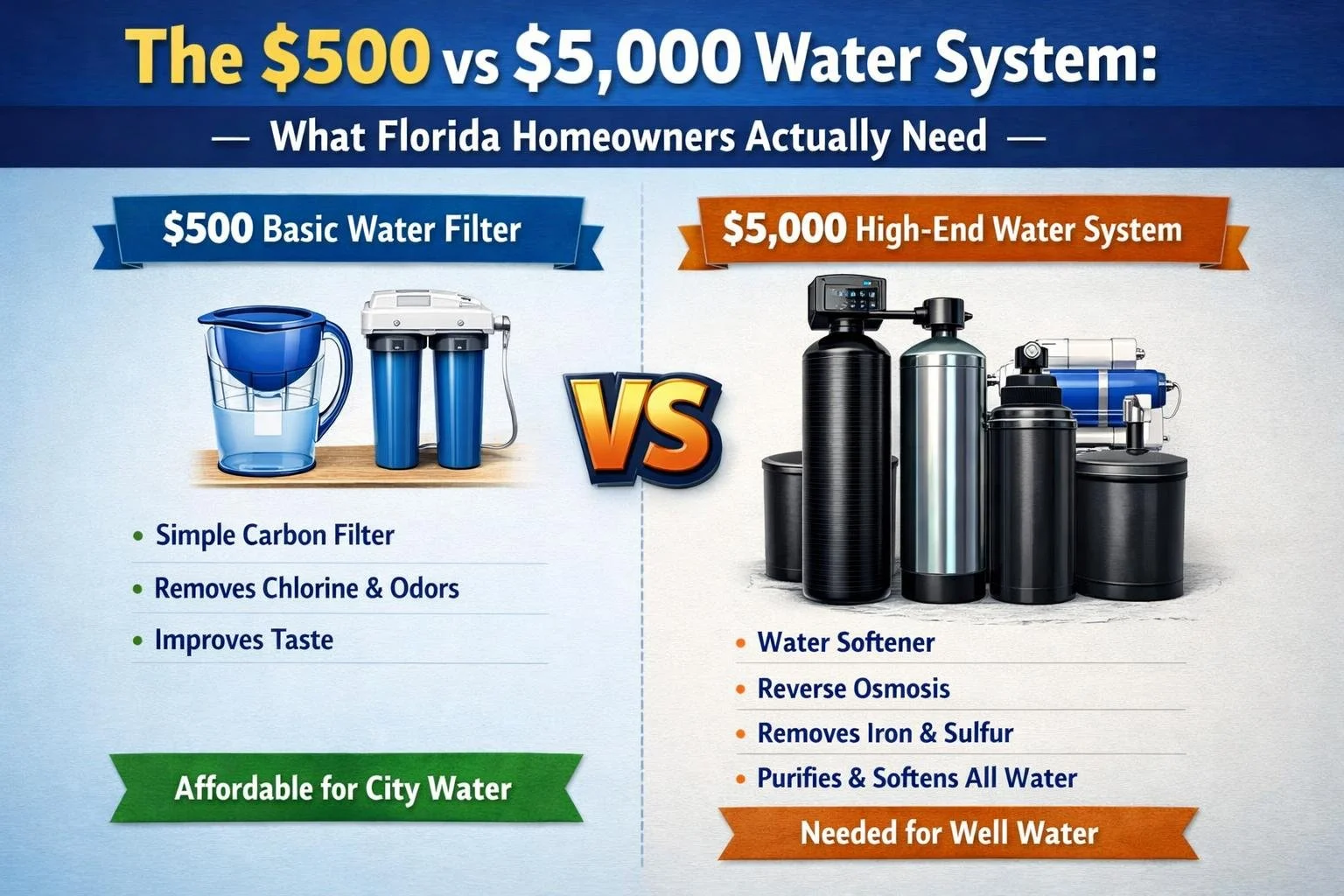
Last month a homeowner in Cape Coral called me, pretty upset. She'd just gotten a quote for a whole-house water treatment system: $7,800. The salesman had spent two hours in her home, shown her scary test results, and told her that her family was drinking "contaminated" water that would destroy their appliances within years.
She wanted to know if she really needed a system that expensive.
The honest answer? Probably not. But here's the thing—she might not need a $500 system either. The reality is more nuanced than "cheap bad, expensive good" or the equally wrong "expensive is a scam."
So let me break down what actually determines whether you need a $500 system, a $5,000 system, or something in between. By the end of this, you'll understand exactly what you're paying for and what you actually need.
Safe to Drink?
The Wide World of Water System Pricing
First, let's establish what's actually out there:
Budget tier ($300-800): Basic water softeners from big-box stores. Single-tank systems with timer-based regeneration. Minimal features, shorter warranties, often undersized for Florida conditions.
Mid-range ($1,000-2,500): Quality softeners from established brands. Demand-initiated regeneration, better efficiency, longer warranties. Adequate for most Florida homes with city water.
Premium ($2,500-5,000): High-capacity systems, multi-stage treatment, advanced features like smart monitoring and WiFi connectivity. Appropriate for large homes, very hard water, or well water with multiple issues.
Luxury/Boutique ($5,000-10,000+): Name-brand systems sold through in-home sales presentations. Often includes lifetime warranties, regular service visits, and premium features. Sometimes worth it, often overpriced.
The question isn't which category is "best"—it's which category matches your actual needs.
What You're Really Paying For
Every water treatment system involves three cost categories: equipment, installation, and ongoing maintenance. Understanding each helps you evaluate whether a quote makes sense.
Equipment Costs
The physical equipment—tanks, control valves, resin, media, and electronics—varies widely in quality.
Control valves are the brain of your softener. Budget systems often use basic timer-controlled valves that regenerate on a schedule, whether you need them or not. Better systems use metered valves that track your water usage and regenerate only when necessary—using 30-40% less salt over time.
Resin quality matters more than most people realize. Standard 8% crosslink resin works fine but degrades faster, especially with chlorinated city water. Premium 10% crosslink resin lasts longer and resists chlorine damage better. The difference might be $50-100 in resin cost, but it affects how long your system performs.
Tank construction ranges from basic fiberglass to reinforced composite materials. Better tanks resist Florida's humidity and last longer without developing stress cracks.
Grain capacity needs to match your home's actual needs. This is where many budget systems fail in Florida—they're sized for average US water hardness (7-10 gpg), not Florida's much harder water (12-20+ gpg in many areas). An undersized system regenerates too frequently, wearing out faster and using more salt.
Installation Costs
Professional installation typically runs $500-1,500 depending on complexity. This includes:
Bypassing the outdoor hose bibs (you don't want softened water on your lawn)
Proper drain line connection with the required air gap
Electrical connection, if needed
Testing and programming for your specific water conditions
Permits (where required)
Some companies roll installation into equipment pricing (making the total look higher). Others quote equipment separately and add installation later (making the initial quote look cheaper). Always compare total installed prices.
Ongoing Costs
The purchase price is just the beginning. Factor in:
Salt: $8-15 per 40-pound bag. The average Florida home uses 6-12 bags per year, or $50-180 annually. More efficient systems use less salt.
Maintenance: Professional service every 1-2 years costs $100-300. Some premium brands include this in service contracts.
Repairs: Budget systems often need repairs by year 5-7. Quality systems typically run 10-15+ years before needing significant work.
Replacement filters: If your system includes carbon filters, RO membranes, or other media, these need periodic replacement. Budget $50-200 annually, depending on your system.
The Real Difference Between Cheap and Expensive
Let me show you what $500 vs $5,000 actually buys in practical terms:
The $500-800 Big-Box System
32,000-grain capacity (often undersized for Florida)
Timer-based regeneration (uses more salt)
1-3 year warranty on parts, 90 days on labor
Basic 8% crosslink resin
Installation is usually DIY or an additional $300-500
Expected lifespan: 5-10 years
Salt usage: 10-15 bags per year (timer-based systems waste salt)
True cost over 10 years:
Equipment: $600
Installation (DIY or paid): $0-500
Salt ($120/year): $1,200
Repairs (likely around year 6-7): $300-500
Replacement at year 8-10: $600-1,000
Total: $2,700-4,400
The $1,500-2,500 Quality Mid-Range System
48,000-64,000 grain capacity (properly sized for Florida)
Metered/demand-initiated regeneration
5-10 year warranty on tanks, 3-5 years on electronics
Quality 10% crosslink resin
Professional installation included
Expected lifespan: 12-18 years
Salt usage: 6-10 bags per year (demand-based efficiency)
True cost over 10 years:
Equipment + installation: $2,000
Salt ($90/year): $900
Maintenance (optional): $300-500
Repairs (minimal): $0-200
Total: $3,200-3,600
The $5,000+ Premium/Name-Brand System
64,000+ grain capacity
Smart features, WiFi monitoring, app control
Lifetime warranty on tanks, 10+ years on everything else
Premium components throughout
Professional installation + annual service visits
Expected lifespan: 20-30 years
Salt usage: 5-8 bags per year (maximum efficiency)
True cost over 10 years:
Equipment + installation: $5,000-7,000
Salt ($75/year): $750
Maintenance (often included): $0
Repairs: $0 (warranty coverage)
Total: $5,750-7,750
Notice something? The mid-range system often provides the best value. You're not paying for marketing and sales presentations, but you're getting quality equipment that lasts.
When Budget Systems Actually Make Sense
I'm not going to tell you that cheap systems are always a mistake. Here's when a budget option might work:
You're selling the house soon. If you're moving within 2-3 years, investing in a 20-year system doesn't make sense. A basic softener addresses the immediate issues without overcapitalizing.
Your water is only moderately hard. If you're in one of Florida's lower-hardness areas (North Florida, some Central Florida zones around 7-10 gpg), a smaller system doesn't work as hard and can last longer.
You're genuinely handy and willing to maintain it. Budget systems need more attention. If you're comfortable monitoring salt levels weekly, cleaning the brine tank annually, and diagnosing issues yourself, you can extend a budget system's life.
You're on a very tight budget. Some water treatment is better than none. If the choice is a $600 system or no system, the $600 system protects your appliances and improves your daily life. You can upgrade later.
You have simple city water with only hardness issues. No iron, no sulfur, no special contaminants—just basic hardness. A straightforward softener handles this without needing premium components.
When You Need to Spend More
On the other hand, here's when investing in a better system makes sense:
You have very hard water (15+ gpg). Much of South Florida and the Gulf Coast has extremely hard water—200-300+ ppm. Budget systems can't keep up. They'll regenerate every 2-3 days, burn through salt, and wear out quickly. You need properly sized equipment.
You have well water. Well water often has multiple issues—hardness, iron, sulfur, bacteria, or other contaminants. You may need a multi-stage system: sediment filter, iron removal, softening, and possibly UV sterilization. Budget systems don't address this complexity.
You have a larger home (4+ bathrooms, 5+ people). More water usage requires more capacity. A 32,000-grain system that's fine for a 2-person condo fails miserably in a 6-person family home.
You value low maintenance. Premium systems need less attention, use less salt, and come with service plans that handle everything. If your time is worth something, this has real value.
You're staying long-term. In a home you'll keep for 15+ years, a quality system that lasts the entire time costs less than replacing budget systems multiple times.
You have specific health concerns. If you need guaranteed contaminant removal for health reasons, you want certified equipment with verifiable performance claims.
The Overselling Problem
Let's address the elephant in the room: the water treatment industry has a reputation for aggressive sales tactics and overpriced systems.
Here's what legitimate companies do:
Test your water and explain the results honestly
Recommend equipment sized to your actual needs
Provide written quotes with itemized costs
Offer warranties in writing with clear terms
Allow you time to compare options
Welcome second opinions
Here are red flags that suggest you're being oversold:
Scare tactics. If someone claims your water is dangerous or contaminated when municipal water meets EPA standards, they're manipulating you. Hard water isn't a health hazard—it's a nuisance.
"Today only" pricing. Legitimate companies have consistent pricing. If a quote is only valid if you sign today, that's a high-pressure tactic, not a business reality.
Refusing to leave written quotes. Some salespeople won't leave documentation because they don't want you to compare prices. Always insist on written quotes.
Claims about competitors. If a salesperson spends significant time trashing other companies, they're trying to scare you away from comparison shopping.
Vague answers about cost. "It depends on your situation" is fine initially, but after testing your water and assessing your home, they should give you a specific number.
Manufacturer partnerships that "require" their equipment. No, you don't have to buy their specific brand to get proper treatment.
What Florida Homeowners Actually Need
Based on my experience with hundreds of Florida homes, here's what most people need:
City Water, Standard Home (3-4 people)
The situation: Municipal water, 2-3 bathrooms, hardness around 10-15 gpg, no special issues.
What you actually need:
48,000-grain water softener with metered regeneration
Under-sink RO for drinking water (optional but recommended)
Reasonable price range: $1,500-2,500 installed for softener; add $300-600 for RO
What you don't need: Whole-house filtration, UV sterilization, specialty media, "patented" technology, or anything costing over $4,000.
City Water, Large Home (5+ people)
The situation: Bigger family, more bathrooms, higher water usage, standard municipal water.
What you actually need:
64,000-grain water softener with metered regeneration
Under-sink RO for drinking water
Reasonable price range: $2,000-3,500 installed for softener
What you don't need: Dual-tank systems (unless you truly can't tolerate any hard water during regeneration), smart home integration (nice but not necessary).
City Water, Chlorine-Sensitive
The situation: You notice a strong chlorine taste/smell, have sensitive skin, or simply want better water throughout the house.
What you actually need:
48,000-64,000 grain water softener
Whole-house carbon filter (installed after softener)
Under-sink RO for drinking water
Reasonable price range: $2,500-4,000 installed for the complete system
Well Water, Hardness Only
The situation: Private well with hard water but no iron, sulfur, or bacteria issues (confirmed by testing).
What you actually need:
Appropriately sized water softener (based on actual hardness testing)
Sediment pre-filter
UV sterilization (recommended for all well water)
Under-sink RO for drinking water
Reasonable price range: $2,500-4,500 installed
What you don't need: Iron filters if you don't have iron.
Well Water, Multiple Issues
The situation: Private well with hardness PLUS iron, sulfur, or other contaminants.
What you actually need:
Sediment pre-filter
Iron/sulfur treatment (air injection or chemical feed)
Water softener (sized for your actual conditions)
UV sterilization
Under-sink RO for drinking water
Reasonable price range: $4,500-8,000 installed for a complete multi-stage system
This is where $5,000+ makes sense. When you genuinely need multiple treatment stages, properly designed and integrated systems cost more—and they should. The alternative is a hodgepodge of incompatible equipment that doesn't work well together.
The Sizing Question Nobody Asks
Here's a critical point most salespeople won't explain clearly: proper sizing matters more than brand prestige or advanced features.
For Florida water, use this rough formula:
Determine your water hardness in grains per gallon (gpg). Convert ppm to gpg by dividing by 17.1. Example: 200 ppm ÷ 17.1 = 11.7 gpg
If you have iron, add 5 gpg for every 1 ppm of iron.
Multiply total hardness by your daily water usage (75-80 gallons per person per day).
Multiply by 7 days (weekly capacity needed).
Add 30% for peak usage and efficiency margin.
Example: Family of 4, water hardness 15 gpg, no iron
Daily usage: 4 people × 80 gallons = 320 gallons
Daily grain removal: 320 × 15 = 4,800 grains
Weekly requirement: 4,800 × 7 = 33,600 grains
With 30% margin: 33,600 × 1.3 = 43,680 grains
This family needs at least a 48,000-grain softener. A 32,000-grain "budget" unit would regenerate every 4-5 days instead of weekly, using 40% more salt and wearing out faster.
| Household Size | Moderate Hardness (8-12 gpg) |
Hard (12-17 gpg) |
Very Hard (17+ gpg) |
|---|---|---|---|
| 1-2 people | 24,000-32,000 grain | 32,000-40,000 grain | 40,000-48,000 grain |
| 3-4 people | 32,000-40,000 grain | 48,000-56,000 grain | 56,000-64,000 grain |
| 5-6 people | 48,000-56,000 grain | 64,000-80,000 grain | 80,000+ grain |
| 7+ people | 64,000+ grain | 80,000+ grain | 80,000+ or dual tank |
Note: These are minimum recommendations. Consider upgrading one size for efficiency and longevity.
How to Evaluate a Quote
When you receive a quote for water treatment equipment, ask these questions:
"What's the grain capacity, and how did you determine this size for my home?"
Good answer: References your water test results, household size, and shows the calculation.
Red flag: Vague response or "this is what we recommend for everyone."
"What's the warranty, specifically?"
Good answer: Written warranty document with clear terms—X years on tanks, Y years on valve/electronics, Z years on labor.
Red flag: Verbal warranty promises without documentation, or "lifetime warranty" with extensive fine print exclusions.
"What's the total installed price, including everything?"
Good answer: Single number including equipment, installation, permits, testing, and startup.
Red flag: Lots of "plus" items that add up, or refusal to provide a written quote.
"What are the ongoing costs?"
Good answer: Estimated salt usage, recommended maintenance schedule, and typical service costs.
Red flag: "Virtually maintenance-free" or refusal to discuss ongoing costs.
"What brand is this, and why do you recommend it?"
Good answer: Names the brand, explains its strengths for your situation, and acknowledges that alternatives exist.
Red flag: Proprietary "custom" system with no identifiable brand, or aggressive criticism of all other options.
"Can I have time to compare this with other quotes?"
Good answer: "Absolutely, here's our written quote. Call us when you're ready to proceed."
Red flag: Pressure to sign today, "special pricing" that expires immediately, or reluctance to leave documentation.
My Honest Recommendation
Here's what I tell homeowners who ask me whether they need a $500 or $5,000 system:
For most Florida homes on city water: A quality mid-range system ($1,500-2,500 installed) provides the best value. You're getting properly sized equipment, efficient operation, reasonable warranties, and professional installation—without paying for premium branding, unnecessary features, or high-pressure sales overhead.
For well water or complex situations: Expect to spend $3,000-6,000 for properly designed multi-stage treatment. This isn't overpaying—it reflects the genuine complexity of your water treatment needs.
For budget-conscious buyers: A $600-800 big-box system is better than nothing, but understand you're likely replacing it in 7-10 years. If the budget is tight, start with a softener and add other components later.
What you should almost never pay: Over $5,000 for a simple city water softening solution, regardless of brand name or warranty claims. Over $8,000 for anything except genuinely complex whole-house treatment addressing multiple well water issues.
The $7,800 quote that the Cape Coral homeowner received? After I looked at her water test, she had moderately hard city water with no iron, sulfur, or special issues. A properly sized softener with under-sink RO would have cost $2,200-2,800 installed. She was being quoted nearly $5,000 more than necessary because the company's sales model involved heavy marketing, commissioned salespeople, and premium branding.
She ended up going with a local company, paid $2,400 for a 48,000-grain system with RO, and has had zero issues in two years.
The right system for you depends on your water, your home, and your situation—not on which company has the most persuasive sales presentation.
Frequently Asked Questions
Is a more expensive water softener really better quality?
Sometimes, but not always. Price reflects component quality, capacity, efficiency features, warranty coverage, and brand positioning. A $2,000 system from a reputable manufacturer is typically excellent quality. Systems above $4,000 often include premium branding, extensive warranties, and service contracts—value that some people appreciate but others don't need. The $300 difference between a $1,500 and $1,800 system might reflect meaningful quality differences; the $3,000 difference between a $2,500 and $5,500 system often reflects marketing rather than equipment.
How long should a water softener last?
Budget systems (under $1,000): 5-10 years Quality mid-range ($1,500-3,000): 12-18 years Premium systems ($3,000+): 15-25+ years
These ranges assume proper maintenance. Neglected systems fail faster regardless of initial quality. Florida's extremely hard water in some areas also accelerates wear—another reason sizing matters.
Can I install a water softener myself to save money?
Technically yes, but consider the full picture: DIY installation voids some warranties, risks improper sizing and programming, and can create problems that cost more to fix than professional installation. For a first-time installation with no existing plumbing loop, DIY is challenging. For a straightforward replacement of existing equipment, handy homeowners can manage it. See our article on DIY vs. Professional Installation for a detailed analysis.
What's the difference between salt-based and salt-free systems?
Salt-based systems (traditional ion exchange) actually remove hardness minerals. Salt-free systems (water conditioners) don't remove minerals—they change their structure to reduce scale formation. Salt-free systems don't provide the full benefits of soft water (better soap lathering, softer skin/hair, etc.) but require no salt and produce no wastewater during regeneration. For Florida's hard water, traditional salt-based softening generally works better.
Why do some companies charge so much more than others?
Price differences reflect: Equipment quality (meaningful), business model (some companies have heavy marketing/sales costs built in), service inclusions (some quotes include years of maintenance), and simply different profit margins. A company with commissioned door-to-door salespeople and extensive TV advertising has higher costs that get passed to customers. A local company with minimal marketing often provides equivalent equipment for less.
Should I get whole-house treatment or just point-of-use (like under-sink)?
For hardness, whole-house treatment protects your entire plumbing system and appliances—that's the point. Point-of-use solutions (like under-sink RO) are excellent additions for drinking water, but don't address the scale buildup, soap scum, and appliance damage from hard water throughout your home. Most Florida homeowners benefit from whole-house softening plus point-of-use RO for drinking water.
What questions should I ask before buying?
Always ask: What's the grain capacity? What warranty is included in writing? What's the total installed price? What are the ongoing maintenance costs? How did you determine this is the right system for my home? Can I have this quote in writing to compare with other options? Legitimate companies welcome these questions.
Water Wizards provides free in-home water testing and honest assessments of what you actually need—no high-pressure sales, no scare tactics. We'll tell you the truth about your water and recommend only what makes sense for your specific situation. If you've received a quote that seems too high (or too low), we're happy to provide a second opinion.