Hard Water and Hair Loss in Florida: Is Your Shower Making It Worse?
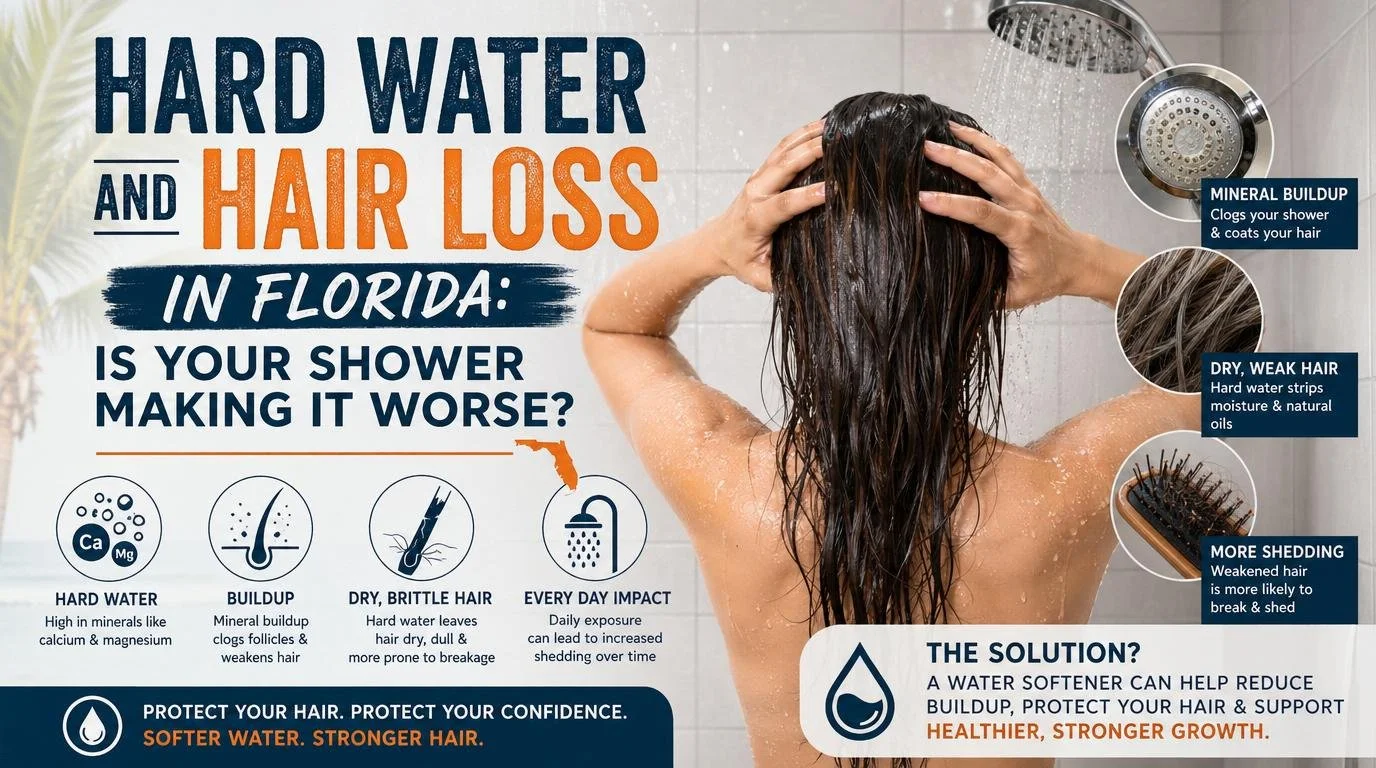
By Jared Beviano | Water Wizards Filtration | Delray Beach, FL
I hear a version of this almost every week.
Someone moved to South Florida from somewhere else — Atlanta, New York, the Midwest — and within six to twelve months of living here, they notice their hair is different. Thinner-looking. More brittle. Falls out more when they brush it. Harder to manage. They've changed nothing about their routine. Same shampoo, same conditioner, same diet. The only thing that changed was where they live.
They've usually already done a lot of research. They've talked to their hairdresser. Sometimes they've seen a dermatologist. Everyone has theories. Stress. Hormones. Getting older. Florida humidity. What almost nobody mentions — and I find this genuinely surprising — is the water.
South Florida water runs 13–22 grains per gallon of dissolved calcium and magnesium. That's among the hardest municipal water in the country. And the research — published in peer-reviewed dermatology and trichology journals — shows consistently that hard water changes the physical structure and mechanical properties of hair in ways that cause exactly the symptoms these people are describing.
I want to be honest about what the science says and what it doesn't say. The distinction matters, and I'm going to walk through it carefully.
What Hard Water Actually Does to Your Hair — The Science
Let me start with what's well-established, because the research base here is more solid than most people realize.
The mineral deposition problem:
When hard water contacts your hair, calcium and magnesium ions don't just rinse away. They bind to the outermost layer of the hair shaft — the cuticle — and accumulate there with repeated washing. A 2024 study published in the Journal of Oilseed Research on Dermatology found that calcium concentrates primarily in the cuticle layer, with levels increasing from root to tip, showing progressive accumulation with ongoing exposure.
A scanning electron microscopy study published in the International Journal of Dermatology found measurable differences between hair washed with hard water and hair washed with distilled water over 30 days. The results: mean hair thickness in the hard water group was 72.78 micrometers versus 78.14 micrometers in the soft water group. Visible, measurable thinning of the hair shaft from mineral deposition — not from follicle loss, but from structural change.
The tensile strength problem:
A 2025 study in the International Journal of Trichology — one of the most rigorous peer-reviewed trichology journals — found that hair treated with hard water showed significantly reduced tensile strength compared to hair treated with deionized water. The elastic modulus of hard water-treated hair showed a 19% difference compared to soft water-treated hair.
What that means in everyday terms: hard water makes your hair weaker and more prone to breaking under the same mechanical stress — the tension of brushing, towel drying, styling. Hair that breaks more easily looks thinner. It sheds more visibly on your brush and in your shower drain. The appearance of hair loss is real, even when the follicles themselves are healthy.
The shampoo chemistry problem:
Hard water interferes with how shampoo works. The calcium and magnesium ions react with the fatty acids in shampoo to form an insoluble soap scum — the same white residue that forms around your faucets. On your hair and scalp, this residue coats the hair shaft, making it feel heavy and dull, and deposits on the scalp where it can block follicles and disrupt the scalp microbiome.
South Florida has an additional layer to this problem that many other hard water regions don't: chloramine disinfection. All South Florida municipal systems use chloramine rather than plain chlorine. Chloramines are more chemically stable than free chlorine and react differently with hair proteins — they can oxidize the disulfide bonds that give hair its structural integrity, causing a different kind of damage on top of the mineral deposit problem.
What the Science Hasn't Proven — The Honest Part
Here's where I want to be careful, because the internet is full of confident claims that the research doesn't entirely support.
Does hard water directly cause follicle-level hair loss — the kind where your follicles stop producing new hairs?
The honest answer is: the research hasn't clearly established this. Studies on hard water consistently show hair shaft damage, reduced tensile strength, mineral deposition, and increased breakage. What they haven't conclusively shown is a direct causal link between hard water and follicle damage or permanent hair loss in the way that androgenetic alopecia or alopecia areata causes it.
The Wimpole Clinic, which reviewed this literature in December 2024, put it this way: "Research suggests mineral deposits on your hair from hard water may worsen its condition and indirectly contribute to shedding, but it's unlikely to be the main reason your hair is falling out."
That's the honest assessment. Hard water is a real and documented contributor to hair problems — but it's probably not the only factor if you're experiencing significant shedding, and other causes (hormonal changes, nutritional deficiencies, stress, thyroid issues, androgenetic alopecia) should be evaluated too.
What hard water clearly does cause:
Increased breakage — structural weakening of the hair shaft
Visible thinning — mineral deposits reduce shaft diameter
Dullness and heaviness — mineral and soap residue coating
Scalp irritation — mineral-shampoo residue disrupting scalp balance
Reduced manageability — cuticle damage and mineral buildup
Faster color fade — minerals interact with hair dye molecules
These are real, documented, South Florida-specific problems. They affect the quality and appearance of your hair meaningfully. They're also largely reversible when the water quality changes.
Why South Florida Is Worse Than Most Places
Not all hard water is equal, and South Florida's specific water profile creates a compounding problem that goes beyond simple hardness.
22.4 GPG in Miami. 18 GPG in West Palm Beach. 15–16 GPG in Boynton Beach and Delray Beach.
Research generally identifies hair impact from hard water at concentrations above 120 ppm (about 7 GPG). South Florida's water, at 250–380 ppm, is operating at two to three times that threshold. The damage mechanisms are the same as in any hard water area — they're just running faster here.
Add chloramine to the equation.
Chloramines — the disinfectant used throughout South Florida's municipal water systems — penetrate the hair shaft more aggressively than plain chlorine. They can oxidize the cysteine disulfide bonds that give hair its elasticity and strength. The result is hair that's structurally compromised in two distinct ways: mechanically weakened by mineral deposits in the cuticle, and chemically damaged by chloramine oxidation deeper in the cortex.
People who moved here from cities with plain chlorine water (or very soft water) notice the difference because the combination is genuinely worse. It's not Miami making you stressed. It's Miami's water.
High iron in some zones adds a third factor.
In well water areas (Loxahatchee, The Acreage, parts of western Broward), iron in the water deposits on hair as a reddish-orange cast and further disrupts the cuticle. Iron ions generate free radicals that can damage hair proteins. This is particularly visible on lighter hair colors.
The Symptoms — What to Look For
🔍 Is Your Florida Water Affecting Your Hair?
Check every symptom that applies — we'll tell you how likely hard water is contributing.
How to Tell If It's the Water or Something Else
This is an important distinction that the checklist above can help with — but it's not always clean. Hard water hair damage often coexists with other contributing factors, and it's worth knowing how to separate them.
Signs that point specifically to water as the cause:
Symptoms started or worsened noticeably after moving to South Florida or switching water sources
Hair problems affect your whole head somewhat uniformly, rather than a specific thinning pattern
Your scalp feels better when you wash your hair with filtered or bottled water (a simple test)
White scale on fixtures confirms you have hard water
The dullness and heaviness return quickly after washing — within a day or two
Signs that suggest other factors may be primary:
Thinning concentrated at the temples, crown, or a specific pattern (suggests androgenetic alopecia)
Significant shedding with no texture change (may suggest telogen effluvium from stress, illness, or hormonal change)
Recent thyroid diagnosis, pregnancy, or significant hormonal change coinciding with hair changes
Nutritional deficiencies (iron, B12, zinc, vitamin D are all associated with hair health)
The cleanest test is simple: wash your hair with filtered or bottled water for two to four weeks and observe whether the texture and manageability improve. If it does, water quality is at least part of your problem. If nothing changes, look elsewhere.
→ Hard water appliance damage too: Hard Water Damage to Appliances: The True Cost in South Florida Homes → What else is in your shower water: What's Actually in Your South Florida Tap Water?
The Hard Water Hair Damage Scale — South Florida vs Elsewhere
The implication is clear: South Florida water operates at 2–3× the research threshold for documented hair damage. The advice your hairdresser learned in cosmetology school — developed for typical US water hardness — doesn't scale to what's coming out of a Boynton Beach shower.
What Actually Helps — Ranked by Effectiveness
Let me give you a practical hierarchy here, from most effective to least, because the internet is full of suggestions that range from genuinely useful to essentially placebo.
1. Water softener (most effective — addresses root cause) A whole-house ion-exchange softener removes calcium and magnesium before water enters your shower. The mineral deposition problem stops at the source. People who install softeners in South Florida homes consistently report changes in hair texture and manageability within 4–8 weeks. This is the only intervention that actually changes the water chemistry rather than working around it.
2. Shower filter (effective — addresses chloramine specifically) A vitamin C-based or KDF shower filter removes chloramines from the water flowing through your showerhead. Standard carbon filters are less effective against chloramines — look specifically for filters rated for chloramine removal. A good shower filter costs $40–$100 and needs cartridge replacement every 6 months. It doesn't address hardness, but it reduces the chloramine oxidation component of the damage. Worth adding alongside a softener.
3. Chelating shampoo (useful — symptom management) Chelating shampoos contain EDTA or citric acid that chemically binds to mineral deposits and removes them from the hair shaft during washing. Brands like Malibu C, Kenra Platinum, and Ion make chelating formulas specifically for mineral buildup. They don't prevent ongoing deposition — they remove what's already there. Using one once a week or after a significant mineral exposure can restore some manageability. Not a substitute for addressing the water, but a useful bridge.
4. Apple cider vinegar rinse (mild — temporary smoothing) ACV is mildly acidic, which can help close the hair cuticle and temporarily improve smoothness and shine. It doesn't chelate minerals effectively or remove chloramine damage. The effect is cosmetic and wears off within a wash or two. Worth knowing about but modest in impact.
5. Filtered shower head inserts (low — mostly marketing) Many products marketed as "water softening" showerheads use carbon or KDF media that doesn't actually remove hardness minerals. Read specifications carefully. A filter that says it "reduces limescale" or "reduces chlorine" is not the same as one that reduces water hardness.
→ Wellington's soft water advantage: Wellington FL Water Quality: What Horse Owners and Homeowners Need to Know → Water softener costs for South Florida: Water Softener Installation Cost in South Florida: Full 2026 Price Breakdown
→ Miami water at 22.4 GPG: Miami Water Quality Report 2026 → How a softener works: Hard Water vs. Soft Water: What's the Difference and Do You Need a Softener?
What Changes After You Install a Softener
Most South Florida homeowners who install a water softener primarily for appliance protection notice the hair and skin changes first, because they're the most immediate and most noticeable.
Within 1–2 weeks: shampoo lathers differently. Conditioner rinses cleaner. Skin doesn't feel the mineral residue after showering.
Within 4–8 weeks: hair texture starts to improve. Less breakage at the brush. Better manageability without additional product.
Within 3–6 months: visible change in shine and condition for most people. Color (if chemically treated) holds longer.
This timeline is based on what we hear from customers — it's not a clinical study, and individual results vary. But it's consistent enough across enough installations that the connection to water quality is clear.
What doesn't change: if you had significant follicle-level hair loss from other causes (androgenetic alopecia, extended nutritional deficiency, thyroid issues), softening your water won't reverse that. What it does is stop adding the water-quality component of damage on top of whatever else is happening.
→ Annual maintenance for your softener: The Annual Water System Maintenance Checklist for Florida Homeowners → Benefits of filtered water for overall health: Benefits of Drinking Filtered Water vs. Tap Water in South Florida
Frequently Asked Questions
Does hard water cause hair loss in South Florida? Hard water causes documented hair shaft damage — mineral deposition that reduces tensile strength, decreases hair diameter, and increases breakage — which produces the visible appearance of thinning and hair loss. Whether hard water directly damages hair follicles and causes the kind of permanent hair loss seen in androgenetic alopecia is less clearly established by current research. The distinction matters: if you're experiencing increased breakage and dullness, water quality is likely a significant factor. If you're experiencing a specific thinning pattern, other causes should also be evaluated.
Why is South Florida water worse for hair than other states? South Florida municipal water runs 13–22 GPG of hardness — two to three times the national average and two to three times the research threshold above which hair damage is documented. Additionally, South Florida uses chloramine disinfection, which causes oxidative damage to hair proteins on top of the mineral deposition problem. The combination is more damaging than hard water or chloramines alone.
Will a water softener help with hair loss and damage? Yes — particularly for the breakage, thinning appearance, dullness, and manageability issues caused by mineral deposition. Most South Florida homeowners report noticeable improvement in hair texture within 4–8 weeks of installing a whole-house softener. A softener addresses the root cause (water hardness) rather than managing symptoms after the fact.
What shampoo is best for hard water in Florida? Chelating shampoos — containing EDTA, citric acid, or phytic acid — are the most effective over-the-counter option for managing hard water hair damage. Brands specifically formulated for mineral removal include Malibu C Mineral Wellness, Kenra Platinum Silkening Mist series, and Ion Crystal Clarifying Treatment. Using a chelating treatment weekly, combined with softened shower water, produces better results than either alone.
Can a shower filter help with hair damage from South Florida water? A shower filter designed specifically for chloramine removal (vitamin C-based or KDF-85 media) addresses the chloramine component of South Florida water damage. It doesn't remove hardness minerals — that requires a whole-house softener or a specific ion-exchange shower filter (less common and less effective than full softeners). Shower filters are a useful addition but not a complete solution for South Florida's combined hard water + chloramine problem.
My hairdresser says hard water isn't the problem. Who's right? Most hairdressers are trained on national averages of water hardness — typically 7–10 GPG, which is significantly softer than South Florida's 13–22 GPG. The advice that "hard water isn't a major factor" may be accurate for most of the country and less accurate for our specific region. It's worth having a water test done to confirm your actual hardness level before dismissing water quality as a factor.
The Water Test That Starts Everything
If you're experiencing the hair symptoms described in this article and you haven't tested your water hardness, that's the starting point. Knowing your specific hardness level — not a county average — tells you what you're dealing with and whether a softener is likely to make a meaningful difference.
We offer free in-home water testing across Palm Beach, Broward, and Martin County. The test takes 20 minutes and gives you your exact hardness in GPG, chloramine levels, iron content, TDS, and pH. From there, the system recommendation follows directly from the data.
Book Your Free Water Test → 561-352-9989
Water Wizards Filtration | Delray Beach, FL | Serving Palm Beach · Broward · Martin County
Sources: Luqman et al. — hard water hair tensile strength, International Journal of Trichology (2025); PubMed / PMC — Effects of Hard Water on Hair, International Journal of Trichology (2013); PubMed — Scanning electron microscopy of hair treated in hard water (2016); JOJ Dermatology — Hair Invisible Damages (2024); Wimpole Clinic — Does Hard Water Cause Hair Loss? (December 2024); Tangié Co. — Can Hard Water Cause Hair Loss? (April 2026); Miami-Dade Water and Sewer Department — Water Quality Report 2024; Wellington Village — 2024 Water Quality Report