Water Softener Installation Cost in South Florida: Full 2026 Price Breakdown
By Jared Beviano | Water Wizards Filtration | Delray Beach, FL
I had a customer call me last spring from a house in Boynton Beach. She'd spent two months getting quotes — from a big box store, from a national chain, from a guy she found on Nextdoor — and every single one was different. Not a little different. One was $850. One was $3,400. One was $1,800.
Same house. Same water. Completely different numbers.
She wasn't asking me to be cheaper than the others. She was asking me to explain what she was actually paying for. And that, I realized, is what nobody in this industry does well. You get the number. You rarely get the breakdown.
So here it is. The actual breakdown — itemized, honest, South Florida-specific — of what a water softener costs to install in 2026. Not a national average that doesn't account for 20 GPG hard water. Not a range so wide it's useless. The real picture.
Why South Florida Pricing Is Different From What You Read Online
Before we get to numbers, one thing needs to be said clearly.
Most water softener cost guides are written for a national audience. They quote averages based on data from Cincinnati, Denver, and Raleigh — places where water hardness runs 7–10 grains per gallon and a 32,000-grain softener handles most households comfortably.
South Florida is not that.
Palm Beach County water comes out of the Biscayne Aquifer at 15–22 GPG. Broward County runs 13–18 GPG. Miami-Dade tops out at 22.4 GPG — among the hardest municipal water in the country. At those hardness levels, the sizing math changes completely, and so does the price.
A 32,000-grain softener — the size most national guides call "right for a family of four" — is severely undersized for a four-person household dealing with 18 GPG South Florida water. Let me show you why.
The sizing calculation for South Florida:
4 people × 75 gallons/day × 18 GPG × 7 days = 37,800 grains minimum
That family needs a 48,000-grain system, not a 32,000-grain one. The 32,000-grain unit would regenerate every 3–4 days instead of weekly — burning through salt, straining the resin, and still delivering marginal performance between cycles. Buying the wrong size isn't just a comfort issue. It's an ongoing operating cost that adds up fast.
This is why South Florida prices run higher than national averages. It's not just labor or geography. It's that we genuinely need bigger, more capable systems.
The Full Price Breakdown — Line by Line
Let me walk through what you're actually paying for when a water softener gets installed.
The System Itself
This is the biggest variable in any quote. System prices range from under $400 for a consumer-grade big box unit to $2,500+ for a professional-grade system with an industrial control valve and high-crosslink resin. Here's what that difference means in practice.
Consumer-grade (big box stores — Whirlpool, GE, WaterBoss):
40,000-grain unit: $500–$900 at Home Depot or Lowe's
Proprietary control valve — 1–3 year warranty on electronics
8% crosslink resin — degrades faster in South Florida's chloramine-treated water
Sized for national average hardness, frequently undersized for our conditions
Realistic service life in South Florida: 7–10 years
Professional-grade (water treatment specialist install):
48,000–64,000 grain unit built around Fleck or Clack control valve
5-year valve warranty, 10-year tank warranty
10% crosslink resin — chloramine-resistant, significantly longer life
Sized specifically for your measured water hardness and household usage
Realistic service life in South Florida: 15–25 years with maintenance
The upfront price difference: roughly $600–$1,200 more for the professional unit. The long-term cost difference: often inverted — the professional system costs less over a 10-year horizon because it doesn't need to be replaced at year eight.
Installation Labor — South Florida Specifics
Labor for water softener installation in South Florida runs $350–$750 for a professional water treatment company. Here's what drives that number.
Simple installation (lower end — $350–$450):
Modern home, accessible garage or utility room
PVC or PEX plumbing, easily cut
Drain within 5–10 feet
Standard 110V outlet nearby
No pre-existing equipment to remove
Complex installation (higher end — $550–$750):
Older home with copper plumbing (requires different fittings, soldering or proper compression connections)
Tight utility space — under a sink, in a closet, unusual configuration
Drain line needs to run further than standard
Existing old softener to remove and dispose of ($50–$150 additional for removal)
Pre-1986 home where lead service concerns require extra precautions around pipe work
Florida-specific complication: Heat. Our garages routinely hit 100°F+ in summer. Systems installed in unconditioned spaces need to account for this — certain control valve electronics don't love sustained heat, and the brine tank can develop salt bridging issues more quickly in humid, hot environments. A good installer knows to position the system, orient the brine tank, and program regeneration timing to account for Florida's climate, not assume the defaults that work in Chicago.
The Pre-Filter — Non-Optional in South Florida
This one surprises people. Most quotes for a water softener include the softener. They don't always include the sediment pre-filter and, more importantly, the catalytic carbon pre-filter that's essentially mandatory in South Florida.
Here's why it matters.
South Florida municipal water uses chloramine disinfection. Chloramines — unlike plain chlorine — aggressively oxidize water softener resin. 10% crosslink resin handles it better than 8%, but even premium resin degrades faster without protection. Installing a catalytic carbon filter upstream of the softener removes chloramines before they hit the resin, extending resin life by an estimated 3–5 years.
I've seen resin that should have lasted 12 years fail at year five — not from wear, but from chloramine oxidation damage that was entirely preventable. The customer spent $425 on a resin replacement that a $150 pre-filter would have postponed for years.
Pre-filter options and costs:
Sediment pre-filter (5–20 micron cartridge housing): $80–$150 installed
Catalytic carbon pre-filter (separate tank, whole-house): $400–$800 installed — often quoted as part of a system package
Combined carbon + softener package price: $2,500–$4,500 professionally installed
Some companies quote softeners at lower prices precisely because they don't include the pre-filter. Always ask: "Does this include carbon pre-filtration?" If not, factor it in.
Bypass Valve and Plumbing Connections
Every professional installation should include a properly installed bypass valve — a three-valve assembly that lets you route water around the softener during service, regeneration issues, or emergencies without shutting off water to the whole house. Most professional-grade systems include this. Consumer systems often include a simpler version.
Plumbing connection costs are typically included in the labor quote. If your plumber or installer needs to purchase fittings, elbows, or additional tubing at your job site, add $30–$100 in materials.
Permits — The One Everyone Forgets
In Palm Beach County, Broward County, and most South Florida municipalities, water softener installation doesn't automatically require a permit for straightforward residential installations. However:
If the installation involves significant plumbing modifications — cutting into the main line, rerouting supply lines, or creating new drain connections — some jurisdictions require a permit
Some HOAs have their own requirements, separate from municipal code
If you're in an older home and the installer discovers issues with existing plumbing that need code compliance, that can trigger permit requirements
A permit, when required, typically costs $100–$200 in South Florida. Reputable installers know the local requirements and handle this. If a company never mentions permits, ask.
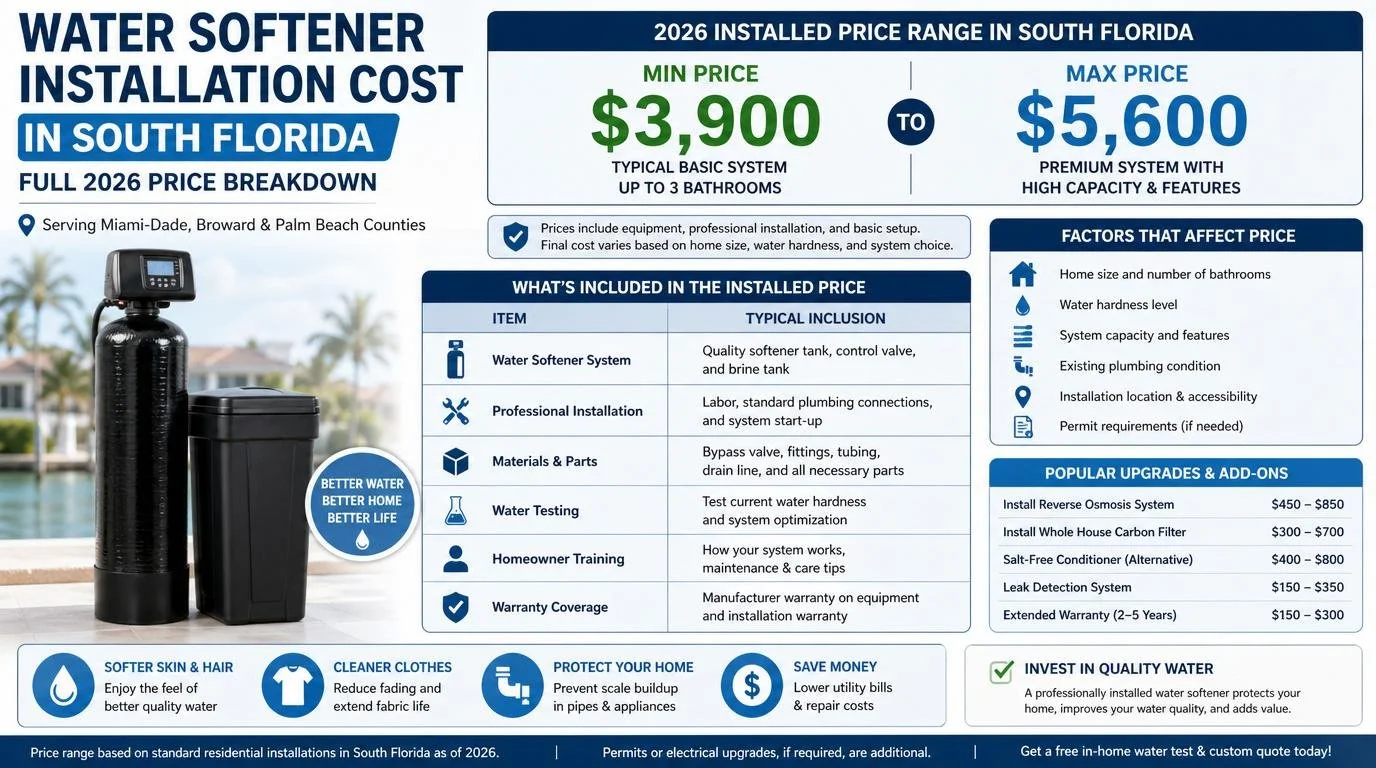
Total Cost Summary — South Florida 2026
| System Configuration | System Cost | Installation Labor | Total Installed (South FL) | Annual Maintenance |
|---|---|---|---|---|
| Big box softener (32–40K grain) — DIY install | $500–$900 | $0 (DIY) | $500–$900 | $200–$400 (salt) |
| Big box softener — professional install | $500–$900 | $350–$550 | $850–$1,450 | $200–$400 (salt) |
| Professional 48K grain (city water) Most Common | $900–$1,500 | $400–$600 | $1,200–$2,200 | $150–$300 (salt) |
| Professional 64K grain (large home / Miami hardness) | $1,200–$2,000 | $500–$750 | $1,700–$2,800 | $200–$400 (salt) |
| Professional 48K + catalytic carbon pre-filter Best Value | $1,200–$2,000 | $600–$900 | $1,800–$3,000 | $150–$300 |
| Dual-tank system (continuous soft water) | $1,800–$3,000 | $600–$900 | $2,500–$4,000 | $200–$400 |
| Well water system (softener + iron + UV) | $2,500–$5,000 | $800–$1,500 | $3,500–$6,500 | $400–$700 |
| Salt-free conditioner (moderate hardness only) | $1,200–$2,500 | $400–$700 | $1,500–$3,500 | $0–$100 (minimal) |
The Annual Operating Cost Nobody Quotes You
The installation price gets all the attention. The operating cost runs quietly in the background for 15 years.
Salt.
A properly sized softener for a family of four in South Florida — 15–18 GPG, regenerating weekly — uses approximately 10–12 pounds of salt per regeneration cycle. At one regeneration per week: 40–50 pounds per month. A 40-lb bag of evaporated salt pellets at Costco, Home Depot, or Publix runs $8–$12.
Annual salt cost for a properly programmed, properly sized system: $100–$180/year.
An improperly sized system that regenerates every 3–4 days? It uses 2–2.5× as much salt annually: $240–$450/year. Over 10 years, that's an extra $600–$2,700 in salt costs alone — from a sizing decision made on day one.
This is why proper sizing isn't just about water quality. It's about operating costs compounding over the life of the system.
Resin replacement (every 10–15 years for professional-grade resin, 5–8 years for consumer-grade in South Florida conditions): $250–$450 professionally done.
Control valve service (every 5–7 years for a professional valve — often just O-ring replacement and cleaning): $80–$150.
The honest 10-year cost:
Professional 48K grain system, properly sized: $2,000 (installed) + $1,500 (salt, 10 yrs) + $150 (valve service) = ~$3,650
Big box 32K grain, undersized for South Florida, consumer install: $850 (installed) + $3,600 (extra salt from over-regeneration, 10 yrs) + $425 (resin replacement at yr 6) + $900 (replacement system at yr 8) = ~$5,775
The "cheaper" option costs more. Not a little more — significantly more.
Salt-Free "Conditioners" — Are They Worth It in South Florida?
This question comes up constantly, especially because salt-free systems are marketed as maintenance-free and environmentally friendly.
The honest answer for South Florida: salt-free conditioners work for moderate hardness, and South Florida's water is extreme.
Salt-free systems use template-assisted crystallization (TAC) to change the physical structure of calcium and magnesium ions so they don't stick to surfaces — but they don't remove the minerals. The water stays "technically hard" in terms of TDS. At 5–10 GPG, TAC systems prevent scale reasonably well. At 15–22 GPG, the research and field experience is less convincing.
If you're on Wellington's treated municipal supply (~5 GPG post-treatment), a salt-free conditioner is a legitimate option. If you're in Miami at 22.4 GPG, West Palm Beach at 18 GPG, or Boca Raton at 16 GPG — I'd want to see strong evidence that a salt-free system performs adequately at those hardness levels before recommending one.
Salt-free systems cost $1,500–$3,500 installed with no ongoing salt cost. They're worth considering for moderate hardness situations, for condo buildings with HOA restrictions on salt discharge, or for health-motivated homeowners who specifically want to avoid adding sodium to their water. For extreme hardness South Florida conditions, the ion-exchange salt softener remains the most reliable performer.
→ Miami's extreme 22.4 GPG hardness explained: Miami Water Quality Report 2026 → More on system comparisons: Professional vs. Big Box Water Softeners: An Honest Comparison for South Florida Homes
The Hidden Cost of Getting It Wrong
I want to say something that might sound counterintuitive from someone who sells these systems.
The most expensive water softener mistake isn't buying too much system. It's buying the wrong system and spending the next decade dealing with the consequences.
I've walked into homes where a softener was clearly the wrong choice from day one — installed three years ago, already struggling, owner not sure why their skin still feels dry and their water heater is still scaling. Turns out the installer set the hardness level to the Palm Beach County "average" without actually testing the water at that property. Their well pulls from a zone with 22 GPG, not the 15 GPG average. The softener has been running at 70% capacity since the day it was installed.
Fixing that isn't cheap...
Actually — wait, let me be precise about this. Fixing it isn't always expensive. Sometimes it's a reprogramming visit. Sometimes it's a resin rebed. Sometimes it's starting over. The point isn't the repair cost. The point is that a proper water test before installation would have caught it in 20 minutes.
The test costs nothing. Getting the installation right the first time saves hundreds over the life of the system.
→ Signs yours may be off: Is Your Water Softener Programmed Correctly? Signs You're Wasting Salt and Water
→ And: Signs Your Water Softener Isn't Working (And What to Do About It)
What to Ask Before Signing Any Quote
Whether you call us or someone else, these five questions separate a real quote from a sales number.
1. What grain capacity are you recommending, and how did you calculate it? If the answer is "family of four usually needs 40K" without mentioning your actual hardness level — that's a red flag. The calculation requires your hardness in GPG and your household's water usage. If they haven't tested your water, they're guessing.
2. What control valve does the system use? Fleck and Clack are the professional-grade standards. If they can't name the valve brand, or if they say "our proprietary system" — ask what happens when that valve needs a part in eight years.
3. Is a carbon pre-filter included or recommended? In South Florida's chloramine water, this isn't optional for system longevity. If they don't mention it, ask why.
4. What's the resin crosslink rating? Ten percent crosslink for South Florida conditions. Eight percent is consumer grade. This one question alone separates a thoughtful quote from a box-store installation.
5. What does the warranty cover, specifically? "Lifetime warranty" often means the tank only. Electronics, control valve, resin — ask what's actually covered and for how long.
The ROI Calculation — What a Softener Actually Saves
People sometimes ask whether a water softener is "worth it" in South Florida.
→ What else is in South Florida water beyond hardness: What's Actually in Your South Florida Tap Water? That question is genuinely answerable with numbers.
Appliance savings:
Water heater at 15–22 GPG without softener: fails at 6–8 years instead of 12–15. Average replacement cost in South Florida: $1,200–$2,800. A softener potentially doubles the lifespan.
Dishwasher: scale-related repairs and early replacement at 5–7 years vs. 10–12. Avoided cost: $600–$1,200.
Washing machine: reduced mineral buildup extends motor and valve life. Avoided cost: $400–$800 over 10 years.
Soap and detergent savings: Hard water requires 2–3× more soap to achieve the same lather. For an average South Florida family: $200–$400/year in reduced soap, shampoo, and detergent use.
Energy savings: Scale buildup forces your water heater to work harder. Published research puts the efficiency reduction at up to 24% for traditional tank heaters with scale buildup. At South Florida energy prices: $150–$300/year in reduced heating costs.
Total estimated annual savings from a properly installed softener: $800–$1,200+
At $800/year in savings, a $2,000 professional installation pays for itself in about 2.5 years. After that, you're ahead — and your appliances are still running.
→ Full cost comparison: How Much Does a Whole House Water Filtration System Cost in Florida?
City Water vs. Well Water — Different Systems, Different Prices
City water homes in Palm Beach and Broward County are dealing primarily with hardness and chloramines. The softener + carbon pre-filter combination covers both. Price range: $1,800–$3,000 installed for most city water homes.
Well water homes — particularly in western Palm Beach County (Loxahatchee, The Acreage, Wellington equestrian area) — face a more complex picture. Iron, hydrogen sulfide, bacteria, nitrates, and hardness can all be present, requiring multiple treatment stages before or alongside the softener. Starting the water softener conversation without a comprehensive well water test is a mistake that costs money.
A complete well water softening system with iron pre-treatment typically runs $3,500–$6,500 installed, depending on what the test reveals and what treatment stages are required.
→ Well water specifics: Well Water vs. City Water in Palm Beach County: Different Challenges, Different Solutions
→ And: Why Does My Florida Water Smell Like Rotten Eggs?
Frequently Asked Questions
How much does water softener installation cost in South Florida? A professionally installed water softener in Palm Beach or Broward County typically runs $1,200–$2,800 for a standard city water installation, and $1,800–$3,000 when a catalytic carbon pre-filter is included. Well water systems with iron pre-treatment run $3,500–$6,500. These figures reflect South Florida's hardness levels (13–22 GPG), which require larger-capacity systems than national averages suggest.
What size water softener do I need for South Florida water? Most families of four in South Florida need a 48,000-grain system — not the 32,000-grain size that national guides recommend for "four people." The difference comes from hardness: South Florida water runs 15–22 GPG, while national averages assume 7–10 GPG. The correct size depends on your specific hardness level (requires a water test) and household usage.
Is a water softener worth it in South Florida? Yes, strongly — particularly at South Florida's 15–22 GPG hardness levels. A properly installed softener typically generates $800–$1,200+ annually in avoided appliance repairs, energy savings, and reduced soap use. Most systems pay for themselves in 2–3 years. The financial case is stronger here than almost anywhere else in the country due to the severity of our hard water.
How long does a water softener last in South Florida? Professional-grade systems with Fleck or Clack control valves and 10% crosslink resin: 15–25 years with proper maintenance. Consumer-grade big box systems: 7–12 years in South Florida conditions. The shorter lifespan reflects chloramine exposure (degrades resin faster than plain chlorine) and the high frequency of regeneration cycles required by our hard water.
Does a water softener need a permit in Palm Beach County? Most straightforward residential softener installations don't require a permit in Palm Beach or Broward County. If the installation requires significant plumbing modification, or if the property is under HOA restrictions, permit requirements may apply. A reputable installer will know the local requirements and advise accordingly.
What's the difference between a water softener and a water conditioner in Florida? A water softener (ion-exchange) physically removes calcium and magnesium from water, producing genuinely soft water. A water conditioner (salt-free / TAC) changes the structure of minerals so they don't stick to surfaces, but doesn't remove them — water remains technically hard by TDS measurement. For South Florida's extreme 15–22 GPG hardness, ion-exchange softeners perform more reliably. Salt-free conditioners are more appropriate for moderate hardness levels or situations where sodium addition is a concern.
Do I need a carbon pre-filter with my water softener in South Florida? Yes — strongly recommended. South Florida municipal water uses chloramine disinfection. Chloramines oxidize water softener resin significantly faster than plain chlorine. A catalytic carbon pre-filter removes chloramines before water reaches the resin, extending resin life by an estimated 3–5 years. This is one of the most cost-effective investments in protecting your softener system.
Start With a Free Water Test
The quote that actually fits your home starts with knowing what's in your water. Not a regional average. Not what your neighbor has. What's coming out of your tap, at your address, today.
We offer free in-home water testing across Palm Beach, Broward, and Martin County. The test takes 20 minutes and tells us your hardness level (GPG), chloramine content, iron, TDS, and pH — everything needed to size and specify the right system for your home. From there, the quote reflects your actual water, not a guess.
Same-day installation. 5-year warranty on the control valve. 10-year warranty on tanks. And we'll be here when something needs servicing — not a 1-800 number in another state.
Book Your Free Water Test → 561-352-9989
Water Wizards Filtration | Delray Beach, FL | Serving Palm Beach · Broward · Martin County
Sources: WaterLux — South Florida water softener pricing (March 2026); Angi — water softener installation cost guide (March 2026); HomeGuide — water softener cost 2026; HomeAdvisor — water softener installation cost 2025; Modernize.com — water softener prices 2026; Mid Atlantic Water — Fleck 5600SXT guide and pricing (2026); Hella Water — water softener prices 2026; Palm Beach County Water Utilities hardness data; SoftPro Water Systems — ROI research