Water Treatment Company Boca Raton: What's Actually in Your Water and Who Can Fix It
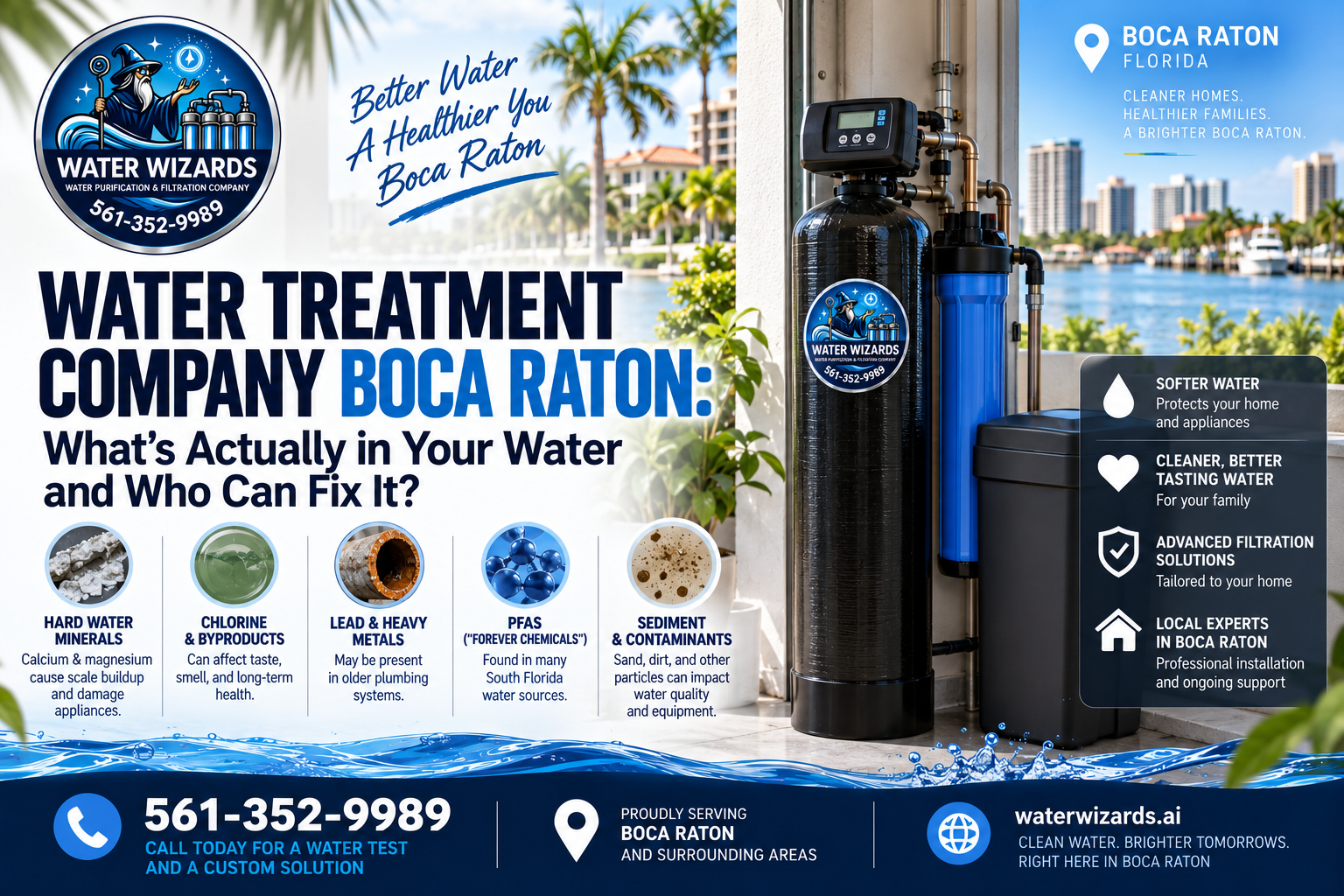
Published by Jared Beviano · Water Wizards Filtration
Boca Raton has a reputation for being one of the most well-maintained cities in South Florida. The landscaping is immaculate. The neighborhoods are well-kept. The infrastructure is newer than most of the county. People who move here often assume the water quality matches the surroundings.
It doesn't.
Boca Raton is served primarily by Palm Beach County Water Utilities — PBCWUD, state ID FL4504393. The utility delivers water that meets all federal legal standards. It also delivers water that fails the Specialty Coffee Association's standards for coffee brewing, the FDA's informal guidance on drinking water for infants, and the Environmental Working Group's health guidelines for chromium-6, chlorate, PFAS, and total dissolved solids — by significant margins.
This isn't a criticism of PBCWUD specifically. They operate within the rules. The rules were written decades before the science on PFAS, chromium-6, and chlorate reached its current state. South Florida's geology — limestone aquifers, agricultural runoff, proximity to industrial sites — creates water quality challenges that utilities manage but cannot fully solve at the treatment plant.
What they can't solve at the plant, you can solve at the point of use. That's what a water treatment company does.
What's in Boca Raton's Water
PBCWUD's annual Consumer Confidence Report is a public document. The EWG Tap Water Database cross-references it against current health science rather than outdated legal limits. Here's what Boca Raton tap water contains above EWG health guidelines:
Chromium-6 (hexavalent chromium): Detected above EWG's cancer risk guideline of 0.02 ppb. Chromium-6 is a known carcinogen — the same chemical at the center of the Erin Brockovich case. The federal MCL for total chromium is 100 ppb, set in 1991. The EWG cancer guideline is based on more recent California health science. PBCWUD water is within federal limits. It is above the health guideline.
Chlorate: Detected above EWG's thyroid health guideline. Chlorate is a disinfection byproduct formed during water treatment using chlorine dioxide. It disrupts thyroid hormone production, with particular concern for pregnant women, infants, and people with thyroid conditions. There is no federal MCL for chlorate in drinking water.
PFAS (per- and polyfluoroalkyl substances): Multiple PFAS compounds detected above EWG's health guideline of 1 ppt. PFAS are synthetic compounds used in industrial and consumer products — firefighting foam, non-stick cookware, waterproof fabrics. They accumulate in the body and don't break down in the environment, which is why they're called forever chemicals. The EPA established legal limits for six PFAS compounds in 2024 — PBCWUD water has been working toward compliance with these new limits.
Total dissolved solids: 274–291 ppm TDS — significantly above the SCA's recommended ceiling of 150 ppm for drinking and brewing water, and above what most bottled water brands contain.
Hardness: 16–17 GPG (274–291 ppm) — more than double the national average of 6.3 GPG. Hard water doesn't present direct health risks, but it destroys appliances, clogs pipes, and makes every water-using system in your home work harder and fail sooner.
Chloramine: PBCWUD uses chloramine for disinfection throughout the distribution system. Chloramine is more persistent than free chlorine — it's still active when the water reaches your tap, which is the point. It's also what gives South Florida tap water its characteristic chemical taste and smell, and it's significantly more damaging to pipes, fixtures, and water-using appliances than free chlorine.
| Contaminant | Detected level | EWG health guideline | Federal legal limit | Health concern | Removed by RO? |
|---|---|---|---|---|---|
| Chromium-6 | Above EWG guideline | 0.02 ppb | 100 ppb (total Cr) | Carcinogen — cancer risk with long-term exposure | ✓ 85–95% |
| Chlorate | Above EWG guideline | 210 ppb | No federal MCL | Thyroid disruption — elevated concern for pregnant women & infants | ✓ 85–90% |
| PFAS (total) | Above EWG guideline | 1 ppt combined | 4 ppt (EPA 2024) | Cancer, immune, hormone disruption — forever chemicals | ✓ 90–99% |
| TTHMs (trihalomethanes) | Near EWG threshold | 0.15 ppb | 80 ppb | Bladder and colorectal cancer risk with long-term exposure | ✓ 85–95% |
| Hardness (calcium + magnesium) | 274–291 ppm / 16–17 GPG | No health limit | No federal limit | Appliance damage, scale, dry skin — not a direct health risk | ✓ 90–97% |
| Chloramine | Present throughout system | Zero preferred | 4 ppm (as Cl₂) | Respiratory irritant; dermal absorption in shower; pipe corrosion | ✓ Pre-carbon stage |
| Total dissolved solids (TDS) | 274–291 ppm | 150 ppm (SCA brewing) | 500 ppm (secondary) | Taste, mineral buildup — above optimal range for drinking | ✓ 90–97% |
Why Boca Raton Has Specific Water Challenges
Beyond the county-wide water quality issues, Boca Raton has some local factors worth knowing:
Location within the distribution system. Boca Raton is at the southern end of PBCWUD's service area. Water that travels farther through distribution pipes picks up disinfection byproducts — TTHMs and HAAs form when chloramine reacts with organic matter in the pipes. The longer the transit time, the more byproducts accumulate. Southern portions of the service area generally have slightly higher disinfection byproduct concentrations than areas closer to the treatment plant.
High-density residential development. The large number of condo buildings, HOA communities, and apartment complexes in Boca Raton means that water passes through additional internal plumbing infrastructure — building water mains, shared risers, unit shutoffs — before reaching individual units. Older internal plumbing in high-rises and condo conversions can add lead, copper, and corrosion byproducts to the water chemistry after it leaves PBCWUD's system.
Irrigation and fertilizer runoff. The extensive landscaping culture in Boca Raton — residential lawns, golf courses, commercial landscaping — creates agricultural-style fertilizer runoff that affects groundwater. Nitrates from fertilizers are a concern in well water and can affect some municipal sources in the western portions of the service area.
Proximity to I-95 and industrial corridors. PFAS contamination in South Florida is partly attributable to historical use of AFFF (aqueous film-forming foam) at airports, military installations, and fire training facilities. Boca Raton's position relative to certain historical sites affects the PFAS load in the regional aquifer.
What a Water Treatment Company Actually Does
A water treatment company is not a plumber and not an appliance dealer. The work is diagnostic first — understanding your specific water chemistry — and then prescriptive: recommending and installing the right combination of treatment for your situation.
The process for a residential installation in Boca Raton typically looks like this:
Water testing. A professional water test goes beyond the utility's annual report. We test at your tap, which accounts for your home's internal plumbing. We test for the specific parameters relevant to your water source: hardness, TDS, iron, chloramine, pH, and if indicated, PFAS, nitrates, and heavy metals. The test takes 30–45 minutes at your home.
System design. Based on the test results and your household's specific needs — how many people, what appliances, any health concerns, what applications matter most (drinking water, cooking, laundry, bathing) — we design a treatment approach. In most Boca Raton homes, the right answer involves multiple stages: whole-house treatment for hardness and chloramine, point-of-use RO for drinking and cooking water.
Installation. A professional installation connects to your home's plumbing, not around it. Whole-house systems are installed at the main water entry point. Under-sink RO systems connect to the cold water supply under the kitchen sink and include a dedicated faucet. Installation typically takes 3–6 hours for a complete whole-house plus under-sink system.
Ongoing service. Filters need to be changed. Salt needs to be delivered. Membranes need periodic replacement. A good water treatment company offers maintenance service, not just installation — they come back.
The Right System for a Boca Raton Home
Based on PBCWUD water quality and typical Boca Raton housing (single-family homes, condos, HOA communities), here's what effective treatment looks like:
For a single-family home:
Stage 1 — Whole-house water softener: Addresses the 16–17 GPG hardness. Eliminates scale in water heaters, dishwashers, washing machines, and all plumbing fixtures. Expected to save $600–1,200 per year in appliance damage, energy waste, and chemical overconsumption. Size: 48,000–64,000 grain for a typical 3–4 bedroom Boca Raton home.
Stage 2 — Whole-house catalytic carbon filter: Removes chloramine, TTHMs, and HAAs from every tap, shower, and appliance in the home. Standard activated carbon doesn't remove chloramine — the catalytic grade is required. This is the stage that transforms the taste and smell of water throughout the house, not just at the kitchen sink.
Stage 3 — Under-sink reverse osmosis at kitchen: Removes PFAS, chromium-6, chlorate, nitrates, and remaining dissolved solids from drinking and cooking water. Produces water at 15–30 ppm TDS — clean, neutral water that lets food and beverage flavors come through without competition from dissolved minerals or chloramine. Includes a dedicated faucet on the kitchen sink.
Optional Stage 4 — Whole-house sediment pre-filter: Protects the softener and carbon filter from particulate matter in the source water. 20–50 micron sediment filter installed before the softener. Extends the life of downstream treatment stages.
For a condo or high-rise unit:
Building-level water treatment in Boca Raton condos is rare — most buildings deliver PBCWUD water directly to units. A whole-house softener isn't practical in a condo unit, but point-of-use treatment is:
Under-sink RO at the kitchen addresses drinking and cooking water — the highest-priority use case. A compact 4-stage RO system fits under most condo kitchen sinks and delivers the same contaminant removal as a full residential system.
Shower filter addresses chloramine exposure in the shower — a meaningful consideration since dermal absorption and inhalation of chloramine during a hot shower can exceed oral intake from drinking water.
In-line carbon filter on the refrigerator water line addresses ice and drinking water from the fridge dispenser.
For a business in Boca Raton:
Boca Raton has a significant commercial sector — professional offices, medical practices, restaurants, retail. Commercial water treatment needs are application-specific:
Restaurants need whole-building softeners for equipment protection, carbon filtration for beverage quality, and potentially RO for espresso and cooking applications. Medical practices need RO for water used in autoclaves and patient care. Office buildings with water coolers and coffee stations benefit from point-of-use filtration at each use point.
Choosing a Water Treatment Company in Boca Raton
South Florida has no shortage of water treatment companies. The range in quality, transparency, and approach is significant. Here's what to look for:
They test your water first. Any company that recommends a system before testing your water is guessing. Your neighbor's water test is not your water test — even within the same zip code, internal plumbing can produce meaningfully different results. A professional water test at your tap is non-negotiable.
They explain what they're treating and why. A good water treatment company can tell you specifically what's in your water, which contaminants they're targeting with each stage of treatment, and what the treated water will test at. If the explanation is vague — "our system makes your water better" — that's a red flag.
They're licensed. Florida requires water treatment dealers and contractors to be licensed by the Department of Business and Professional Regulation. Verify the license before signing anything.
They don't sell you more than you need. A whole-house 7-stage system with UV, ozone, and magnetic conditioning is not what most Boca Raton homes on PBCWUD water need. If a company is pushing a system that addresses problems you don't have, they're selling rather than solving.
They offer service after installation. The equipment needs maintenance. A company that installs and disappears is not a long-term partner. Ask specifically about filter replacement schedules, service contracts, and what happens if something fails.
They're local. Water treatment is a local business. A company based in Boca Raton or the Palm Beach County area understands PBCWUD water, knows the local geology, and has seen what works in the housing stock in your area. National chains often rely on generic system configurations that aren't optimized for local conditions.
What to Expect From Your First Call
At Water Wizards, the process for a new Boca Raton customer looks like this:
You call or fill out our online form. We schedule a free water test at your home — typically within 48 hours. A technician comes to your home, tests your water at the tap, walks through the results with you, and answers your questions. There's no pressure to buy anything at that appointment.
If you want a proposal, we prepare one based on your specific test results and your home's characteristics. If you proceed, installation is typically scheduled within one to two weeks. Most whole-house plus under-sink installations are completed in a single day.
After installation, we set up a maintenance schedule — filter changes, salt delivery if you have a softener, annual system checks. You get our direct line. If something isn't working, we come back.
That's the model. Straightforward, based on what your water actually contains, and designed to last.
Call 561-352-9989 for a free water test in Boca Raton — results same day
Water Wizards Filtration | Delray Beach, FL | Water softeners, reverse osmosis systems, whole-house filtration, and water treatment service throughout Boca Raton, Palm Beach County, Broward, and Miami-Dade.