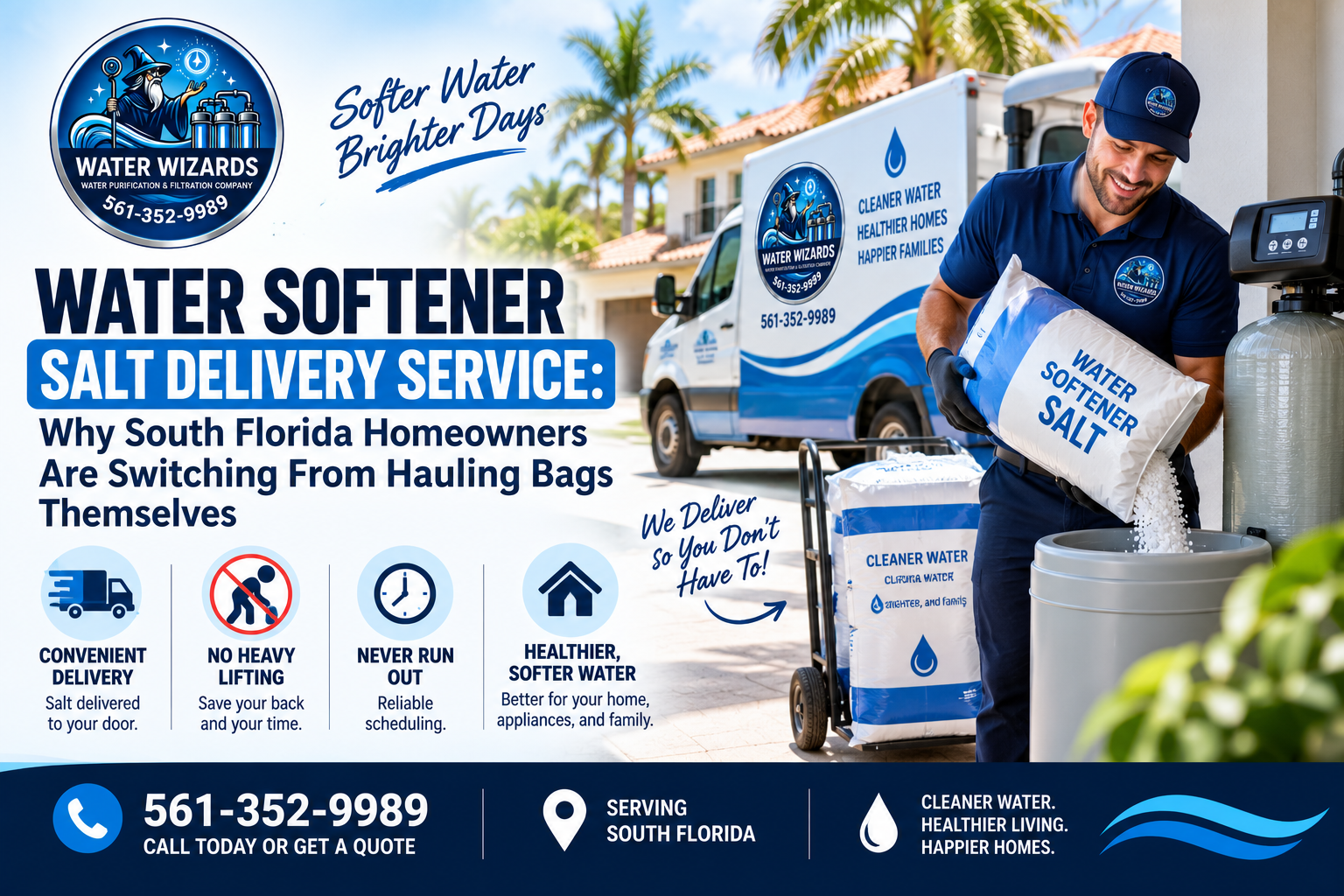
Water Softener Salt Delivery Service: Why South Florida Homeowners Are Switching From Hauling Bags Themselves
Published by Jared Beviano · Water Wizards Filtration
A customer in Plantation called me after throwing out his back lifting 40-pound bags of water softener salt. He'd been doing it himself for six years — once a month, sometimes twice, hauling bags from Home Depot, lugging them down the side of the house, pouring them into the brine tank. He was 58. His back had finally said enough.
"I didn't even know this was a service," he told me.
Most people don't. Water softener salt delivery is one of those things that nobody talks about because the people doing it assume everyone knows, and the people not doing it have never been told it exists.
It exists. And in South Florida, where softeners run harder and use more salt than almost anywhere in the country, it makes more sense here than just about anywhere else.
Why South Florida Softeners Use So Much Salt
Salt consumption in a water softener is directly tied to water hardness and water usage. The harder the water and the more water your household uses, the more salt the softener needs to regenerate the resin.
At 15–22 GPG — the hardness range across Palm Beach, Broward, and Miami-Dade counties — South Florida softeners are working at two to three times the hardness intensity of the national average. A softener that might use 15–20 pounds of salt per month in Atlanta is using 35–60 pounds per month in Boca Raton. At Miami-Dade WASD hardness levels, some households with high water usage are going through 80–100 pounds of salt per month.
That's a lot of bags. 40-pound bags means 2–3 bags per month at moderate hardness. At peak usage on WASD water, that's potentially 2–3 bags per visit, multiple times per month.
Every bag is a trip to the store. Every bag is lifting 40 pounds from a flatbed cart, into a car, out of a car, and into the brine tank. Every bag is a task that most households quietly absorb into their routine without thinking about whether it needs to be their problem.
What Water Softener Salt Delivery Actually Looks Like
A salt delivery service sends a technician to your home on a scheduled basis — typically monthly or every six weeks in South Florida — who checks the brine tank level, fills it with the right type and amount of salt, inspects the system for any issues, and leaves. No lifting for you. No trips to the hardware store. No running out of salt and going two weeks with hard water because you forgot.
The better services also include a basic softener health check with each visit: checking for salt bridges and salt mushing, verifying regeneration settings, and flagging anything that needs attention before it becomes a repair.
What it isn't: a complicated service contract or a long-term commitment. Most providers offer month-to-month scheduling. You're paying for salt at a delivered price plus a service fee — typically a combined cost that competes reasonably with retail bags when you account for your time and the lifting.
The Real Cost Comparison
This is where people assume delivery costs significantly more than buying bags themselves. The math is closer than most people expect.
DIY salt (40-pound bags from Home Depot or Costco):
Morton Clean and Protect: $8–12 per 40-lb bag
Diamond Crystal: $9–13 per 40-lb bag
Usage at 15–18 GPG (Palm Beach/Broward): 40–60 lbs per month → $10–20/month
Usage at 22 GPG (Miami-Dade WASD): 60–100 lbs per month → $15–32/month
Your time: 20–40 minutes per trip including driving, store time, loading, unloading
Physical effort: lifting 40–80 lbs per visit
Delivered salt service (South Florida):
Salt cost per pound: typically $0.35–0.60/lb delivered
Monthly service fee: $15–35 depending on provider and frequency
Usage at 15–18 GPG: $25–55/month all-in
Usage at 22 GPG: $40–80/month all-in
Your time: zero
Physical effort: zero
The delivery premium is real — typically 30–60% more than buying bags yourself. But it's buying something real: your time, your back, and the assurance that your salt level never drops low enough to let hard water through because you were busy and forgot to go to Home Depot.
| Water source / hardness | Monthly salt use | DIY cost (bags) | Delivery cost (all-in) | Monthly premium | Time saved / month |
|---|---|---|---|---|---|
| Broward County WWS (14–16 GPG) | 40–60 lbs | $10–20 | $28–50 | +$15–30 | 25–35 min |
| Palm Beach County PBCWUD (16–17 GPG) | 45–65 lbs | $12–22 | $30–55 | +$16–35 | 25–35 min |
| Seacoast Utilities / Jupiter (18–19 GPG) | 55–75 lbs | $14–25 | $34–62 | +$18–40 | 30–40 min |
| Miami-Dade WASD (22.4 GPG) | 70–100 lbs | $18–33 | $42–80 | +$22–50 | 30–45 min |
| High-usage household (22 GPG, 4+ people) | 90–120 lbs | $23–40 | $55–95 | +$30–60 | 35–50 min |
| Potassium chloride (any hardness) | 40–80 lbs | $35–80 | $65–130 | +$20–55 | 25–45 min |
For households where the primary softener maintainer is over 50, has back issues, or simply values not making monthly hardware store runs, the premium is an easy trade.
Types of Salt — What Goes in Your Softener
Not all softener salt is the same, and delivery services vary in what they stock. Understanding the types helps you specify what your system needs.
Rock salt: The cheapest option — minimally processed, contains natural minerals and impurities. The impurities accumulate in the brine tank and require more frequent cleaning. Not recommended for South Florida systems that already run hard.
Solar salt (evaporated salt crystals): Produced by evaporating sea water or brine lake water. Higher purity than rock salt — typically 99.5–99.8% sodium chloride. Comes in crystals or pellets. Widely available and appropriate for most residential softeners. Standard option for most delivery services.
Evaporated salt pellets: The highest purity option — 99.9%+ sodium chloride produced by further processing of solar salt or brine. Dissolves more cleanly, produces less residue in the brine tank, and is recommended for high-efficiency softeners and systems that go long periods between cleanings. Morton Clean and Protect and Diamond Crystal Bright and Soft are common brands.
Potassium chloride (KCl): A salt-free alternative for households concerned about sodium. Works through the same ion exchange mechanism but replaces hardness ions with potassium rather than sodium. Significantly more expensive ($25–40 per 40-lb bag vs. $10–13 for sodium), but appropriate for people on sodium-restricted diets who still want softened water. Not all delivery services carry it — ask specifically if this is your requirement.
Block salt: Large solid blocks rather than pellets or crystals. Used in specific block salt softener designs — not interchangeable with pellet/crystal systems. Less common in South Florida residential installations.
For most South Florida systems on municipal water: evaporated salt pellets at highest purity. For well water systems: same, plus consider iron-fighting formulas (Morton Rust Remover, Diamond Crystal Iron Fighter) if iron is present in your source water.
What to Look for in a Salt Delivery Service
Not all delivery services are equivalent. When you're evaluating options in South Florida:
Salt type options. Can they deliver evaporated pellets? Potassium chloride if needed? A service that only stocks one type of salt may not be right for your system.
System inspection included. The best services include a basic softener health check with each delivery — checking salt bridges, verifying the brine tank is functioning correctly, confirming regeneration settings. This is where you get value beyond just salt delivery: problems get caught early.
Flexible scheduling. Monthly is standard for most South Florida households. Some high-usage households or those with very hard water need six-week or bi-monthly service. A good provider adjusts to your actual consumption rather than selling you a fixed schedule that doesn't match your system.
No long-term contracts. Month-to-month service is the norm for reputable providers. Be cautious of services requiring 12-month commitments for basic salt delivery.
Licensed and insured. Anyone accessing your home and handling your water treatment equipment should be licensed in Florida as a water treatment specialist. Ask.
Service area. Salt delivery is a logistics business — providers have geographic limits. Confirm coverage for your specific address, particularly if you're in a less-dense area of western Palm Beach County or further south in Miami-Dade.
When Salt Delivery Makes the Most Sense
Salt delivery is genuinely the right solution for some households and unnecessary for others. It makes the most sense when:
You're on Miami-Dade WASD or other high-hardness water. At 22.4 GPG, you're using significantly more salt than the average softener owner. Monthly or six-week delivery takes a frequent, heavy task off your plate.
The primary person managing the softener has physical limitations. Lifting 40-pound bags repeatedly is a real physical demand. For anyone with back problems, arthritis, or mobility limitations, delivery isn't a convenience — it's a practical necessity.
You travel frequently. A softener that runs out of salt while you're away for two weeks comes home to a house that's been running hard water through the plumbing, the water heater, and every appliance connected to it. Scheduled delivery ensures your salt level is maintained whether you're home or not.
You've had salt bridges or salt mushing. Both of these issues — where salt clumps in the brine tank and prevents proper regeneration — are more likely when salt levels fluctuate significantly between fills. Consistent delivery at regular intervals keeps salt levels more stable and reduces bridging frequency.
You want to consolidate softener maintenance. If your delivery service includes system inspection, you're combining salt replenishment and preventive maintenance into one visit. For households that don't want to think about the softener until something goes wrong, this is the right model.
It doesn't make sense if: you're on relatively soft water and using salt infrequently, you genuinely enjoy maintaining your own system, or you have easy access to a Costco with competitive bag pricing and don't mind the lifting.
Setting Up Salt Delivery in South Florida
The process is straightforward:
Step 1: Know your system. Before calling a delivery service, know your softener's tank size (look for a label on the brine tank or the original paperwork), what type of salt it uses, and approximately how often you've been adding salt. This lets the provider schedule the right delivery frequency.
Step 2: Get a current assessment. If your softener hasn't been serviced in over a year, have it checked before starting delivery. A salt bridge or failing resin will make your system ineffective regardless of how reliably the salt is delivered. Starting delivery on a malfunctioning system is wasted money.
Step 3: Confirm salt type. Tell the provider your water source (municipal utility name or well), whether you have iron in your water, and any specific requirements (potassium chloride, iron-fighting formula). The right salt for your system matters.
Step 4: Schedule and confirm access. Most delivery technicians need access to the area where your brine tank is located — side yard, garage, utility room. Confirm whether they need you home or can handle it unattended. Many providers leave a service slip noting the date, salt quantity added, and any observations about the system.
The Broader Picture: Softener Maintenance Beyond Salt
Salt delivery is the recurring task, but a water softener needs more than salt to stay in optimal condition — especially in South Florida.
Annual professional service: Once per year, have a technician check the control valve settings, inspect the resin bed, verify regeneration timing, and clean the brine tank. This is separate from salt delivery and catches issues before they become expensive repairs.
Resin cleaner: Every 3–4 months, add a resin cleaner product to the brine tank. Iron-OUT, Res-Up, or similar products clean iron deposits and organic fouling from the resin bed. This is especially important for South Florida systems where iron in source water is common and chloramine causes accelerated resin degradation.
Brine tank cleaning: Every 3–5 years, the brine tank should be emptied and cleaned. Salt mushing — where salt breaks down into a thick slurry at the bottom of the tank — reduces brine tank efficiency and can interfere with regeneration. A good delivery service will flag mushing during inspections.
Resin replacement: As covered in our previous article, South Florida resin typically needs replacement at 10–12 years due to high regeneration frequency, chloramine exposure, and heat. If your softener is approaching that age, have the resin assessed proactively.
What the Homeowner in Plantation Did
He signed up for monthly salt delivery. The service costs him about $55 per month — roughly $20 more than he was spending on bags, accounting for his Costco membership savings. What he got back was the time, the trips, the lifting, and the minor but persistent stress of remembering to check the salt level.
His back recovered. His softener has been running without interruption since. He had one service call in two years — a minor salt bridge that the delivery technician caught during a routine inspection before it became a problem.
"It's one less thing," he said. That's exactly what it is.
Call 561-352-9989 to schedule water softener salt delivery and service in South Florida
Water Wizards Filtration | Delray Beach, FL | Water softener salt delivery, softener service, resin replacement, and complete water treatment throughout Palm Beach, Broward, and Miami-Dade counties.