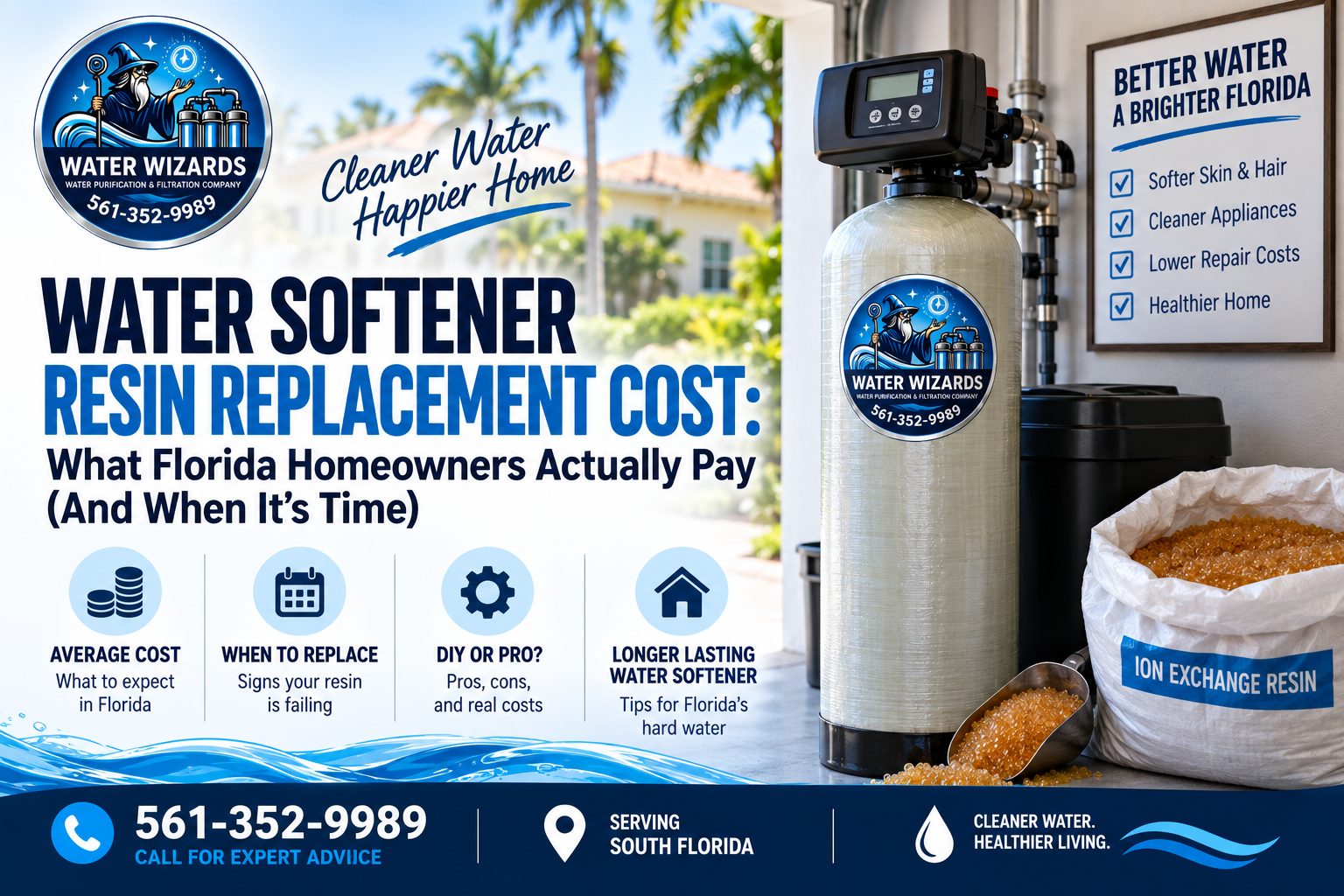
Water Softener Resin Replacement Cost: What Florida Homeowners Actually Pay (And When It's Time)
Published by Jared Beviano · Water Wizards Filtration
A homeowner in Coral Springs called me last fall. His water softener was eight years old and had stopped softening. He'd already replaced the control valve the year before — $380 with labor. He'd had the unit serviced twice. Salt was going in, but soft water wasn't coming out.
I drove out and tested the resin. It was exhausted — the ion exchange capacity was gone. The beads had degraded to the point where they couldn't hold a charge long enough to do meaningful softening. The unit was working mechanically. The resin was dead.
Resin replacement: $300 in materials, $180 in labor. Total: $480.
He almost bought a new unit instead. A new comparable softener would have cost him $1,800–2,400 installed. The resin replacement extended the life of his existing system by another 8–12 years at a fraction of the cost.
This article covers what water softener resin actually does, how to tell when it's failing, what replacement costs in South Florida, and when replacement makes more sense than buying new.
What Water Softener Resin Is and What It Does
A water softener works through ion exchange. Inside the resin tank is a bed of small plastic beads — typically polystyrene — coated with sulfonate groups that carry a negative charge. These beads attract positively charged ions: primarily calcium and magnesium, the minerals that cause hard water.
As hard water flows through the resin bed, calcium and magnesium ions attach to the beads, displacing sodium ions that were placed there during the regeneration cycle. The water leaving the tank has had its hardness ions removed and replaced with sodium — it's now soft.
When the resin beads are fully loaded with calcium and magnesium, the softener runs a regeneration cycle. A salt brine solution flushes through the resin tank, the high concentration of sodium ions displaces the calcium and magnesium, and the resin is recharged for another service cycle.
This process is designed to repeat thousands of times over the life of the softener. Quality resin from major manufacturers is rated for 10–20 years of normal service. In South Florida, "normal service" is a relative term.
Why South Florida Is Hard on Resin
At 15–22 GPG, South Florida water puts more demand on resin than almost anywhere in the continental US. Every gallon of water that flows through the softener carries two to three times more hardness minerals than the national average — meaning the resin exhausts faster, regenerates more frequently, and experiences more mechanical stress per unit of time.
The specific factors that accelerate resin degradation in South Florida:
High iron content in some areas. Western Palm Beach County, parts of Broward, and areas on well water frequently have elevated iron. Iron fouling of resin — where iron coats the bead surface and physically blocks the ion exchange sites — is one of the most common causes of premature resin failure in Florida. Iron-fouled resin doesn't exhaust the beads — it smothers them. Standard resin cleaners can address mild iron fouling; advanced fouling requires resin replacement.
Chloramine exposure. South Florida utilities use chloramine for disinfection. Chloramine is more oxidatively aggressive than free chlorine and degrades standard resin faster. Over 8–12 years of chloramine exposure, the crosslinks in the polystyrene bead structure break down — the beads become fragile, crack, and lose their capacity to hold charge. This is called resin degradation by oxidative attack, and it's more common in Florida than in markets using free chlorine.
High regeneration frequency. At 20+ GPG, a properly sized softener in a typical South Florida home regenerates every 3–4 days rather than every 7–10 days in a low-hardness market. Each regeneration cycle is a mechanical stress event — brine flows in, brine flows out, the bed expands and contracts. More cycles per year means more mechanical wear per year.
Heat. Resin performance degrades faster at elevated temperatures. South Florida ambient water temperatures are higher than in northern markets, and resin sitting in warm well water or in systems installed in non-climate-controlled spaces ages faster than it would in cooler climates.
A resin bed rated for 15 years in Minneapolis might deliver 10–12 years in South Florida. Plan accordingly.
Signs Your Resin Needs Replacement
Resin failure is gradual, not sudden. The softener doesn't stop working one day — it slowly loses effectiveness over months, and many homeowners don't notice until they see obvious hard water symptoms returning.
Hard water symptoms returning despite normal salt consumption: Scale is reappearing on faucets and shower glass. Soap isn't lathering well. Skin feels dry after showering. The softener is using salt on schedule, but the output water is hard. This is the most common presentation of resin exhaustion.
TDS or hardness testing shows little difference between inlet and outlet: A $20 TDS meter is the fastest way to diagnose resin exhaustion. Test water before the softener (at an outdoor hose bib or before the softener inlet) and after (at the softened water outlet or a indoor faucet). A working softener should show a significant TDS reduction. If inlet and outlet are similar, the resin isn't working.
Resin beads appearing at faucets: Small brown or amber beads coming out of faucets or the water heater indicate that the distributor tube inside the resin tank has cracked, allowing resin to bypass into the plumbing. This is a mechanical failure — the distributor needs replacement, and if the unit is old, resin replacement at the same time makes sense.
Iron staining despite a functioning softener: Orange or brown staining appearing on fixtures, laundry, or toilets when the softener should be addressing iron indicates iron fouling of the resin bed. The resin has been coated with iron deposits that have blocked the exchange sites.
The softener is over 10–12 years old in South Florida: At South Florida hardness levels and regeneration frequency, resin approaching 10–12 years of service is approaching the end of its reliable service life. Proactive replacement before complete failure avoids the situation where you're without soft water for a week while parts are ordered.
Salt bridges forming frequently: Salt bridges — where salt crusts over in the brine tank and creates a gap between the salt and the water — can cause the resin to not regenerate properly. But if you're clearing bridges regularly and soft water still isn't being produced, the resin itself may be the issue.
Water Softener Resin Replacement Cost
Resin replacement involves draining the tank, removing the old resin, cleaning the tank interior, installing new resin, and reassembling. It's a labor-intensive job that requires the right equipment — a resin removal tool (wet/dry vac with appropriate attachment) and a funnel system for loading new resin without damaging the distributor tube.
Resin material cost:
Standard crosslinked resin (8% crosslink): $60–120 for a typical residential tank (1–1.5 cubic feet). This is the standard grade — fine for most residential applications on municipal water.
High-crosslink resin (10% crosslink): $90–160 for a typical tank. Better resistance to oxidative degradation from chloramine. Recommended for South Florida municipal water due to chloramine exposure.
Fine mesh resin: $100–180 for a typical tank. Designed specifically for iron removal. Appropriate when iron fouling is the cause of failure or a concern in the source water.
Labor cost:
Most water treatment companies in South Florida charge $150–250 for resin replacement labor, depending on tank size and access. Add $50–100 for travel if you're outside the service area.
Total resin replacement cost in South Florida:
Tank sizeResin costLaborTotalSmall (0.75 cu ft / 24,000 grain)$50–90$150–200$200–290Standard (1.0 cu ft / 32,000 grain)$65–120$150–220$215–340Large (1.5 cu ft / 48,000 grain)$95–160$180–250$275–410Extra large (2.0 cu ft / 64,000 grain)$120–200$200–280$320–480
These prices assume standard residential resin and straightforward access. If you're replacing with high-crosslink or fine mesh resin, add 30–40% to resin material cost.
| Tank size | Grain capacity | Resin cost (standard) | Resin cost (high-crosslink) | Labor | Total installed | vs. new unit |
|---|---|---|---|---|---|---|
| Small (0.75 cu ft) | 24,000 grain | $50–90 | $70–120 | $150–200 | $200–290 | Save $900–1,500 |
| Standard (1.0 cu ft) | 32,000 grain | $65–120 | $90–160 | $150–220 | $215–340 | Save $1,000–1,800 |
| Large (1.5 cu ft) | 48,000 grain | $95–160 | $130–210 | $180–250 | $275–410 | Save $1,100–2,000 |
| Extra large (2.0 cu ft) | 64,000 grain | $120–200 | $160–260 | $200–280 | $320–480 | Save $1,200–2,300 |
| Commercial (3.0+ cu ft) | 96,000+ grain | $180–320 | $240–420 | $280–400 | $460–720 | Case by case |
| Symptom | What it means | Urgency |
|---|---|---|
| Hard water returning — scale on fixtures, poor soap lather | Resin exhausted — beads no longer holding charge long enough between regenerations | Replace now |
| TDS/hardness same before and after softener | Ion exchange has stopped. Confirmed resin failure — verify with $20 TDS meter | Replace now |
| Resin beads at faucets or in water heater | Distributor tube cracked — resin bypassing into plumbing. Replace resin + distributor | Replace now |
| Orange/brown staining despite working softener | Iron fouling of resin — exchange sites coated and blocked. Cleaning may help; replacement often needed | Inspect soon |
| Salt use unchanged but soft water reduced | Resin partially degraded — capacity declining. Early warning before complete failure | Test and monitor |
| Unit is 10–12+ years old (South Florida) | At SFL hardness levels and regeneration frequency, resin approaching end of reliable service life | Proactive test |
| Mushy salt / frequent bridging + poor results | May be brine tank issue or resin degradation — diagnose brine tank first, then test resin | Diagnose first |
Resin Replacement vs. Buying a New Softener
This is the question most homeowners are asking when they call me. The math is usually straightforward — but it depends on the age and condition of the rest of the system.
Replace resin when:
The control valve is working correctly and is not due for replacement. The brine tank is in good condition. The unit is under 12–15 years old. The system is properly sized for your household. In this case, resin replacement at $250–480 extends the life of a working system by another 8–12 years.
Buy a new unit when:
The control valve has failed or is approaching end of life (control valves typically last 10–15 years). The tank itself is compromised — physical damage, heavy corrosion, or structural issues. The system is undersized for your current household — if you've added people or water-using appliances since installation, a new larger unit may be appropriate. The unit is over 15 years old and multiple components are showing wear.
The numbers:
Resin replacement on a functioning 10-year-old softener: $275–480 New comparable softener installed: $1,200–2,800
If the rest of the system has 5+ more years of serviceable life, resin replacement is the clear choice. If the control valve is also failing and the unit is 14 years old, the math shifts toward replacement — paying $480 for resin plus $400 for a control valve on a unit that might need full replacement in two years is poor economics.
Can You Replace Resin Yourself?
Technically yes. The process is:
Bypass and depressurize the softener
Remove the control valve head
Extract old resin (wet/dry vac method or scoop method)
Clean tank interior
Install new distributor tube if needed
Load new resin (with funnel to protect distributor)
Reassemble and restart
The challenges: resin is heavy (30–50 lbs per cubic foot when wet), the process is messy, and loading resin incorrectly can damage the distributor tube — which means a service call anyway. For most homeowners, professional replacement at $275–480 all-in is the right call given the risk of distributor damage.
If you're technically inclined and willing to do it carefully, DIY resin replacement saves $150–250 in labor. The resin itself can be ordered directly from suppliers — Purolite, Resintech, and Lanxess are the major manufacturers supplying the water treatment industry.
Extending Resin Life in South Florida
Given the accelerated wear from hard water, high regeneration frequency, chloramine, and heat, South Florida homeowners can take specific steps to extend resin life:
Use resin cleaner regularly. Iron-OUT, Super Iron Out, and dedicated resin cleaning products like Res-Up remove iron fouling and organic deposits that reduce resin capacity over time. Add resin cleaner to the brine tank every 3–4 months in South Florida — more frequently if you have elevated iron.
Size the softener correctly. An undersized softener regenerates too frequently, wearing resin faster. An oversized softener regenerates too infrequently, which can allow bacterial growth in the resin bed and salt mushing. A properly sized system — matched to your actual daily water usage and hardness level — runs the optimal number of regeneration cycles per week.
Add a sediment pre-filter. Sediment in source water — common in South Florida well water and in areas with older distribution infrastructure — can coat resin beads and reduce capacity. A 20–50 micron sediment filter upstream of the softener costs $50–80 installed and meaningfully extends resin life.
Consider high-crosslink resin from the start. If you're replacing resin now, specify 10% crosslink resin rather than standard 8% crosslink. The additional crosslinking resists the oxidative degradation from chloramine and extends rated life in Florida conditions.
Keep salt at proper levels. Running the brine tank low on salt causes incomplete regeneration — the resin partially regenerates and operates at reduced capacity, increasing the frequency of full exhaustion cycles. Keep the brine tank at least one-third full at all times.
The Call Worth Making Before You Buy a New Softener
The homeowner in Coral Springs was three days from buying a new unit when he called me. His reasoning: the softener isn't working, so it must be broken, and broken means replace. It was a reasonable assumption — and wrong in his case.
Resin replacement isn't well-known among homeowners because it's not well-marketed. Softener manufacturers and big-box retailers have obvious incentives to sell new units rather than service existing ones. A water treatment professional with no stake in whether you replace or repair can give you an honest assessment.
Before you buy a new softener, have your resin tested. A hardness test on the water before and after the softener, combined with a visual inspection of the resin bed and a check of the control valve, takes about 30 minutes and costs nothing when done as part of a service call.
In many cases — not all, but many — the fix is $300, not $2,000.
Call 561-352-9989 for a free water softener inspection and resin assessment
Water Wizards Filtration | Delray Beach, FL | Water softener service, resin replacement, and complete water treatment systems throughout Palm Beach, Broward, and Miami-Dade counties.