Signs Your Water Softener Isn't Working (And What to Do About It)
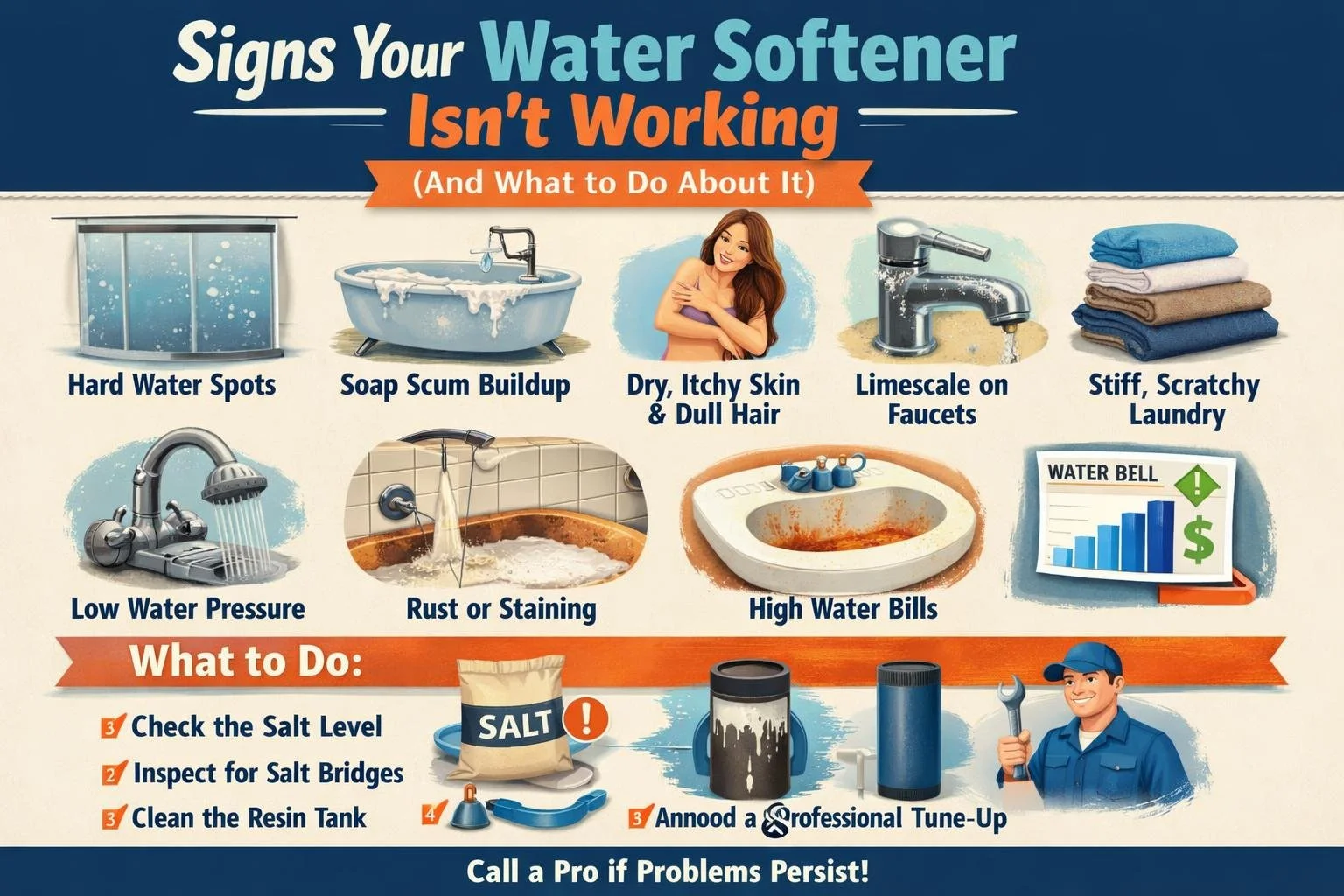
How to tell if your system is failing — and when it's time to call for help
There's nothing quite like the frustration of realizing your water softener has quietly stopped doing its job. You invested in the system to get rid of hard water problems, and for months or years, it worked perfectly. Then one day, you notice the spots are back on your dishes, your skin feels tight after showers, and there's that familiar scale building up on the faucets again.
I see this scenario play out constantly with Florida homeowners. The tricky part is that water softeners don't fail with a dramatic breakdown — they deteriorate gradually, and by the time you notice the obvious symptoms, the problem has usually been developing for weeks or months. Catching the early warning signs can save you from dealing with scale damage to your plumbing and appliances, and often the fix is simpler than you'd expect.
Let me walk you through exactly what to look for, what's likely causing the problem, and how to know whether you can fix it yourself or need professional help.
The Classic Warning Signs That Your Softener Is Failing
Some symptoms are obvious. Others are subtle enough that you might not connect them to your water softener right away. Here's what to watch for:
Hard Water Symptoms Returning
This is the big one — the reason you got a softener in the first place. When the system stops working properly, the signs of hard water come back:
Spots and film on dishes and glassware. Your dishwasher runs the same cycle, uses the same detergent, but suddenly everything comes out with white spots or a cloudy film. That's calcium and magnesium deposits — the minerals your softener should be removing.
Scale buildup on faucets and showerheads. That white, chalky crust appearing around fixtures is unmistakable. In Florida, where our water is particularly hard, this can accumulate quickly once your softener fails.
Soap and shampoo don't lather properly. Hard water reacts with soap to form soap scum instead of suds. If you're suddenly using twice as much shampoo to get a lather, or your soap feels like it leaves a residue rather than rinsing clean, hard water is likely the culprit.
Dry, itchy skin and dull hair after bathing. The minerals in hard water and the soap scum they create don't rinse away cleanly. You'll feel it on your skin — that tight, almost squeaky feeling instead of smooth and soft.
Stiff, scratchy laundry. Clothes washed in hard water feel rougher and may look faded or dingy. You might also notice you're using more detergent to get things clean.
If you're experiencing any combination of these, your water softener almost certainly isn't removing hardness minerals as it should. The question is why, and that determines whether the fix is simple or requires professional attention.
Salt Tank Problems
Your brine tank (the salt tank) is often the first place to look when troubleshooting a malfunctioning softener. Here's what you might notice:
Salt level isn't going down. If you haven't added salt in months but the level looks the same, the system isn't using it. This usually indicates a salt bridge, a programming issue, or a problem with the regeneration cycle.
Salt level drops too fast. The opposite problem — going through salt much faster than usual — can indicate that the system is regenerating too frequently, often because the resin bed has lost capacity.
The water level is too high in the brine tank. You should see a few inches of water at the bottom of the tank, well below the salt. If the water level is up near the salt line or the tank appears flooded, something is preventing proper drainage during regeneration.
Crusty or mushy salt. If the salt has formed a hard layer on top (salt bridge) or become a thick sludge at the bottom (salt mushing), brine can't form properly, and regeneration fails.
Changes in Water Pressure or Flow
A water softener that's clogging up or experiencing internal problems can affect water pressure throughout your home:
Noticeably lower water pressure. Mineral buildup, sediment, or degraded resin can restrict flow through the softener.
Pressure varies depending on the faucet. Uneven pressure can indicate localized problems in the system.
A simple test: Put your softener in bypass mode (most systems have a bypass valve) and check if pressure improves. If it does, the softener is the source of the restriction.
Unusual Sounds or Behavior
Water softeners should be relatively quiet except during regeneration. If you're hearing something off, pay attention:
Persistent hissing during normal operation. This often indicates a pressure problem or valve issue — not something to ignore.
The system runs constantly or never runs. A healthy softener regenerates on a schedule (typically every few days for most households). If it's cycling all the time or you never hear it regenerate, there's a problem.
Water is running to drain continuously. This indicates a stuck valve or control issue — and it's wasting water constantly.
Taste or Odor Changes
Salty-tasting water. If your softened water suddenly has a salty taste, the system may not be rinsing properly after regeneration. This can happen when the drain line is blocked, the rinse cycle is too short, or there's a programming error.
Unusual odors. Sulfur smell or other strange odors from your softener can indicate bacterial contamination in the resin bed or other issues that need professional attention.
Common Causes of Water Softener Problems (And DIY Fixes)
Many water softener issues have straightforward causes that you can address yourself. Let's go through the most common ones:
Salt Bridges
A salt bridge is a hard crust that forms in the brine tank, creating an empty space between the water at the bottom and the salt above. Since the water can't reach the salt to dissolve it, no brine forms — and without brine, the resin can't regenerate.
How to check: Use a broom handle or similar tool to gently push down into the salt. If you hit a hard layer with hollow space underneath, you have a salt bridge.
How to fix: Carefully break up the bridge by pushing through it in several places. Don't pound on the outside of the tank — you could damage it. Remove the broken chunks and let the system regenerate normally.
Prevention: Don't overfill your brine tank with salt. Keeping it around half full reduces the chance of bridging. High humidity (common in Florida) makes bridging more likely, so keeping the area around your softener as dry as possible helps.
Salt Mushing
Salt mushing is different from bridging — it's a layer of thick, sludgy recrystallized salt at the bottom of the tank. This sludge blocks the drain and prevents proper brine formation.
How to identify: If you test for a bridge but can't break through a solid layer, or if you see thick, wet sludge when you dig into the salt, you have mushing.
How to fix: Unfortunately, there's no shortcut here. You need to drain the tank completely, scoop out all the old salt and sludge, clean the bottom, and start fresh with new salt.
Prevention: Use high-quality salt pellets rather than rock salt. Rock salt contains more impurities that contribute to mushing. Also, don't let the salt level get too low before refilling — that gives old salt time to recrystallize.
Low Salt Level
This seems obvious, but I've seen more than a few homeowners troubleshoot everything else before realizing they simply forgot to add salt.
How to check: Look in the brine tank. Salt level should be at least a few inches above the water line. If you can see water without any salt above it, you've run out.
How to fix: Add salt. Most systems work best with salt pellets kept about half to two-thirds full.
Best practice: Check salt level monthly. In Florida's hard water, most households go through 40-80 pounds per month, depending on water usage and hardness level. At Water Wizards, we recommend setting a monthly reminder to check your salt — it's the single most common preventable cause of softener problems.
Bypass Valve Position
Every water softener has a bypass valve that allows water to flow around the unit. If someone accidentally bumped it or left it in bypass after maintenance, your water isn't being treated at all.
How to check: Locate the bypass valve (usually behind or beside the unit) and verify it's in the "service" position, not "bypass."
How to fix: Just move the handle back to the service position.
Incorrect Settings
If your hardness level is programmed incorrectly, or if the regeneration schedule doesn't match your household's water usage, the system won't keep up with demand.
Common issues:
Hardness setting too low (system doesn't regenerate enough)
Regeneration time set during high-usage periods (you use hard water while the system regenerates)
Timer lost power and wasn't reset (common after power outages)
How to fix: Check your owner's manual for programming instructions. In Florida, water hardness typically ranges from 10-20+ grains per gallon, depending on your area. If you're unsure of your actual hardness, we offer free water testing to get accurate numbers for proper programming.
When DIY Won't Cut It: Problems Requiring Professional Service
Some water softener issues are beyond what most homeowners should tackle themselves. Here's when it's time to call in help:
Resin Bed Failure
The resin beads inside your softener are what actually remove hardness minerals through ion exchange. Over time, resin degrades — and in Florida, we see this happen faster than in many other states.
Why Florida is tough on resin:
Our municipal water contains chlorine for disinfection. Chlorine breaks down the structure that holds resin beads together, eventually turning them into ineffective mush. At typical Florida chlorine levels of 2-3 ppm, resin lifespan can be cut significantly — sometimes to just 5-7 years instead of the expected 10-15.
Iron is another resin killer, especially common in Florida well water. Iron coats the outside of resin beads, blocking the sites where calcium and magnesium normally attach. Without regular cleaning, iron-fouled resin loses capacity quickly.
Signs of resin failure:
Hard water symptoms despite salt being used normally
Tiny yellow or amber beads appearing in faucet aerators or toilet tanks
Increasing salt usage without improvement in water quality
Brown or discolored water coming from the softener
What to do: Resin bed replacement is a job for a professional. The process involves draining the tank, removing the old resin, installing new resin, and properly calibrating the system afterward. At Water Wizards, we can typically complete a resin replacement in a single service visit.
Pro tip: If your softener is more than 12-15 years old, it often makes more sense to replace the entire unit rather than just the resin. Newer systems are more efficient with salt and water usage, and you get updated control technology.
Control Valve Problems
The control valve is the "brain" of your water softener — it manages regeneration cycles, monitors water usage (in metered systems), and directs water flow through different phases of operation. When it fails, the whole system fails.
Signs of valve problems:
System stuck in one position (constantly draining, won't regenerate, etc.)
Inconsistent or unpredictable regeneration
Display errors or blank display
Water is leaking from the valve assembly
What to do: Control valve repair or replacement requires specialized knowledge and often specific parts. This is definitely a call-a-professional situation. We service most major brands and can diagnose valve issues quickly.
Motor Failure
The motor drives the control valve through its various cycles. If it fails, regeneration stops.
Signs of motor problems:
The system doesn't cycle at all
Unusual grinding or clicking sounds
Valve position doesn't change during regeneration
What to do: Motor replacement is possible on most systems, though on older units it may be more cost-effective to replace the entire softener. We can help you evaluate the options.
Leaks
Water leaking from your softener — whether from the tanks, valve assembly, or connections — needs professional attention to diagnose and repair properly. Some leaks can be fixed with new O-rings or fittings; others indicate tank failure requiring replacement.
How to Test If Your Softener Is Working
Not sure whether your softener is actually the problem? Here are a few ways to verify:
The Soap Test
Run some warm water in a sink and try to lather hand soap or dish soap. Properly softened water creates rich, fluffy suds easily. Hard water makes soap feel slippery without much lather, and you'll need more soap to get the same effect.
Check for Recent Regeneration
Most modern softeners display information about the last regeneration cycle. Check that it regenerated within the expected timeframe (typically every 2-7 days depending on your usage and settings).
The Hardness Test
This is the most definitive method. Hardness test strips are available at hardware stores for a few dollars, or you can use a liquid test kit. Test your raw water (before the softener) and your softened water. The softened water should show near-zero hardness.
Or skip the guesswork: At Water Wizards, we offer free in-home water testing that tells you exactly what's in your water — hardness, iron, pH, and more. We test the water going into your softener and the water coming out, so you know exactly whether the system is working.
The Florida Factor: Why Your Softener May Wear Out Faster
I've mentioned this throughout, but it's worth emphasizing: Florida is one of the toughest environments in the country for water softeners. Here's why:
Exceptionally hard water. Our water comes from the Floridan Aquifer, which runs through limestone formations that add high levels of calcium and magnesium. Hardness levels of 15-25 grains per gallon are common, well above the national average.
High chlorine in municipal water. Cities add chlorine to kill bacteria, but it also degrades softener resin over time. At Florida's typical chlorine levels, resin may only last 5-8 years instead of 10-15.
Iron in well water. Many Florida wells have significant iron content, which fouls resin if not properly managed.
Humidity. Florida's humidity contributes to salt bridging in brine tanks.
Heavy water usage. Between lawn irrigation, pools, and generally higher household water use, Florida softeners often work harder than systems in other states.
The bottom line: even a well-maintained softener in Florida may need service or replacement sooner than you'd expect based on manufacturer estimates. Regular maintenance extends lifespan significantly.
When to Repair vs. When to Replace
This is the question every homeowner asks when their softener starts having problems. Here's how I think about it:
Lean toward repair if:
The system is less than 8-10 years old
The problem is isolated (valve issue, motor, etc.) rather than systemic
The system is properly sized for your household
Repair cost is less than 50% of the replacement cost
Lean toward replacement if:
The system is 12-15+ years old
Multiple components are failing or worn out
The system is undersized for your current household (added bathrooms, more people)
Technology has significantly improved since you bought it (metered vs. timer, efficiency improvements)
You're dealing with recurring problems despite repairs
The efficiency factor: Newer water softeners use significantly less salt and water than systems from 10-15 years ago. A new metered system might save you 25-40% on salt compared to an old timer-based unit. Over the remaining life of the system, that can add up to real money.
How Water Wizards Can Help
Whether your water softener needs troubleshooting, maintenance, repair, or replacement, we're here to help Florida homeowners get their soft water back.
Free Water Testing
Not sure if your softener is the problem? We'll test your water — before and after the softener — and tell you exactly what's happening. No guesswork, no charge, no obligation.
Expert Diagnosis
Our technicians have seen every water softener problem Florida can throw at a system. We'll quickly identify what's wrong and give you honest options — whether that's a simple adjustment you can do yourself, a repair we can perform, or a recommendation for replacement when that makes more sense.
Professional Repair and Maintenance
From resin bed replacement to control valve repair to complete system overhaul, we service most major brands. We carry common parts on our trucks so most repairs can be completed in a single visit.
Quality Replacement Systems
If it's time for a new softener, we'll help you choose the right system for your household size, water conditions, and budget. We install high-quality equipment properly sized for Florida's challenging water — not the undersized systems you'll find at big box stores.
Ongoing Support
After installation or repair, we're still here. Have questions about salt usage? Settings? Maintenance? We're just a phone call away.
Frequently Asked Questions
How often should my water softener regenerate?
Most residential systems regenerate every 2-7 days, depending on water hardness, household size, and system capacity. Metered systems regenerate based on actual water usage, which is more efficient. Timer-based systems regenerate on a set schedule regardless of usage.
Why is my softener using so much salt?
Common causes include: hardness setting programmed too high, regeneration frequency set too often, salt mushing causing incomplete regeneration, or failing resin that can't hold capacity. It can also indicate a leak or stuck valve causing continuous drain flow.
Can I use any type of salt in my water softener?
While most salt-based softeners will work with various salt types, we recommend high-purity salt pellets for Florida conditions. Rock salt is the cheapest but contains impurities that cause residue and mushing. Solar salt is better, and evaporated pellets are best. Avoid mixing salt types.
How do I know if my resin needs replacing?
Signs include: hard water despite normal salt usage, tiny beads in your water or fixtures, brown/discolored water, and significantly increased salt consumption without improvement. Resin typically lasts 8-15 years, depending on water quality and chlorine exposure.
Should I add a pre-filter before my water softener?
In many Florida situations, yes. A carbon pre-filter removes chlorine before it reaches the softener, dramatically extending resin life. A sediment pre-filter removes particles that can clog the resin bed. We can advise whether pre-filtration makes sense for your specific water.
My softener is working, but the water still tastes bad. Why?
Water softeners remove hardness minerals (calcium and magnesium) but don't address taste, odor, chlorine, or other contaminants. For better-tasting water, add an under-sink reverse osmosis system or whole-house carbon filtration. We offer both.
Is it worth repairing a 15-year-old water softener?
Usually not, unless the repair is minor. At 15 years, the resin is likely degraded even if other components work, and you're missing out on efficiency improvements in newer systems. Investing in a new system typically makes more financial sense than major repairs on aging equipment.
How can I extend the life of my water softener?
Use high-quality salt, check the brine tank monthly, keep salt levels appropriate (not too full, not too low), clean the brine tank annually, and consider a chlorine-removing pre-filter if you're on city water. Regular professional maintenance every 1-2 years can catch problems early.
Having trouble with your water softener? Not sure if it's working properly? Contact Water Wizards for free water testing and expert diagnosis. We'll help you figure out what's wrong and give you honest options for fixing it — whether that's a simple DIY solution or professional service. Call us today or schedule a free in-home consultation.