Is South Florida Well Water Safe? A Complete Homeowner's Guide (2026)
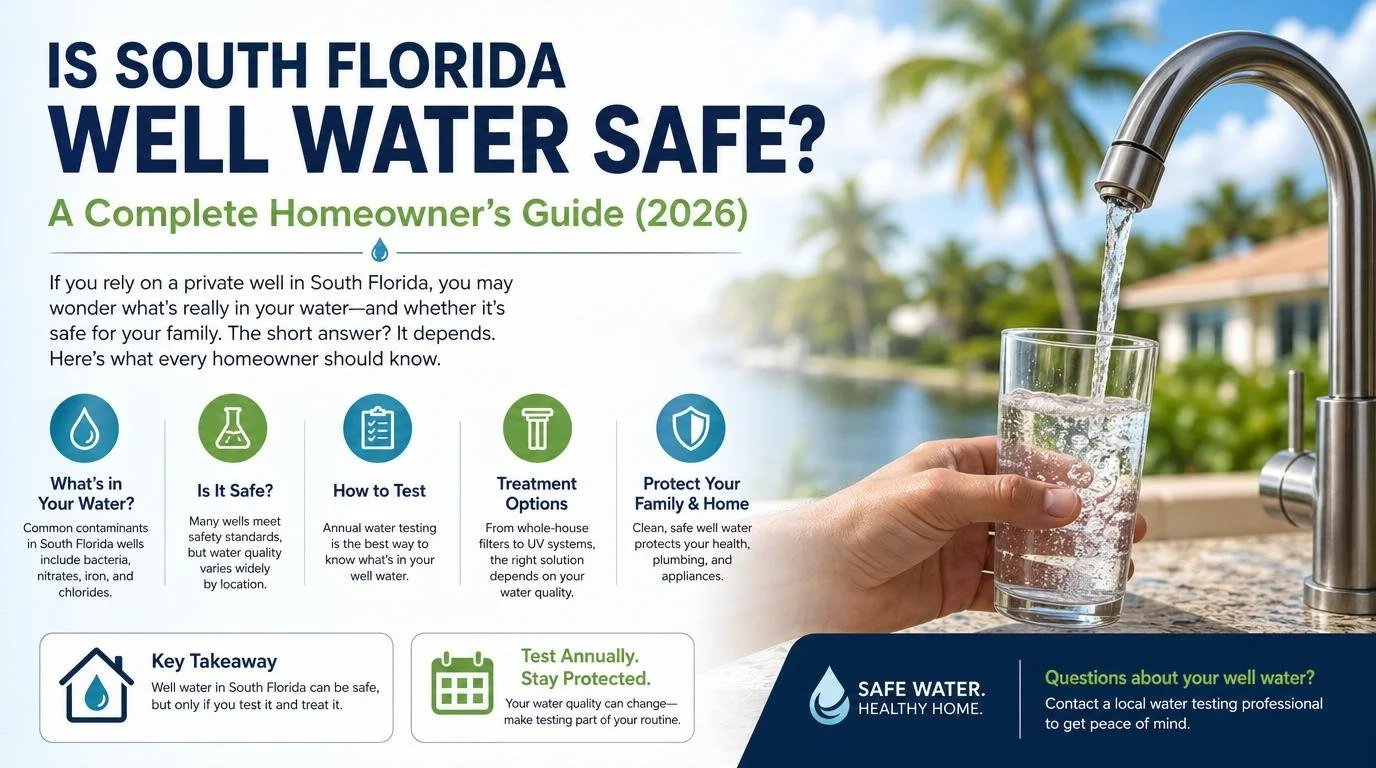
By Jared Beviano | Water Wizards Filtration | Delray Beach, FL
There's an assumption I run into regularly when I visit homes with private wells — particularly out in Loxahatchee, The Acreage, Jupiter Farms, western Wellington, and the rural stretches of Broward County west of I-75.
The assumption goes something like this: "It's groundwater. It's natural. It can't be as bad as city water with all those chemicals."
I understand the logic. And honestly, I'd rather gently correct that assumption than let it sit unchallenged — because in South Florida specifically, it doesn't hold up.
Here's the thing that might actually surprise you.
The State of Florida does not require routine testing of private home well water. Nobody — not the county, not the state, not the EPA — is monitoring what's in your well. The Florida Department of Health recommends that you test annually for bacteria and nitrates. They can't make you. And based on what we see in the field, a significant portion of South Florida's private well owners have never had their water professionally tested at all.
That's not a moral failing. Most people don't know that private wells aren't regulated the same way municipal systems are. The 88% of Florida residents on city water get annual Consumer Confidence Reports, thousands of tests per year, and federal oversight. The 12% on private wells get... a recommendation from the DOH website.
You are the only person responsible for knowing what's in your water. That's worth sitting with for a moment.
Why South Florida Wells Are Uniquely Vulnerable
Not all private wells face the same risks. A deep well in granite country in New Hampshire faces different challenges than a shallow well in South Florida's limestone aquifer. Our wells are harder to protect — for reasons that are worth understanding.
The Biscayne Aquifer is shallow and extraordinarily permeable. The surficial aquifer that supplies most South Florida private wells sits just feet below ground level in many areas — sometimes as little as 10–20 feet. Water moves through it quickly. So does everything that enters the ground above it.
South Florida is flat and floods. When heavy rain falls — and South Florida gets 60+ inches annually — the water table rises rapidly. Surface contamination that sits in drainage ditches, agricultural runoff channels, and retention ponds can reach well water faster here than in most of the country.
Western Palm Beach County is an active agricultural zone. The Acreage, Loxahatchee, and areas around Wellington sit adjacent to — and in some cases within — one of Florida's most productive agricultural regions. Sugar cane fields, sod farms, citrus groves, vegetable operations. All of them use fertilizers, pesticides, herbicides. Nitrogen-based fertilizers are a primary source of nitrate contamination in groundwater. The limestone geology that makes the aquifer so permeable also means agricultural chemicals can move from fields to wells with minimal filtration.
Septic systems and wells coexist closely in rural areas. In South Florida's unincorporated areas, the same properties often have both a septic system and a private well. State regulations require minimum separation distances, but older properties predate current standards. A failing septic system — which happens — can introduce bacteria, viruses, and nitrates into nearby groundwater.
PFAS is now essentially ubiquitous in South Florida groundwater. The Biscayne Aquifer has been contaminated by PFAS from airport firefighting foam, military installations, industrial sites, and — as FIU researchers documented in 2024 — literally from rainfall. PFAS doesn't respect the boundary between municipal and private water systems.
→ PFAS in South Florida: PFAS "Forever Chemicals" in Palm Beach County Water: What Homeowners Need to Know If it's in the aquifer, it's potentially in your well.
The Contaminants South Florida Well Owners Actually Face
Let me be direct about what we find — and what the risk profile actually looks like — for different well water situations in our region.
Bacteria and Coliform
This is the most common finding in South Florida well water testing, and the one the DOH emphasizes most strongly. Coliform bacteria — total coliform and, more seriously, fecal coliform (E. coli) — indicate that surface water or sewage has entered the well. The bacteria themselves may not always be pathogenic, but their presence is a signal that pathogens could be present.
Sources: failing or inadequately separated septic systems, surface flooding events, livestock and pet waste, poorly sealed well casings.
In The Acreage and Loxahatchee — where large lots frequently have horses, chickens, and other livestock alongside private wells — bacterial contamination testing is particularly important. We recommend testing after every significant flooding event, not just annually.
Bacterial contamination isn't always visible or tasteable. Your water can look crystal clear and still contain E. coli. The only way to know is to test.
Treatment: UV sterilization (destroys bacteria and viruses by damaging their DNA) and, for severe contamination, whole-house filtration with UV as a stage.
Nitrates — The Invisible Threat to Infants
Nitrates in South Florida well water come primarily from fertilizer runoff and septic leaching. They're odorless and tasteless at concerning concentrations. Adults and older children can process nitrates without significant harm at typical groundwater levels. Infants under six months cannot.
When infants consume formula mixed with high-nitrate water, or when nursing mothers drink high-nitrate water, the nitrates can interfere with hemoglobin's ability to carry oxygen — causing methemoglobinemia, or "blue baby syndrome." Severe cases can be fatal.
The EPA limit for nitrates is 10 mg/L. DEP data shows some South Florida agricultural area wells exceeding this — particularly during heavy rain seasons when agricultural runoff enters the aquifer in greater volumes.
Critically: boiling water does not remove nitrates. It concentrates them. The only reliable home treatments are reverse osmosis (85–95% removal) and distillation.
If you have a private well in western Palm Beach or western Broward County, and you have infants in the home, nitrate testing is not optional. It's the test that matters most.
→ On nitrates and infant formula: Is Filtered Water Better for Making Baby Formula in Florida?
Iron and Hydrogen Sulfide — The Problems You Can Smell and See
These are the most immediately noticeable issues in South Florida well water — not necessarily the most dangerous, but the most visible and the ones that drive most initial calls.
Iron: The Biscayne Aquifer naturally contains iron — particularly in the southern Broward and Miami-Dade zones. Dissolved iron (ferrous iron) is invisible in fresh water but turns orange-red when it oxidizes — leaving characteristic rust staining on toilet bowls, sinks, laundry, and irrigation systems. At concentrations above 0.3 mg/L, iron also affects taste and promotes bacterial growth in pipes.
Hydrogen sulfide: Anaerobic bacteria in the aquifer produce hydrogen sulfide as they break down organic matter. The result is the rotten egg smell that many South Florida well users simply accept as normal. It's not dangerous at low concentrations, but at higher levels it's corrosive to copper plumbing, affects taste significantly, and is a sign of other biological activity worth investigating.
Treatment: Oxidizing filter (air injection or ozone-based) for iron and sulfur. These systems oxidize dissolved iron and sulfur compounds so they can be filtered out as particles.
→ On rotten egg smell: Why Does My Florida Water Smell Like Rotten Eggs?
PFAS — The Contaminant Your Well Doesn't Filter
Municipal systems at least treat their water — running it through lime softening, filtration, and disinfection before distribution. Your well draws directly from the aquifer.
The Biscayne Aquifer has documented PFAS contamination throughout South Florida, migrating from airport firefighting foam at Palm Beach International, Fort Lauderdale-Hollywood International, and other sources, plus atmospheric deposition detected in South Florida rainfall by FIU researchers.
Private well water contains whatever the aquifer contains at that location. There's no treatment plant between the aquifer and your tap. If PFAS is in the groundwater at your well's location, it's in your drinking water.
PFAS testing is not part of the DOH's standard annual recommendation (bacteria and nitrates are). It requires a specific lab panel, typically $150–$300. Given South Florida's documented contamination, it's worth including in any comprehensive well water test.
Treatment: Reverse osmosis at 90–99% for PFAS. This is non-negotiable for PFAS — no other common home treatment achieves reliable removal.
Hard Water — Always Present, Always Damaging
Raw Biscayne Aquifer water runs 15–22 GPG in most of South Florida — significantly harder than the partially softened water municipal customers receive. Private well owners get the full, unprocessed hardness.
At 18–22 GPG, the scale buildup on water heaters, dishwashers, washing machines, and plumbing is aggressive. Without a softener, well water users in Palm Beach and Broward County are typically replacing appliances years ahead of schedule.
→ Hard water effects explained: Hard Water vs. Soft Water: What's the Difference and Do You Need a Softener?
Pesticides and Volatile Organic Compounds
Florida DEP has identified over 427,000 acres statewide with known soil and groundwater contamination from industrial solvents, historic citrus fumigants (specifically methyl bromide and ethylene dibromide), and other agricultural chemicals. Some of these contamination plumes have been migrating for decades.
In western Palm Beach County, historic EDB (ethylene dibromide) contamination from citrus fumigation is documented in certain areas. If your property sits within or near a known contamination plume — which DEP maps publicly — VOC testing should be part of your comprehensive panel.
Treatment: Activated carbon filtration for most VOCs and pesticides. Reverse osmosis adds additional protection.
When to Test Your Well — And What to Test For
📅 Annual Testing (Every Year, No Exceptions)
- Total coliform bacteria
- E. coli (fecal coliform)
- Nitrates / Nitrites
- pH
🔬 Every 3 Years (Comprehensive Panel)
- Lead and heavy metals
- Iron and manganese
- Hydrogen sulfide
- Hardness and TDS
- Arsenic
- Volatile organic compounds (VOCs)
- pH, alkalinity, turbidity
☣️ Once (or When Moving to a New Property)
- PFAS panel (29+ compounds)
- Pesticides and herbicides (if near agricultural areas)
- Ethylene dibromide / EDB (if in historic citrus areas)
- Radon (if deeper well)
⚡ Test Immediately If Any of These Occur
- Significant flooding or standing water near the well
- New taste, odor, or color change in water
- Illness in household members that might be water-related
- Nearby septic system failure or sewage spill
- Agricultural chemical spill in surrounding area
- Well pump replacement or well repair work
- Purchasing a home with a private well (always test first)
What a Complete Well Water Treatment System Looks Like
This is where I want to be direct: there is no such thing as a standard well water treatment system. The right setup depends entirely on what your test reveals. Guessing at a treatment system for well water is like guessing at a prescription without a diagnosis.
That said, here's the typical treatment stack for South Florida well water with common findings:
Stage 1 — Sediment pre-filter (5–20 micron) Removes sand, silt, rust particles, and particulate matter before they reach other treatment stages. Protects downstream equipment. Cost: $150–$300 installed.
Stage 2 — Iron / hydrogen sulfide removal (oxidizing filter) Air injection or ozone-based oxidizing system converts dissolved iron and sulfur compounds to particles that can be filtered. Essential for wells with orange staining or rotten egg odor. Cost: $800–$2,000 installed.
Stage 3 — Catalytic carbon filter Removes pesticides, VOCs, herbicides, chlorination byproducts if any disinfection is applied, and remaining taste and odor compounds. Also reduces some PFAS (long-chain). Cost: $600–$1,500 installed.
Stage 4 — Water softener (48,000–64,000 grain for South Florida) Removes calcium and magnesium hardness from raw aquifer water at 15–22 GPG. Essential for appliance protection. Cost: $1,200–$2,500 installed.
Stage 5 — UV sterilization Kills bacteria, viruses, and other pathogens with UV light — without adding chemicals. Essential for any well with bacterial concerns or in areas with septic proximity. Cost: $400–$900 installed.
Stage 6 — Under-sink reverse osmosis (drinking water) Final stage for drinking and cooking water. Removes PFAS (90–99%), nitrates (85–95%), lead (95–99%), arsenic (95–99%), and any remaining dissolved contaminants. Cost: $400–$700 installed.
Complete system total: $4,000–$8,000+ installed, depending on what the test reveals and which stages are required. Not every well needs every stage. A well with no iron or sulfur skips Stage 2. A well with excellent bacterial results might not require UV. The test determines the system.
→ RO installation costs: How Much Does Reverse Osmosis Installation Cost in Florida? → Full cost breakdown: How Much Does a Whole House Water Filtration System Cost in Florida?
→ City vs well water differences: Well Water vs. City Water in Palm Beach County: Different Challenges, Different Solutions
The Home-Buying Situation — Never Skip This
If you are purchasing a home with a private well in South Florida — and this is non-negotiable — have the water tested before closing.
Most FHA, VA, and USDA mortgage lenders require well water testing anyway. But even conventional buyers who aren't required to test should insist on it. Here's why.
A seller's disclosure tells you what the seller knows about the well. It doesn't tell you what's in the water. Water chemistry doesn't appear in a home inspection. The well pump might work perfectly and deliver water that contains nitrates at 15 mg/L — 50% above the EPA limit — and nobody would know without testing.
The cost of a comprehensive well water test: $150–$400. The cost of discovering a contamination problem after closing: potentially tens of thousands in remediation, filtration, or in extreme cases, connecting to municipal water.
Ask for a 30-day testing contingency. Most sellers in well-water areas understand the request. If they don't — that's information too.
South Florida Well Water by Zone — What We See
Different areas have different risk profiles based on geology, land use, and proximity to contamination sources.
| Area | Primary Concerns | Risk Level | Priority Tests |
|---|---|---|---|
| Loxahatchee / The Acreage (western PBC) | Nitrates (ag runoff), bacteria (livestock + septic), iron, hardness, PFAS | High | Bacteria, nitrates, PFAS panel, iron, VOCs |
| Jupiter Farms | Bacteria, iron, hydrogen sulfide, hardness, PFAS migration | High | Bacteria, iron/sulfur, PFAS, nitrates |
| Wellington equestrian area (unincorporated) | Nitrates (manure), bacteria, hardness, iron | High | Nitrates, bacteria, hardness, iron |
| Western Broward (Davie, Southwest Ranches, Weston outskirts) | Hardness, iron, PFAS (airport proximity), bacteria | Medium-High | PFAS panel, bacteria, hardness, iron |
| Western Miami-Dade (Homestead, Redland, South Dade) | Pesticides / herbicides (ag zone), nitrates, bacteria, EDB (historic citrus) | High | VOC/pesticide panel, nitrates, bacteria, EDB |
| Martin County / rural St. Lucie | Iron, hydrogen sulfide, hardness, bacteria, tannins | Medium | Bacteria, iron/sulfur, tannins, hardness |
| Coastal / near-coastal well zones | Saltwater intrusion (chlorides), hardness, bacteria | Medium | Chlorides, hardness, bacteria, TDS |
The "Natural Water" Conversation
I want to return to where we started — the assumption that well water is somehow purer or more natural than city water.
Here's the honest version of that conversation.
Well water can be excellent. In areas with deep wells, good geology, low agricultural pressure, and no nearby contamination sources, private well water is often genuinely cleaner than treated municipal water — no chloramine taste, no disinfection byproducts, no PFAS from airport firefighting foam.
But in South Florida specifically — with its shallow aquifer, its agricultural zones, its septic-dense rural areas, its PFAS-contaminated groundwater, and its flooding climate — "natural" doesn't mean "uncontaminated." It means untreated and untested.
The people I worry about most are the ones who haven't tested their well in years, have young children at home, are near agricultural land, and are confident their water is fine because it looks and smells okay. Iron staining and hydrogen sulfide smell are obvious. Nitrates, bacteria, and PFAS are invisible.
The DOH recommendation — test annually for bacteria and nitrates — exists because these are the most common and most time-sensitive risks. It's not the ceiling of what you should do. It's the floor.
Frequently Asked Questions
Is private well water safe to drink in South Florida? It depends entirely on what's in your well — which requires testing to determine. South Florida's shallow, permeable Biscayne Aquifer is vulnerable to contamination from agricultural runoff (nitrates, pesticides), septic system leaching (bacteria), livestock operations (bacteria, nitrates), and regional PFAS contamination. Florida does not require routine private well testing, so many homeowners don't know the current quality of their water. Annual testing for bacteria and nitrates is the minimum DOH recommendation.
How often should I test my well water in Florida? The Florida DOH recommends testing private wells annually for bacteria (total coliform, E. coli) and nitrates. A comprehensive panel including lead, iron, hardness, VOCs, and arsenic is recommended every three years. PFAS testing — a separate certified lab panel — should be done at least once, particularly in South Florida where aquifer contamination is documented. Test immediately after flooding, after any change in taste/odor/color, or when purchasing a property.
What are the most common contaminants in South Florida well water? Based on field experience and Florida DOH data: bacteria (coliform, E. coli) from septic systems and livestock, nitrates from agricultural fertilizers and septic leaching, iron and hydrogen sulfide from the Biscayne Aquifer's geology, hardness (15–22 GPG) from limestone geology, and PFAS from regional groundwater contamination. In agricultural areas (Loxahatchee, western Miami-Dade), pesticides and herbicides are also a concern.
Does boiling well water make it safe? Boiling kills bacteria and pathogens effectively. It does not remove nitrates, PFAS, heavy metals, pesticides, or chemical contaminants — and it concentrates them as water evaporates. Boiling is a partial solution for biological contamination only, and should not replace proper filtration.
What filter is best for South Florida well water? There's no universal answer — the right system depends on your water test results. A comprehensive system for typical South Florida well water with multiple concerns (bacteria, iron, hardness, PFAS) typically includes: sediment pre-filter, iron/sulfur removal filter, water softener, UV sterilization, and under-sink reverse osmosis for drinking water. Total installed cost: $4,000–$8,000 depending on well water profile and which stages are required.
Do I need a water softener if I'm on a private well in Palm Beach County? Almost certainly yes. Raw Biscayne Aquifer water runs 15–22 GPG of hardness — significantly harder than the partially treated municipal water city customers receive. Without softening, scale buildup on appliances and plumbing in South Florida well water homes is aggressive and expensive over time.
Start With the Test — Everything Else Follows From That
→ What's in South Florida water overall: What's Actually in Your South Florida Tap Water?
The single most important thing any South Florida well owner can do is get a comprehensive water test. Not because your water is definitely unsafe — it may be fine. But because "probably fine" and "confirmed safe" are genuinely different things when you're talking about what your family drinks every day.
We offer free in-home consultations for well water clients throughout Palm Beach, Broward, and Martin County. For bacterial and nitrate testing, we can connect you with local certified labs. For PFAS and comprehensive panels, we arrange certified laboratory testing and interpret the results with you.
From there, we recommend exactly what your water needs — not a generic well water package, but a system built around your specific test results.
Book Your Free Water Consultation → 561-352-9989
Water Wizards Filtration | Delray Beach, FL | Serving Palm Beach · Broward · Martin County
Sources: Florida Department of Health — Private Well Testing; Florida Department of Health — Private Well Water Systems; DrillerDB — Florida Private Well Guide (2025); FIU News — PFAS in South Florida rainfall (November 2024); Florida DEP — Source Water Assessment and Protection Program; The Invading Sea — PFAS in Florida drinking water (December 2024); EPA — National Primary Drinking Water Regulations; Florida Inspections Unlimited — South Florida well water testing