Commercial Water Filtration for Restaurants in South Florida
Published by Jared Beviano · Water Wizards Filtration
I got a call from a restaurant owner in Pompano Beach last spring. He'd just replaced his commercial ice maker — $4,200, six months after installation. The technician told him the machine failed because of scale buildup. He'd replaced the same machine eighteen months before that for the same reason.
He was about to buy a third one.
I drove out, tested his water, and showed him what was happening. Broward County Water and Wastewater Services. 15 GPG hardness. No filtration anywhere in the building. Every gallon of water going through that ice maker was carrying dissolved calcium and magnesium that precipitated as scale the moment it hit the heating and cooling surfaces inside the machine.
A whole-house carbon filter and water softener installed for $3,200 — less than the cost of that ice maker he was about to replace — solved the problem. Two years later, same machine, still running.
That's commercial water filtration in South Florida in one story. You're either paying for treatment upfront, or you're paying for it through destroyed equipment, service calls, and water that tastes wrong coming out of your taps.
Why South Florida Is Harder on Commercial Equipment Than Almost Anywhere Else
Most restaurant owners know that Florida water is hard. What they don't know is exactly how hard — and what that means for a commercial operation running equipment eight to sixteen hours a day.
Miami-Dade WASD delivers water at 22.4 GPG — 383 parts per million of dissolved calcium and magnesium. That's 3.6 times the national average and the hardest treated municipal water in South Florida. Palm Beach County Water Utilities runs 15–18 GPG. Broward County Water and Wastewater Services runs 14–16 GPG.
For context: water is considered "hard" at 7 GPG. Your restaurant is running on water two to three times past that threshold, through equipment that runs constantly, at temperatures that accelerate mineral precipitation.
Scale forms faster at higher temperatures. Every piece of equipment in your kitchen that heats water — your commercial dishwasher, your steam oven, your combi oven, your espresso machine, your ice maker, your prep sink water heater — is a scale accumulation machine. At 22.4 GPG, scale builds at a rate that would take years in a low-hardness market happens in months in South Florida.
And that's before we talk about what else is in the water.
What's Actually Coming Out of South Florida Restaurant Taps
Hardness is the most visible problem. It's not the only one.
Miami-Dade WASD (Miami, Doral, Hialeah, Aventura, 30+ cities):
Hardness: 22.4 GPG
PFOS: 18.98 ppt — 4.7× the EPA's legal limit
TTHMs and HAAs: above EWG cancer guidelines
Chloramine disinfection: creates the chemical taste your customers notice in their water glass and their coffee
Broward County Water and Wastewater Services (Fort Lauderdale, Pembroke Pines, Coral Springs):
Hardness: 14–16 GPG
Chromium-6: above EWG cancer guideline
HAAs and TTHMs: above EWG guidelines
PFAS: above EWG health guidelines
Palm Beach County Water Utilities (Boca Raton, Boynton Beach, Wellington):
Hardness: 15–18 GPG
Chlorate: above EWG thyroid health guideline
Chromium-6 and PFAS: above EWG guidelines
TTHMs and HAAs: above EWG guidelines
Every one of these systems uses chloramine disinfection. Chloramine is stable, which is why utilities prefer it. It's also harder to remove than free chlorine, and it produces a distinct chemical taste in water and beverages — the taste your customers notice when they drink a glass of tap water, order a coffee, or get ice in their cocktail.
The Equipment Damage You're Already Paying For
Here's the math most restaurant owners have never run.
Commercial ice maker: Expected lifespan with quality water: 7–10 years. Average lifespan in unfiltered South Florida water: 3–4 years. Replacement cost: $3,000–8,000. Annual cost of premature failure: $500–1,500.
Commercial dishwasher: Scale on heating elements, spray arms, and pumps. Scale-coated heating elements use 20–30% more energy to reach operating temperature. Annual energy premium on a commercial unit: $800–1,500. Accelerated element replacement: $300–600 every 18 months instead of every 5 years.
Steam oven / combi oven: Scale in steam generators causes the most expensive failures in commercial kitchen equipment. A scale-blocked steam generator fails completely — it doesn't degrade gracefully. Replacement cost: $500–2,000 for the component. Downtime cost during service: potentially higher.
Espresso machine: A commercial espresso machine running on unfiltered South Florida water needs descaling every 2–3 months. Each descaling service runs $150–300. At 22.4 GPG, the boiler and group heads accumulate scale fast enough that some operators descale monthly. Annual descaling cost: $600–1,800, plus the accelerated wear on seals and internal components.
Water heater: Commercial water heaters in unfiltered South Florida buildings fail in 4–6 years. With proper treatment: 10–15 years. At $1,500–4,000 per commercial unit, that's significant.
EquipmentExpected life (filtered)Expected life (unfiltered in SFL)Annual cost of premature failureCommercial ice maker8–10 years3–4 years$500–1,500Commercial dishwasher10–12 years5–7 years$400–800Steam / combi oven10–15 years5–8 years$300–700Espresso machine8–10 years4–6 years$600–1,800Commercial water heater10–15 years4–6 years$250–600Total annual equipment cost$2,050–5,400
That's what unfiltered water costs a typical South Florida restaurant in equipment damage alone — before service calls, before energy premiums, before the staff time spent managing equipment issues.
The Taste Problem Your Customers Are Noticing
Equipment damage is quantifiable. The taste problem is harder to measure but potentially more costly.
Chloramine at South Florida municipal levels produces a chemical, pool-like taste in water. It's the taste your customers get when they ask for a glass of water and you hand them a glass of tap. It's the taste in your coffee, your tea, your fountain drinks, your cocktails made with ice from an unfiltered machine.
Restaurants spend thousands on quality ingredients and then serve them in water that tastes like a swimming pool. The chloramine in the water interacts with coffee grounds, tea, and spirits in ways that flatten flavor profiles and add off-notes that no amount of sourcing quality product can overcome.
The specialty coffee industry figured this out years ago. SCA (Specialty Coffee Association) water quality standards specify:
TDS: 75–150 ppm (most South Florida municipal water runs 300–450 ppm)
Hardness: 50–175 ppm (South Florida runs 250–380 ppm)
Zero chlorine or chloramine
pH: 6.5–7.5
South Florida tap water fails every single one of these criteria. If you're serving espresso or specialty coffee on unfiltered municipal water, your water is working against your product regardless of the quality of your beans.
The same principle applies to cooking water. Pasta water, blanching water, stock water, bread dough — all of these are affected by the mineral content and chemical profile of the water. High TDS water changes pasta texture. High calcium water strengthens gluten formation in ways that require recipe adjustment. Chloramine suppresses yeast activity in bread dough.
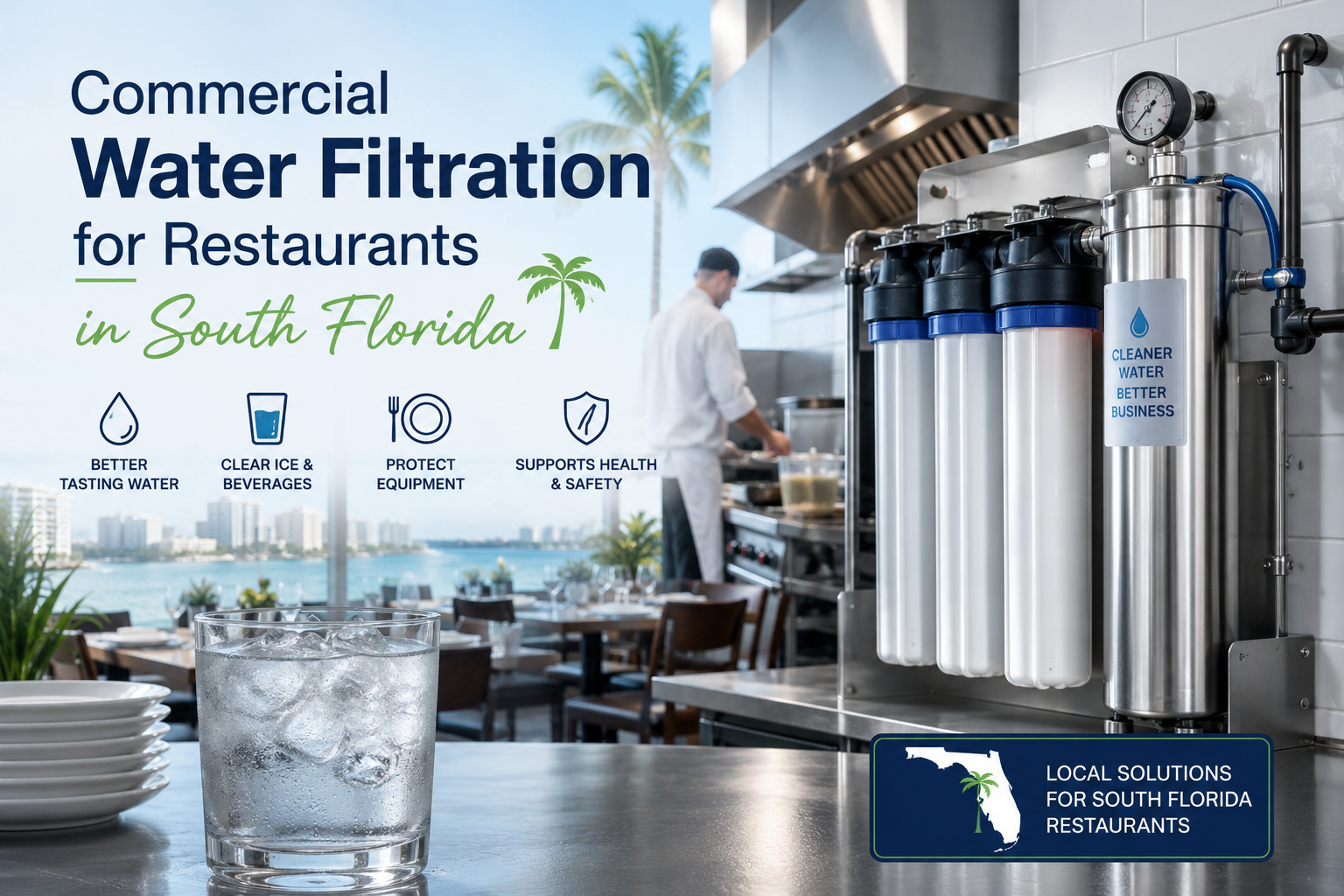
What Commercial Water Filtration Actually Looks Like
The setup depends on your operation size and your specific water chemistry. There's no universal answer, but here's how I structure most South Florida restaurant installations.
Point-of-Entry Treatment (Whole Building)
Water softener: Addresses hardness at the building level. Every piece of equipment that uses water gets softened water. Scale stops forming. Equipment lives longer. Energy costs drop. For a typical South Florida restaurant on municipal water, a commercial-grade softener runs $2,500–5,000 installed. ROI is typically 12–18 months based on equipment protection alone.
Catalytic carbon filter: Removes chloramine and chlorine from the whole building supply. This is the treatment that fixes the taste problem at the source — before the water reaches any tap, any ice maker, any espresso machine. Cost: $1,500–3,000 installed.
Point-of-Use Treatment (Specific Equipment)
Under-counter RO for beverage stations: Coffee, espresso, tea, fountain drinks — all running on RO water. TDS drops from 300–450 ppm to 20–50 ppm. Chloramine removed. Taste transforms. A commercial under-counter RO for a single station runs $800–2,000 installed. For a coffee-focused operation, this is where the most immediate customer-facing ROI shows up.
Ice machine filter: A dedicated pre-filter on your ice maker removes sediment, chloramine, and scale-causing minerals at the point of entry. Commercial ice machine filters run $400–800 installed and require cartridge replacement every 6 months.
Dishwasher rinse aid optimization: Soft water dramatically reduces rinse aid consumption — some operators cut rinse aid use by 30–50% after softening. Reduces chemical costs and improves dish clarity.
The Full System for a Mid-Size Restaurant
ComponentPurposeInstalled CostCommercial water softenerScale prevention, equipment protection$2,500–5,000Catalytic carbon filterChloramine / taste removal$1,500–3,000RO for beverage stationEspresso, coffee, filtered water service$800–2,000Ice machine pre-filterScale and sediment on ice maker$400–800Total$5,200–10,800Annual maintenanceFilter replacements, salt, service$600–1,200
Compare that to $2,050–5,400 per year in equipment damage, plus energy premiums, plus the taste problem you're currently serving your customers. The math is not close.
Florida Health Code and Water Quality
One more angle restaurant owners don't always consider: compliance.
Florida Department of Business and Professional Regulation (DBPR) requires that all food service establishments provide safe, clean water for food preparation, handwashing, and equipment. The standard is "potable water" — which means water meeting federal and state MCLs.
Municipal water meets federal MCLs. But your on-site filtration system, once installed, becomes part of your food service operation and needs to be maintained. A neglected filtration system — expired filter cartridges, fouled media, bypassed equipment — can actually introduce contamination rather than remove it and create compliance issues during inspections.
Properly maintained commercial filtration systems are an asset during health inspections, not a liability. Inspectors note when operators have invested in water quality. They also note when filtration equipment is present but clearly unmaintained.
The Right First Step
If you're a South Florida restaurant owner and you've never had your water tested commercially, that's the starting point. Not a filter purchase. A test.
Your specific water chemistry determines your specific treatment needs. A restaurant in Miami-Dade running espresso machines has different priorities than a seafood restaurant in Boca Raton running a commercial steamer. The hardness numbers are different. The contaminant profile is different. The equipment mix is different.
We do commercial water testing at no charge throughout Palm Beach, Broward, and Miami-Dade counties. Thirty minutes, your kitchen, a complete picture of what you're working with and what it's costing you.
Most restaurant owners who go through this process for the first time are surprised — not that the water has issues, but that the numbers make the filtration investment so obviously worth it.
Call 561-352-9989 to schedule a commercial water test
Water Wizards Filtration serves restaurants, coffee shops, hotels, and food service businesses throughout South Florida. We install, maintain, and service commercial water treatment systems across Palm Beach, Broward, and Miami-Dade counties.