
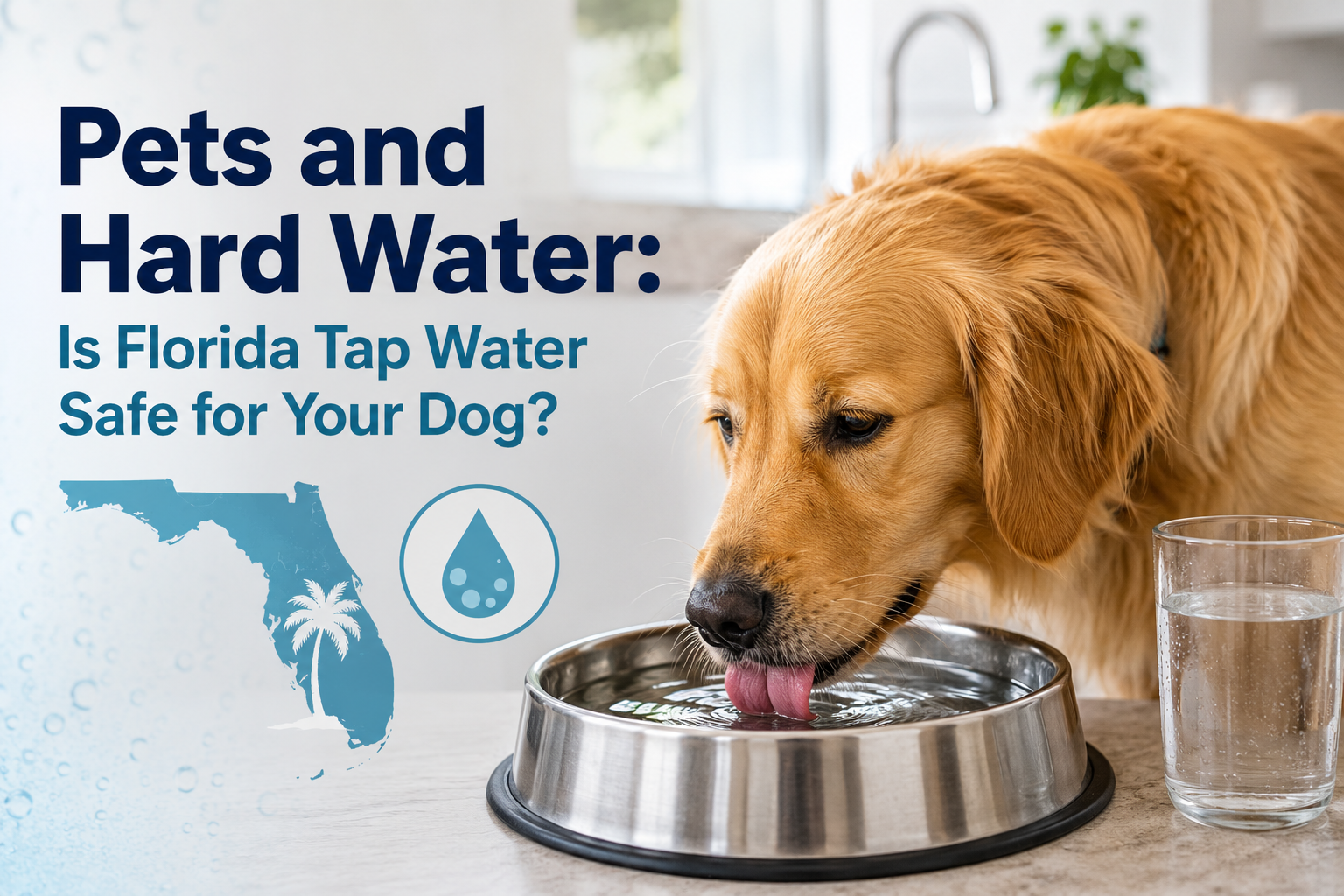
Pets and Hard Water: Is Florida Tap Water Safe for Your Dog?
Published by Jared Beviano · Water Wizards Filtration
My customer in Coral Springs had been to the vet three times in eight months for the same problem: her Golden Retriever kept developing urinary crystals. The vet had changed the dog's food twice, suggested a prescription diet, and run every test imaginable. Nobody mentioned the water.
I tested it on a routine visit for a softener check. Palm Beach County Water Utilities. 17 GPG hardness. Calcium through the roof. Magnesium elevated. The dog was drinking a liter and a half of extremely hard water every day, and the calcium was contributing directly to the crystal formation the vet couldn't explain.
We installed a water softener. Six months later — no new crystals. Same food, same dog, same house. Different water.
I'm not a vet and I'm not claiming hard water causes urinary crystals in every dog. But I am telling you that water quality is almost never part of the conversation when pets get sick, and it probably should be.
Here's what I know after years of testing South Florida water and talking to pet owners about what their animals are actually drinking.
What Your Dog Is Actually Drinking
A medium-sized dog — say, a 50-pound Labrador — drinks roughly 25–50 ounces of water per day under normal conditions. In Florida summer heat, that can double. A large dog, an active dog, a nursing dog — even more.
That's a significant daily intake of whatever is in your water. And in South Florida, what's in your water is not nothing.
Miami-Dade WASD (serving Miami, Doral, Hialeah, and 30+ other cities):
PFOS: 18.98 ppt — 4.7× the EPA's legal limit
PFOA: 7.2 ppt — above EPA MCL
Hardness: 22.4 GPG — hardest municipal water in South Florida
TTHMs: above EWG cancer guidelines
Arsenic and chromium-6: above EWG health guidelines
Palm Beach County Water Utilities (Wellington, Boynton Beach, and surroundings):
Hardness: 15–18 GPG
Chlorate: above EWG thyroid guidelines
Chromium-6: above EWG cancer guidelines
TTHMs and HAAs: above EWG guidelines
Delray Beach Water Department:
Arsenic: 175× EWG's no-risk guideline
Chromium-6: 11× EWG's cancer guideline
PFOS detected above EWG guidelines
Your dog doesn't know any of this. They drink what's in the bowl. They drink it multiple times a day, every day, for their entire life. The cumulative exposure is real — and the research on long-term effects in animals is more developed than most pet owners realize.
Hard Water: The Daily Grind
Let's start with hardness because it's universal across South Florida and it's the most underestimated issue.
Hard water contains high levels of dissolved calcium and magnesium — minerals that are technically not toxic but accumulate in the body over time. For humans, hard water is associated with kidney stones. For dogs, the connection is more direct and more documented.
Urinary crystals and stones: Calcium oxalate stones are the most common urinary stones in dogs, and they're directly linked to high calcium intake — including from water. Breeds with genetic predisposition (Miniature Schnauzers, Yorkshire Terriers, Bichon Frises, Shih Tzus) are at significantly higher risk. High-hardness water adds calcium load on top of dietary calcium, which the kidneys then have to process and excrete. At 22.4 GPG, Miami-Dade water delivers a meaningful daily calcium burden.
Kidney function: Dogs process minerals through their kidneys just like humans do. Chronically elevated mineral intake — calcium, magnesium, and the other dissolved solids in hard water — increases the workload on kidneys over time. For older dogs or breeds prone to kidney disease (Cocker Spaniels, Bull Terriers, German Shepherds), this matters more.
Digestion: Some dogs are sensitive to highly mineralized water. Loose stools, upset stomach, and inconsistent digestion — particularly noticeable when traveling and drinking different water — can signal mineral sensitivity.
The scale you see on their bowl: That white residue that builds up inside your dog's water bowl is calcium carbonate — the same mineral that scales your showerhead and clogs your dishwasher. If it's forming on the bowl, it's going through your dog's body.
The Contaminant Question
Hard water is a nuisance problem. The contaminants are a different category.
PFAS ("Forever Chemicals")
PFAS compounds — PFOS, PFOA, and dozens of related chemicals — are present above health guidelines in multiple South Florida water systems. They're called forever chemicals because they don't break down in the environment or in the body. They accumulate.
Research in animals is actually more extensive than research in humans for PFAS — partly because animal studies preceded human epidemiological work. What the research shows:
PFAS compounds accumulate in liver, kidney, and thyroid tissue
Long-term exposure is associated with liver damage, thyroid disruption, immune suppression, and cancer in animal studies
Dogs appear to be more sensitive to PFAS than humans — they have higher absorption rates and slower elimination
A dog drinking Miami-Dade WASD water — PFOS at 4.7× the EPA's human MCL — is getting daily PFAS exposure. There is no established safe level for PFAS in dogs. The EPA's human MCL of 4 ppt was set based on human body weight and physiology. A 20-pound dog drinking the same water as a 150-pound human is getting a very different dose-to-bodyweight ratio.
Arsenic
Dogs are highly sensitive to arsenic. The lethal dose for dogs is lower than for humans, and chronic low-level exposure is associated with peripheral nerve damage, skin lesions, and cancer. Arsenic in Delray Beach water at 175× EWG's no-risk guideline should concern pet owners specifically — EWG's guideline is based on human cancer risk, and dogs are more vulnerable.
Chloramine
WASD and most South Florida utilities use chloramine for disinfection rather than free chlorine. Chloramine is more stable in distribution, which is why utilities prefer it. It's also harder on the body than free chlorine — harder to remove with standard filtration, and more irritating to the gastrointestinal tract.
Some dogs show GI sensitivity to chloraminated water — vomiting, loose stools, appetite changes. Fish are extremely sensitive to chloramine (it's acutely toxic to aquatic life), which is why aquarium owners always dechlorinate. The effect on dogs is subtler but not zero.
Nitrates
Private well owners in The Acreage, Loxahatchee Groves, and rural Broward face nitrate contamination from agricultural runoff. Nitrates are dangerous for puppies the same way they're dangerous for human infants — they interfere with blood oxygen transport. For adult dogs, elevated nitrates are associated with thyroid disruption and reproductive issues.
What the Research Actually Says
Contaminant Effect in Dogs Risk Level High hardness (calcium) Urinary crystals, kidney stone formation, increased kidney workload Medium — breed dependent PFAS (PFOS/PFOA) Liver damage, thyroid disruption, immune suppression, cancer High — dogs more sensitive than humans Arsenic Nerve damage, skin lesions, GI distress, cancer High — dogs more sensitive than humans Chloramine GI irritation, appetite changes in sensitive dogs Low-Medium Nitrates Methemoglobinemia in puppies, thyroid disruption High for puppies, medium for adults Lead Neurological damage, behavioral changes, kidney damage High — same as humans Chromium-6 Cancer risk (long-term), GI irritation Medium-High TTHMs GI and liver effects with chronic exposure Medium
| Contaminant | Effect in pets | Risk level | Who's most at risk | Solution |
|---|---|---|---|---|
| PFAS (PFOS/PFOA) | Liver damage, thyroid disruption, immune suppression, cancer | 🔴 High | All pets — dogs absorb faster than humans | Under-sink RO |
| Arsenic | Nerve damage, GI distress, skin lesions, cancer | 🔴 High | All pets — lower toxic threshold than humans | Under-sink RO |
| Nitrates | Oxygen transport disruption (puppies), thyroid disruption | 🔴 High | Puppies under 12 weeks, pregnant dogs | Under-sink RO |
| Lead | Neurological damage, behavioral changes, kidney damage | 🔴 High | All pets — especially young animals | Under-sink RO |
| High hardness (calcium) | Urinary crystals, kidney stones, increased kidney workload | 🟡 Medium | Schnauzers, Yorkies, Bichons, Shih Tzus — stone-prone breeds | Water softener + RO |
| Chromium-6 | GI irritation, long-term cancer risk | 🟡 Medium | All pets with long-term exposure | Under-sink RO |
| TTHMs / HAAs | GI and liver effects with chronic daily exposure | 🟡 Medium | All pets — cumulative over years | Carbon filter + RO |
| Chloramine | GI irritation, appetite changes in sensitive animals | 🟢 Low–Med | Sensitive dogs, cats, aquarium fish (acutely toxic to fish) | Catalytic carbon filter |
| Chlorate | Thyroid interference with chronic exposure | 🟢 Low–Med | Dogs with thyroid conditions | Under-sink RO |
Signs Your Dog's Water May Be Affecting Them
These aren't definitive — all of these symptoms have many possible causes. But if your dog has any of the following and you're on unfiltered South Florida water, water quality deserves a look:
Urinary issues:
Frequent urination or straining
Blood in urine
Recurrent UTIs
Urinary crystals (confirmed by vet)
Digestive issues:
Chronic loose stools without clear dietary cause
Intermittent vomiting
Drinking less water than expected (palatability issue — dogs will avoid water that tastes or smells wrong)
Skin and coat:
Dull, dry coat that doesn't respond to dietary changes
Itchy skin without allergy diagnosis
Hard water residue on the coat after bathing (same as hard water on human hair)
General health:
Lethargy without diagnosis
Elevated liver enzymes on blood work without clear cause
Thyroid issues (particularly relevant if PFAS is elevated in your water)
What Filtered Water Actually Does for Pets
I've had customers tell me their dogs started drinking significantly more water after they installed an RO system. The dog that used to be coaxed to drink enough suddenly can't stay away from the bowl.
That's not surprising. Dogs have sensitive noses — far more sensitive than ours. If the water smells like chloramine or hydrogen sulfide or iron, they know before we do. Animals that appear to be under-drinking are often avoiding water that smells or tastes wrong to them.
Under-sink RO: Removes PFAS (90–99%), arsenic (90–96%), nitrates (85–95%), chromium-6 (95–99%), lead (95–98%), and essentially all dissolved minerals including hardness. The water coming out of an RO tap is essentially pure — dogs and cats typically drink more of it.
Water softener: Replaces calcium and magnesium with sodium through ion exchange. Softer water is gentler on the kidneys and eliminates the calcium load that contributes to urinary crystals. Note: softened water has elevated sodium — typically 20–30 mg/L for treated South Florida water. For dogs with heart or kidney disease on sodium-restricted diets, discuss with your vet. For healthy dogs, this sodium level is not a concern.
Whole-house carbon filter: Removes chloramine and chlorine, TTHMs, and improves taste and smell. Dogs and cats notice immediately — palatability improves, water intake often increases.
Cats Too — And Fish, And Birds
Everything above applies to cats, but with one important difference: cats are even more dehydration-prone than dogs and even pickier about water quality. A cat that's drinking too little is at serious risk for urinary tract disease and kidney failure — the leading cause of death in older cats. Filtered water that tastes better increases voluntary water intake. For cats, that's not a nice-to-have.
Fish: I mentioned this above — chloramine is acutely toxic to fish. If you have an aquarium and you're topping it off or doing water changes with tap water, you need to dechlorinate specifically for chloramines, not just free chlorine. Standard dechlorinators like Prime handle chloramines. An RO system with remineralization is what serious aquarium keepers use.
Birds: Parrots and other birds are sensitive to heavy metals, chlorine, and PFAS. Their small body weight means the dose-to-weight ratio is significant. An RO tap for bird water is worth it.
Reptiles: Similar to fish — chloramine is problematic. Tap water conditioner or RO.
The Simple Fix
For most South Florida pet owners, the priority list is:
1. Under-sink RO at the kitchen tap — fill the pet bowl from here. Removes PFAS, arsenic, nitrates, hardness, and essentially everything else. $400–900 installed. This is the most impactful single thing you can do for your pet's water quality.
2. Water softener — addresses the calcium and magnesium load. Particularly important for breeds prone to urinary crystals. $1,400–2,500 installed.
3. Whole-house carbon filter — improves taste and smell for chloramine-heavy municipal water. Cats and dogs drink more when the water smells right. $1,200–2,200 installed.
If budget is limited, start with the RO tap and fill your pet's bowl from it. It's $400–900 and it addresses the most serious contaminants — PFAS, arsenic, nitrates — at the point where your pet actually drinks.
A Note for Vets
If you're a veterinarian reading this — I'm not trying to tell you your job. But water quality is almost never part of the intake conversation, and in South Florida specifically, it probably should be. PFAS at 4.7× the EPA limit in Miami-Dade water, arsenic at 175× EWG's guideline in Delray Beach, chloramine throughout most of South Florida's municipal systems — these are real exposures that your patients accumulate every day.
When a dog presents with unexplained urinary crystals, elevated liver enzymes, thyroid dysfunction, or chronic GI issues, asking about water source and filtration costs nothing. A water test costs $100. It might save months of diagnostic dead ends.
The dog in Coral Springs is doing fine, by the way. Last I heard — no crystals for over a year. The vet is pleased, the owner is pleased, and the Golden Retriever is probably pleased too, even if he doesn't know why his water bowl tastes different now.
Animals can't tell you what's wrong with their water. But they're drinking it every day, and what's in it matters.
Call 561-352-9989 for a free water test
