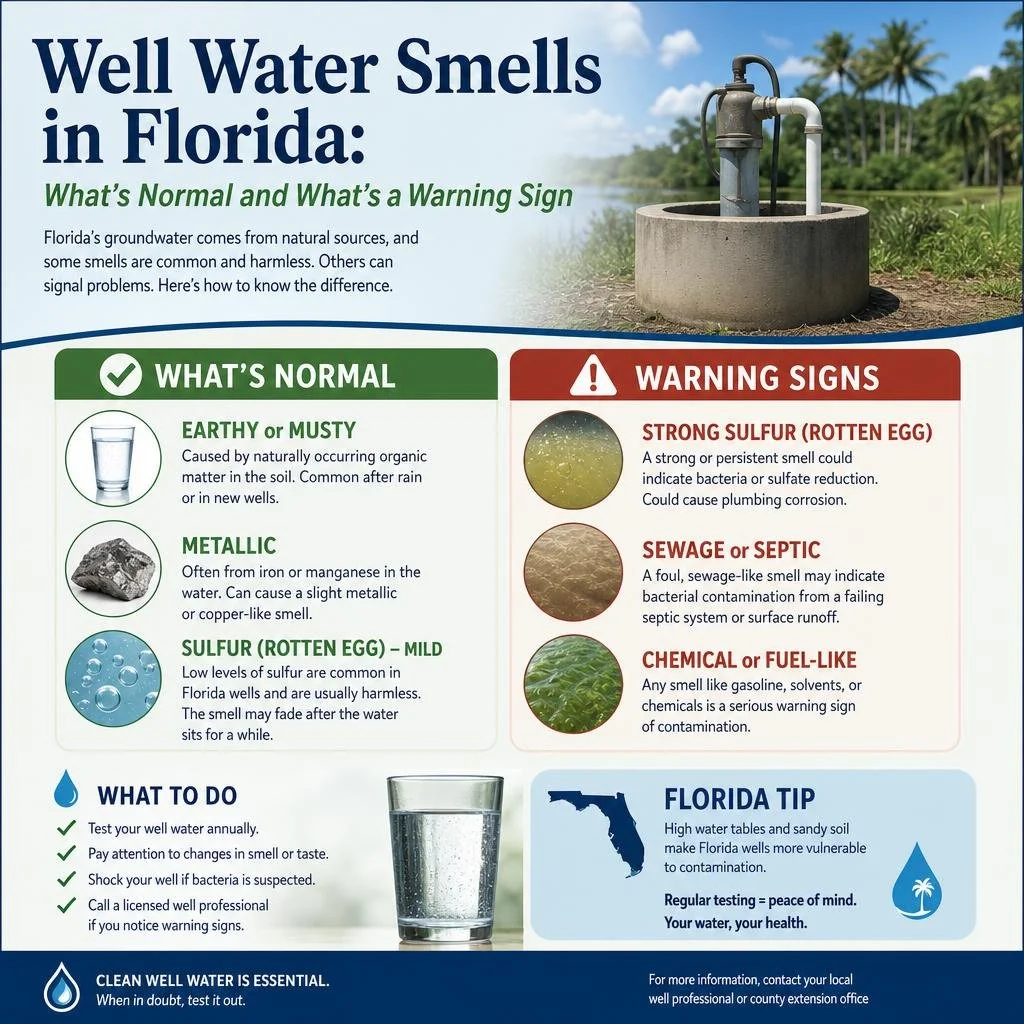
Well Water Smells in Florida: What's Normal and What's a Warning Sign
Published by Jared Beviano · Water Wizards Filtration
A woman in Loxahatchee called me two summers ago. She'd been on well water her whole life, grew up in the house, never thought much about it. But her daughter had just moved back from Boca Raton — city water her whole adult life — and within a week of being home she refused to drink from the tap.
"My daughter says it smells like something died in the pipes," the woman told me. "But it's always smelled like that. Is that normal?"
I get some version of this call every week.
The answer is almost always the same: what you've normalized isn't necessarily safe, and what's new to you isn't necessarily dangerous. The smell of well water in Florida is one of the most misread signals homeowners deal with. Some smells are genuinely harmless. Some are serious. Most people can't tell the difference without knowing what to look for.
Here's what I've learned testing hundreds of wells across Palm Beach, Broward, and Miami-Dade counties.
First: Why Florida Well Water Smells Different at All
Florida's groundwater comes primarily from the Biscayne Aquifer — a shallow, porous limestone formation that runs under most of South Florida. It's one of the most productive aquifers in the country. It's also one of the most chemically active.
Limestone dissolves. Minerals leach. Organic matter from the surface filters down. Agricultural chemicals from the Everglades Agricultural Area move through the porous rock faster than most people realize. Bacteria colonize the water table. Sulfur compounds form in low-oxygen zones deep underground.
The result is source water that is almost never neutral. It carries a chemical signature from everything it's passed through. That signature shows up as smell.
Municipal water gets treated before it reaches your tap — lime softening, filtration, disinfection. Some smells get removed in treatment. Others get added (chlorine, chloramines). But if you're on a private well, you're drinking groundwater with minimal processing. What's in the aquifer is what comes out of your faucet.
That's not automatically a problem. But it does mean the smell is telling you something, and it's worth knowing what.
The Rotten Egg Smell
This is the most common call I get. That sulfur smell — rotten eggs, sometimes described as sewage or natural gas — is almost always hydrogen sulfide (H₂S).
H₂S forms when sulfate-reducing bacteria break down sulfur compounds in low-oxygen aquifer conditions. Florida's limestone aquifer has plenty of sulfate and plenty of low-oxygen zones. Most wells in western Palm Beach County, The Acreage, Loxahatchee, and rural Broward have some level of hydrogen sulfide. It's the smell that hits you when you turn on the hot water first thing in the morning. Sometimes it's faint. Sometimes it clears a room.
Is it dangerous?
At the concentrations found in most Florida residential wells — 0.5 to 5 ppm — hydrogen sulfide is not acutely toxic through drinking. But several things matter here:
First, H₂S makes water significantly less palatable. Birds and pets will often refuse water with high H₂S. For the same reason, people unconsciously drink less of it — which means chronic mild dehydration in households that haven't addressed the problem.
Second, H₂S is corrosive. It attacks copper pipes, water heaters, fixtures, and any metal components in your plumbing. I've seen water heaters in untreated wells corroded through in four years. The estimated lifespan without treatment is 5–7 years versus 12–15 with proper treatment.
Third, and most importantly, H₂S consumes chlorine. If you're adding any chlorination to your well system — many people do — the sulfur is defeating it before it can disinfect. You think you're treating the water. You're not. The bacteria that survive because your disinfection failed are the real health risk.
What the smell intensity tells you:
Faint smell only when water first runs (clears within 30 seconds): low H₂S, likely manageable with aeration
Persistent smell throughout use: moderate H₂S, needs treatment
Smell from cold AND hot water: higher concentration, more aggressive treatment needed
Smell only from hot water: may be a reaction in your water heater specifically (magnesium anode rod reacting with sulfate) — different problem, different fix
The fix: Air injection oxidation (AIO) systems are the cleanest solution for most Florida well levels — no chemicals, automatic backwash. For severe cases, chemical oxidation with hydrogen peroxide followed by filtration. Budget $1,500–$3,500 depending on severity.
The Musty, Earthy Smell
Sometimes described as "dirt," "pond water," "wet basement," or "old pipe." This one gets called "normal well smell" more than anything else — which is partly true and partly a rationalization.
The source is usually geosmin and 2-methylisoborneol (MIB) — organic compounds produced by actinomycetes bacteria and certain algae in the soil and shallow aquifer. They're detectable by the human nose at extraordinarily low concentrations — parts per trillion — which is why even a tiny biological load in your water can produce a noticeable smell.
Is it dangerous?
The geosmin and MIB themselves are not harmful at concentrations that produce smell. But their presence indicates biological activity in your water — bacteria are living in your well, your pipes, or your pressure tank. The compounds themselves aren't the threat. The bacteria producing them potentially are.
This smell warrants a full bacteria test — not just total coliform, but also a heterotrophic plate count (HPC) to measure overall bacterial load. I've tested wells with strong earthy smell that came back with 5,000+ colony forming units per milliliter at the tap. The bacteria weren't pathogenic — but the system was clearly compromised, and the same conditions that allowed that bacterial growth can allow pathogenic contamination during a rain event or system disturbance.
Musty smell that appears suddenly — especially after heavy rain or flooding — is a more urgent signal. Surface water infiltration during flooding can introduce E. coli, Giardia, and Cryptosporidium into a previously clean well. This is not a "wait and see" situation.
The fix: UV sterilization addresses bacterial contamination without adding chemicals. Shock chlorination treats an acute contamination event. Identify and seal any entry points that allow surface water infiltration. Budget $600–$1,200 for UV installation.
The Swimming Pool Smell
This one is almost always chlorine or chloramines — and if you're getting it from a private well, you've added chlorination at some point, or you're getting it from a neighbor's system cross-connecting somewhere (rare but happens).
More commonly, this smell appears in well water during and after periods of heavy rain when surface water carrying dissolved chlorine from municipal sources mixes into the aquifer near suburban areas.
Is it dangerous?
Chlorine at drinking water levels isn't acutely dangerous. But the disinfection byproducts it forms — trihalomethanes (TTHMs) and haloacetic acids (HAAs) — are. When chlorine reacts with organic matter in the water, it creates these compounds, which are probable human carcinogens with long-term exposure.
If you're adding chlorination to your well and smelling it in your water, have your TTHMs tested. Many people who chlorinate their wells have never tested for disinfection byproducts. They addressed one problem (bacteria) and created another (carcinogenic byproducts).
The fix: Catalytic carbon filtration removes chlorine and chloramines and significantly reduces TTHMs. If you're chlorinating a well with high organic content, switching to UV sterilization eliminates the disinfection byproduct problem entirely.
The Metallic Smell (or Taste)
Iron. Usually iron.
Florida well water commonly runs 0.3 to 5+ ppm iron. At 0.3 ppm you might notice a faint metallic taste. At 2+ ppm it's unmistakable — blood-like, metallic, sometimes described as "pennies." It stains everything: toilet bowls, sinks, laundry. The orange streaks.
Manganese produces a similar smell at lower concentrations and is often present alongside iron. At elevated levels, manganese is a neurological concern — particularly for children and pregnant women. Unlike iron, which is mostly an aesthetic and equipment problem, manganese has real health implications.
Is it dangerous?
Iron itself, at the concentrations in Florida wells, is not acutely toxic. But:
Iron bacteria thrive in iron-rich water and produce biofilm that clogs pipes, defeats chlorination, and provides shelter for pathogenic organisms
Manganese above 0.3 mg/L has been associated with cognitive developmental issues in children in peer-reviewed research
High iron corrodes certain types of fixtures and degrades water heater elements faster
What the smell intensity tells you:
The metallic smell gets worse when water sits in pipes. First-draw water (the first water out of the tap after it's been sitting) will smell most intensely metallic. If it clears up after running for 30 seconds, the iron is partially precipitating in your pipes. If it persists, the aquifer concentration is high.
The fix: Air injection oxidation for moderate iron (up to 7–8 ppm), chemical oxidation for severe cases. A water test that quantifies iron and manganese separately is essential before sizing treatment — the two require slightly different approaches. Budget $1,500–$3,000.
The Fishy Smell
Less common, more alarming. A fishy or oily smell in well water usually indicates one of two things: algae blooms affecting the shallow aquifer, or chemical contamination.
Barium, certain industrial solvents, and some agricultural chemicals can produce a fishy odor at low concentrations. In areas near the Everglades Agricultural Area — The Acreage, Loxahatchee Groves, western Broward — this smell warrants a comprehensive chemical panel, not just a standard water quality test.
Pinecrest specifically has documented well contamination including Dieldrin — a banned organochlorine pesticide — from historical agricultural use. The village's own website references this. A fishy or chemical smell in a Pinecrest well is not something to normalize.
Is it dangerous?
A fishy smell from chemical contamination — yes. This is the smell that should send you straight to a comprehensive lab test, not a home test kit. A full chemical panel including pesticides, herbicides, VOCs, and heavy metals runs $350–600 at a certified lab. It's the most important $400 you'll spend if you're getting this smell.
The Smell That Should Scare You: Nothing
Here's the one I want to make sure you don't miss.
Some of the most dangerous contaminants in Florida well water have no smell at all.
Arsenic: odorless. Nitrates: odorless. PFAS: odorless. E. coli: often odorless. Chromium-6: odorless. Radium: odorless.
The family in The Acreage with 9 ppm nitrates in their well — their water smelled fine. The Loxahatchee Groves well with Dieldrin contamination — no smell. The well I tested in Southwest Ranches with E. coli — completely normal-smelling water.
Smell is useful. It tells you something is wrong with your water that shouldn't be there. But the absence of smell tells you almost nothing about the presence of the contaminants that actually scare me as a water professional.
The only way to know what's in your well water is to test it. Not smell it. Not look at it. Test it.
What to Test and When
Every year, minimum:
Total coliform and E. coli
Nitrates
pH, TDS, hardness, iron, manganese
Every 3 years, add:
Pesticide panel (atrazine, glyphosate, 2,4-D, Dieldrin — especially in agricultural-adjacent areas)
Heavy metals (arsenic, lead, barium)
PFAS
Test immediately if:
New smell appears suddenly — especially after heavy rain or flooding
Smell worsens significantly
Any illness in the household that might be waterborne
Nearby agricultural activity, spill, or flooding event
You've never tested the well at all
For specific smells:
Rotten egg → H₂S test + iron/manganese panel
Earthy/musty → bacteria panel (HPC + coliform + E. coli)
Fishy/chemical → comprehensive chemical panel including pesticides
Metallic → iron + manganese quantification
Chlorine → TTHMs and HAAs
A basic well water test covering bacteria, nitrates, and common minerals runs $100–150 at a certified lab. A comprehensive panel with pesticides and metals is $350–600. We offer free basic in-home testing for hardness, TDS, pH, and iron — it won't catch everything, but it establishes your baseline and tells us what to look at more closely.
The Smell Is Trying to Tell You Something
When the woman in Loxahatchee asked me if the rotten egg smell was normal, I told her the truth: it's common. Common enough that most people in her neighborhood have the same smell. Common enough that she'd stopped noticing it.
But common isn't the same as harmless. And "I've always had it" isn't a reason to keep having it.
Her well tested at 3.2 ppm H₂S, 2.8 ppm iron, and moderate iron bacteria. We installed an air injection oxidation system and a UV sterilizer. The smell was gone within 48 hours of installation.
Her daughter now drinks from the tap.
The smell was a signal. It just took someone from outside the house — someone who hadn't normalized it — to notice it clearly enough to act.
If something about your well water smells wrong, trust that instinct. Get it tested. Know what you're dealing with.