Brita vs. Reverse Osmosis: An Honest Comparison from Someone Who Installs Both
Published by Jared Beviano · Water Wizards Filtration
I had a customer in Boca Raton last month who was genuinely offended when I told her the Brita pitcher on her counter wasn't filtering much of anything.
She'd been using it for three years. She'd been buying replacement filters every two months like the box said. She felt good about it. "I'm doing the right thing," she told me.
Her water tested at 18 ppm nitrates, 0.4 ppb arsenic, and detectable PFOS. The Brita had been removing chlorine taste and some sediment. Everything else was passing straight through into her drinking glass.
I'm not here to make anyone feel bad about a Brita. It does what it's designed to do. The problem is most people don't know what that is — and marketing has done an excellent job of keeping it vague.
Here's the honest comparison.
What a Brita Actually Does
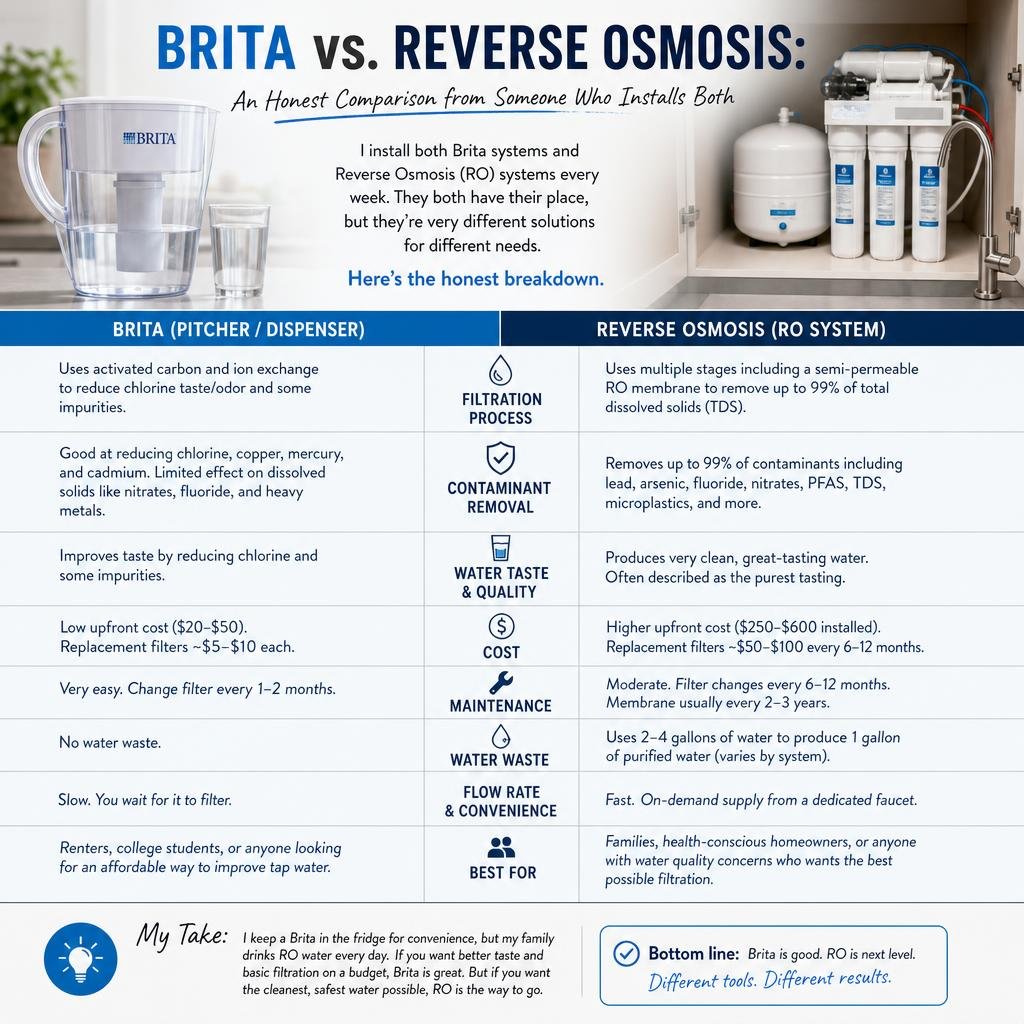
A Brita pitcher uses activated carbon — the same basic technology in most pitcher filters, faucet filters, and refrigerator filters. Activated carbon works by adsorption: contaminant molecules stick to the surface of the carbon as water passes through.
It's genuinely effective for:
Chlorine — yes, removes it well. That pool taste and smell is gone.
Chloramines — partially, depending on the carbon quality and contact time
Some volatile organic compounds (VOCs) — benzene, toluene, some pesticides
Sediment — the visible particles, cloudiness
Taste and odor — significant improvement for most tap water
It does not remove:
PFAS ("forever chemicals") — not effectively. Carbon can adsorb some PFAS compounds, but not at the removal rates that matter for contaminated water.
Nitrates — passes straight through. Activated carbon has no mechanism for nitrate removal.
Arsenic — essentially zero removal. Carbon is not effective against arsenic.
Chromium-6 — not removed by carbon filtration.
Lead — some Brita models are NSF/ANSI 53 certified for lead reduction, but at low levels only. At elevated lead concentrations, they're inadequate.
Fluoride — not removed by standard carbon filters.
Heavy metals (most) — limited to no removal.
Bacteria, viruses, cysts — no. Carbon is not a disinfection technology.
Dissolved salts, TDS — not removed. Hard water stays hard through a Brita.
The marketing language is carefully constructed. "Reduces chlorine taste and odor" — true. "Filters water" — technically true. "Removes contaminants" — which ones, at what percentage, is never specified on the box.
What a Reverse Osmosis System Actually Does
Reverse osmosis forces water through a semi-permeable membrane with pores small enough to block almost everything — typically 0.0001 microns. To put that in perspective: a human hair is about 70 microns. RO membranes are filtering at a scale 700,000 times smaller.
What comes out the other side is essentially water molecules. Very little else makes it through.
Removal rates for a quality under-sink RO system:
ContaminantRO Removal RatePFOS / PFOA90–99%Nitrates85–95%Arsenic90–96%Lead95–98%Chromium-695–99%Fluoride85–95%Bacteria99%+Nitrites80–95%Radium85–95%TDS (dissolved solids)90–99%Sodium90–96%
A full under-sink RO system has multiple stages:
Sediment pre-filter — removes particles that would damage the membrane
Carbon pre-filter — removes chlorine and chloramines that would degrade the membrane
RO membrane — the main filtration stage
Carbon post-filter — final polishing for taste
Storage tank — holds filtered water ready for use
The whole system sits under your kitchen sink. A dedicated faucet on your counter delivers filtered water. You fill water bottles from it, run your coffee maker from it, cook pasta in it.
The Real-World Comparison
Here's the part that matters for anyone living in South Florida.
Brita on South Florida tap water:
Palm Beach County Water Utilities runs 15–18 GPG hard water. PFAS above EWG guidelines. Chlorate above thyroid health guidelines. Chromium-6 above cancer guidelines. TTHMs from chloramine disinfection.
A Brita will make that water taste better. The chloramine taste — gone. The chlorine smell — gone. Everything else is in your glass.
RO on South Florida tap water:
PFAS: gone. Arsenic: 90%+ gone. Chromium-6: 95%+ gone. Nitrates: 85%+ gone. TTHMs: significantly reduced. Lead: 95%+ gone.
The water coming out of an RO system in Delray Beach tests at TDS levels similar to bottled spring water. In some cases better.
The Cost Comparison
This is where Brita looks compelling — until you do the math.
Brita pitcher:
Pitcher: $30–60
Replacement filters: $8–15 each, every 2 months = $48–90/year
10-year cost: $510–960
Under-sink RO system:
System installed: $400–900
Annual maintenance (pre-filters, membrane every 2–3 years, post-filter): $100–200/year
10-year cost: $1,400–2,900
So the RO costs more. About $900–1,900 more over ten years.
Now factor in what you're buying with a Brita versus an RO:
Brita: Chlorine taste removed. Everything else unchanged.
RO: PFAS, arsenic, nitrates, chromium-6, lead, fluoride all dramatically reduced. Water that's genuinely different in quality.
The per-gallon math changes the picture completely. If your household drinks and cooks with 2 gallons per day:
Bottled water at $1/gallon: $730/year. $7,300 over 10 years.
RO at $150/year maintenance: $0.20/gallon. Over 10 years, you save $5,800–7,000 versus buying bottled water.
Most of my customers who install an RO system stop buying bottled water almost immediately. The water coming out of the RO tap is better than most bottled water — and they know exactly what's been removed.
When a Brita Makes Sense
I want to be fair here. There are situations where a pitcher filter is the right answer.
Renters who can't install anything. If you're renting and your landlord won't allow under-sink installation, a Brita is better than nothing for chlorine and taste.
Municipal water with genuinely good quality. If you're on a water system with low contaminant levels and your primary concern is just the chlorine taste, a Brita does that job for $30.
Temporary situations. Traveling, staying somewhere short-term, filling a gap while you're deciding on a permanent solution.
Tight budget with minimal concerns. If money is very tight and your water quality issues are limited to taste, a pitcher filter is a reasonable stopgap.
What a Brita is not, regardless of budget: a solution for PFAS, arsenic, nitrates, or chromium-6. If your water has those — and a lot of South Florida water does — a pitcher filter is not addressing them. Full stop.
The PFAS Problem Specifically
This is the one I want to spend a moment on because it's the one that concerns me most right now.
PFAS — per- and polyfluoroalkyl substances — are detected in water systems throughout South Florida. Miami-Dade WASD shows PFOS at 4.7× the EPA's new 4 ppt MCL. North Miami's utility has been flagged. Broward County Water and Wastewater Services shows PFAS above EWG guidelines.
PFAS are linked to kidney cancer, thyroid disease, immune suppression, reproductive harm, and elevated cholesterol. They're called "forever chemicals" because they don't break down — they accumulate in the body.
A Brita does not remove PFAS effectively. NSF/ANSI 58 certification for RO systems includes PFAS reduction. The two technologies are not comparable for this contaminant.
If you're in a PFAS-affected water district and you're using a pitcher filter, you're filtering the taste out of water that still contains PFAS. I think people deserve to know that.
What About Refrigerator Filters?
Same category as Brita — activated carbon. Most refrigerator filters are NSF/ANSI 42 certified, which covers chlorine taste and odor. Some are NSF/ANSI 53, which covers a broader range including some lead reduction.
Same limitations apply: PFAS, nitrates, arsenic, chromium-6, fluoride — not addressed.
The filter in your refrigerator door is making your ice taste better. It's not making your water safe in the way a full RO system does.
The Practical Setup I Recommend
For most South Florida households, the answer isn't Brita versus RO — it's recognizing they solve different problems.
Under-sink RO: Drinking water, cooking water, coffee, ice. This is your clean water source. Everything that goes into your body from a tap comes from here.
Whole-house carbon filter: Every shower, every bath, every tap. Removes chloramines and TTHMs so you're not absorbing disinfection byproducts through your skin and lungs while you shower. This is separate from the RO.
Water softener: Hard water damage to appliances, pipes, fixtures, and skin. Also separate from the RO.
The RO addresses what you drink. The carbon filter addresses what you absorb. The softener addresses what the water does to your home.
A Brita pitcher on the counter of a house without an RO, without a carbon filter, without a softener — that's a $30 solution to a problem that costs most South Florida homeowners $2,000–4,000 per year in bottled water, appliance replacement, plumber calls, and unaddressed health exposure.
The One Question That Settles It
If I'm in a customer's kitchen and they're asking me whether to upgrade from a Brita, I ask them one question:
What's actually in your water?
Not what they think is in it. Not what the utility's annual report says meets federal standards. What the EWG database shows. What an in-home test shows.
In Delray Beach, that answer includes arsenic at 175× EWG's no-risk guideline. A Brita doesn't touch arsenic.
In Doral, that answer includes PFOS at 4.7× the EPA's legal limit. A Brita doesn't touch PFOS.
In Palm Beach Gardens, that answer includes 19 GPG hard water. A Brita doesn't affect hardness at all.
The technology you use should match the problem you actually have. A free water test tells you what that problem is.
We do that test at no charge. Bring whatever filter you're currently using — we'll show you what it's catching and what it's missing.