Water Softener Salt: How Much, What Kind, and How Often
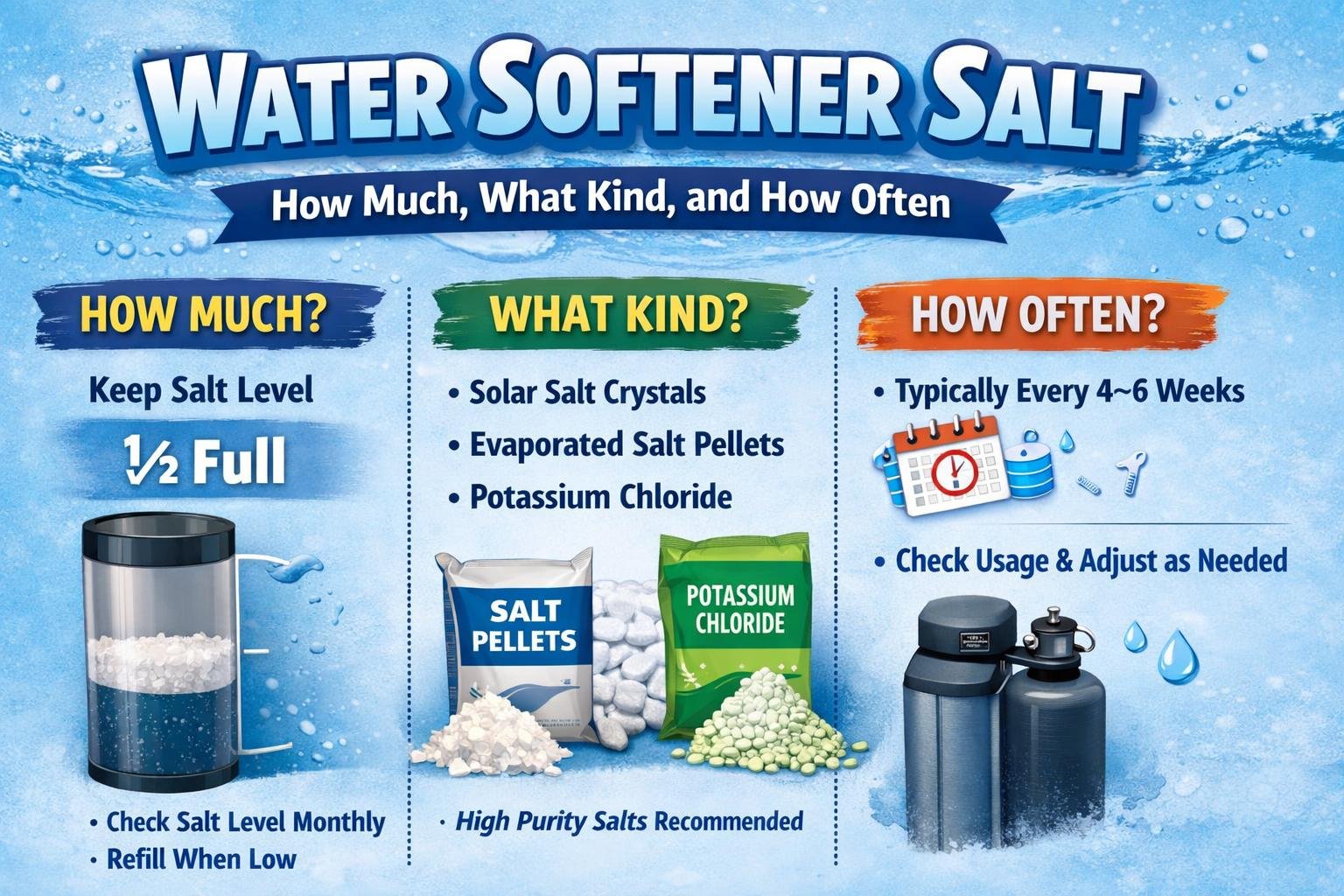
Everything Florida homeowners need to know about keeping their softener running right
If you own a water softener, you've probably stood in the salt aisle at Home Depot or Lowe's wondering what you're supposed to buy. Blue bag? Yellow bag? Green bag? Pellets or crystals? And how much do you actually need?
These seem like simple questions, but I'm constantly surprised by how much confusion exists around water softener salt. I've seen homeowners who've had softeners for years and still aren't sure if they're using the right product — or the right amount. And in Florida, where our hard water works softeners harder than almost anywhere else in the country, getting this right really matters.
Let me break down everything you need to know about water softener salt: what types exist, which one is best for your situation, how much you should be using, and how often to add it. By the end, you'll know exactly what to buy and how to maintain optimal salt levels for consistently soft water.
Understanding Why Your Softener Needs Salt
Before diving into salt types, it helps to understand what salt actually does in your water softener. Your softener doesn't add salt to your water — it uses salt to regenerate.
Here's the quick version: Inside your water softener is a tank full of tiny resin beads. These beads are charged with sodium ions. As hard water flows through, calcium and magnesium ions (the minerals that make water "hard") are attracted to the resin and stick to it, releasing sodium ions in exchange. This is called ion exchange, and it's how your water gets softened.
Over time, the resin beads become saturated with calcium and magnesium and can't capture any more. That's when regeneration happens. Your softener flushes a concentrated saltwater solution (brine) through the resin, which knocks off the calcium and magnesium and recharges the beads with fresh sodium ions. The minerals get flushed down the drain, and the resin is ready to soften water again.
Without salt, there's no brine. Without brine, there's no regeneration. Without regeneration, your softener stops working.
The Main Types of Water Softener Salt
Walk into any hardware store and you'll see several different salt products marketed for water softeners. Here's what you're actually looking at:
Evaporated Salt Pellets
What they are: The most refined and purest form of water softener salt, typically 99.7-99.9% sodium chloride. Made by heating salt brine until all the water evaporates, leaving behind pure salt that's then compressed into pellet form.
Pros:
Highest purity means minimal residue and buildup
Dissolves cleanly and consistently
Less likely to cause salt bridges or mushing
Requires less frequent brine tank cleaning
Best for all-in-one or cabinet-style softeners
Cons:
Most expensive option (typically $7-10 per 40-lb bag)
May be overkill for simple applications
Best for: Florida homeowners with very hard water (15+ grains per gallon), those who want minimal maintenance, cabinet-style softeners, or anyone tired of dealing with salt problems.
Solar Salt (Crystals or Pellets)
What they are: Made by evaporating seawater or brine in outdoor ponds using the sun and wind. The resulting salt is about 99.5-99.6% pure. Available as irregularly-shaped crystals or compressed into pellets.
Pros:
Good balance of purity and price
Solar salt pellets offer many benefits of evaporated pellets at a lower cost
Widely available
Works well for most applications
Cons:
Crystals can be prone to bridging, especially in humid environments (like Florida)
May leave some residue over time
Solar crystals dissolve faster than pellets, which can affect brine consistency
Best for: Most Florida homeowners as a cost-effective middle ground. Solar pellets are preferred over solar crystals due to better performance.
Rock Salt
What it is: Mined directly from underground salt deposits with minimal processing. Typically 95-98.5% pure, with the remainder being dirt, clay, and other impurities.
Pros:
Cheapest option (often $4-6 per 40-lb bag)
Cons:
Contains significant impurities that accumulate in your brine tank
Requires frequent tank cleaning
Can cause sediment buildup in the softener
More likely to cause bridging and mushing
May shorten the life of your system
Best for: Honestly? Almost no one. The small savings aren't worth the maintenance headaches and potential system damage. I'd avoid rock salt for water softeners entirely.
Iron-Fighting or Rust-Removing Salt (The "Green Bag")
What it is: Standard salt pellets with added citric acid or sodium bisulfate that help remove iron buildup from the resin bed during regeneration.
Pros:
Helps maintain resin efficiency in water with moderate iron content
Reduces orange/brown staining
Prevents iron fouling of the resin
Cons:
More expensive than regular pellets ($8-12 per bag)
Not a substitute for proper iron filtration in high-iron situations
Unnecessary if your water doesn't contain iron
Best for: Florida well water owners who have 1-3 ppm of iron in their water. If you have higher iron levels, you need dedicated iron filtration before the softener — the green bag alone won't solve your problem, but it can help maintain the resin.
Potassium Chloride
What it is: An alternative to sodium chloride for people who need to limit sodium intake or have concerns about sodium discharge to the environment.
Pros:
Adds potassium to water instead of sodium
Better for sodium-restricted diets
More environmentally friendly (better for plants, septic systems)
Cons:
Significantly more expensive (often $25-35 per 40-lb bag — 3-4x the cost)
Slightly less efficient at softening than sodium chloride (may need 10-15% more)
Can be harder to find
Best for: Homeowners on low-sodium diets (though the amount of sodium added by a softener is quite small), or those with environmental concerns about sodium discharge.
Which Salt Should You Use? My Recommendations
For most Florida homeowners, here's my straightforward advice:
For city water with moderate hardness (10-15 gpg): Solar salt pellets or evaporated salt pellets. Both work well. If you want the lowest-maintenance option, go with evaporated pellets. If you want to save a few dollars per bag and don't mind occasional brine tank checks, solar pellets work fine.
For very hard water (15+ gpg) or high-demand households: Evaporated salt pellets. The higher purity pays off in consistent performance and reduced maintenance when your softener is working hard.
For well water with iron (1-3 ppm): Iron-fighting pellets (green bag) are worth the extra cost. They'll help keep your resin clean and extend the time between service calls.
For well water with high iron (3+ ppm): You need iron filtration before the softener, not just special salt. The green bag can help as a supplement, but it won't solve a significant iron problem. Give us a call at Water Wizards — we can test your water and recommend the right combination of treatment.
What to avoid:
Rock salt (too many impurities)
Mixing different salt types in the same tank (can cause inconsistent dissolving)
Solar crystals in humid Florida environments (prone to bridging)
Filling your tank to the top (contributes to bridging)
How Much Salt Should You Be Using?
This is where things get more specific to your situation. Salt usage depends on several factors:
Water hardness level — Harder water requires more frequent regeneration
Household size — More people = more water usage = more regeneration
Water consumption habits — Heavy usage (large family, frequent laundry, irrigation) increases demand
Softener capacity and efficiency — Newer metered systems use salt more efficiently than older timer-based units
The General Rule of Thumb
For a family of four with moderately hard water (7-10 grains per gallon), expect to use approximately:
10 pounds of salt per week
40 pounds (one bag) per month
480 pounds (12 bags) per year
But here's the thing — Florida water is typically much harder than 7-10 gpg. Many areas have hardness levels of 15-25 gpg or higher. That can easily double your salt consumption to 80+ pounds per month.
Salt Usage by Hardness Level
| Water Hardness | Family of 2 | Family of 4 | Family of 6+ |
|---|---|---|---|
| Moderate (7-10 gpg) | 20-30 lbs/month | 40 lbs/month | 50-60 lbs/month |
| Hard (11-15 gpg) | 30-40 lbs/month | 50-60 lbs/month | 70-80 lbs/month |
| Very Hard (16-25 gpg) | 40-60 lbs/month | 70-90 lbs/month | 100+ lbs/month |
| Extremely Hard (25+ gpg) | 60-80 lbs/month | 90-120 lbs/month | 120+ lbs/month |
These are estimates — your actual usage will depend on your specific system and water consumption patterns.
What If You're Using More (or Less) Than Expected?
Using significantly more salt than these estimates? Possible causes include:
Softener regenerating too frequently (check settings)
Water hardness higher than programmed
Salt bridge or mushing causing incomplete regeneration (system keeps trying)
Leak in the system causing continuous water flow
Undersized softener for your household
Using significantly less salt than expected? This might indicate:
Softener not regenerating properly
Bypass valve partially or fully open
Programming error
System not working correctly
Either situation is worth investigating. If you're not sure whether your salt usage is normal, give us a call at Water Wizards — we can check your system and make sure everything is dialed in correctly.
How Often Should You Add Salt?
There's no fixed schedule that works for everyone. The right answer is: add salt when it needs it, not on a calendar.
Check Monthly (At Minimum)
Get in the habit of looking inside your brine tank at least once a month. Here's what you're looking for:
Ideal salt level: Salt should be at least 3-4 inches above the water level. Most manufacturers recommend keeping the tank about half to two-thirds full.
Warning signs: If you can see water without salt above it, you've run out. Your softener may have been delivering hard water for days or weeks without you knowing.
Too full: Resist the urge to fill the tank to the brim. Keeping salt lower (half full) actually reduces bridging problems and makes it easier to spot issues.
The Monthly Check Routine
Open the brine tank lid
Look at the salt level — is it at least halfway up the tank?
Tap the salt surface with a broom handle — does it feel solid all the way down, or is there a hollow space? (Hollow = salt bridge)
Add salt if the level is below halfway
Check for any unusual water levels or discoloration
This takes about 30 seconds and prevents most salt-related problems.
Setting a Reminder
I recommend setting a monthly phone reminder to check your salt. It's such a simple task that it's easy to forget — and forgetting for a few months can mean weeks of hard water damaging your plumbing and appliances.
At Water Wizards, we include salt level checks as part of our annual maintenance service. But between service visits, monthly homeowner checks keep everything running smoothly.
Common Salt Problems and How to Avoid Them
Salt Bridges
A salt bridge is a hard crust that forms in the brine tank, creating an empty space between the salt and the water below. Since water can't reach the salt, no brine forms, and your softener can't regenerate.
Why it happens: Humidity (very common in Florida), temperature fluctuations, low-quality salt, or overfilling the tank.
How to detect it: The tank looks full of salt, but your water is hard. When you push a broom handle into the salt, you hit a hard layer with hollow space underneath.
How to fix it: Carefully break up the bridge by pushing through it in several places. Remove loose chunks and let the system regenerate normally.
How to prevent it:
Use high-purity salt pellets (not crystals or rock salt)
Don't overfill the tank — keep it half to two-thirds full
Store your softener in a climate-controlled space if possible
Check monthly for early signs
Salt Mushing
Salt mushing is different — it's a thick, slushy layer of recrystallized salt that forms at the bottom of the tank. This sludge blocks proper brine formation and can clog the system.
Why it happens: Using low-purity salt, humidity, or salt sitting too long without being used.
How to detect it: When you probe the salt, instead of a hard bridge with hollow space, you feel thick, wet sludge that doesn't break apart easily.
How to fix it: Unfortunately, you need to empty the tank completely, scoop out all the old salt and sludge, clean the bottom, and refill with fresh salt.
How to prevent it:
Use high-purity evaporated salt pellets
Don't let salt sit for months without regeneration
Clean your brine tank annually
Running Out of Salt
This is the most common problem, and the most preventable. When you run out of salt, your softener can't regenerate, and hard water returns.
Signs you've run out:
Spots on dishes and shower doors
Soap doesn't lather as well
Dry skin and hair after bathing
Scale starting to appear on fixtures
The fix: Add salt immediately. Note that it may take 2-3 regeneration cycles before water throughout your home is fully softened again.
Prevention: Monthly checks and keeping a spare bag in the garage.
The Cost of Salt: What to Budget
Let's talk real numbers for Florida homeowners:
Price per 40-lb bag (typical retail):
Rock salt: $4-6
Solar salt crystals: $5-7
Solar salt pellets: $6-8
Evaporated salt pellets: $7-10
Iron-fighting pellets: $8-12
Potassium chloride: $25-35
Annual cost for a family of four:
With moderate hardness (1 bag/month):
Solar pellets: $72-96/year
Evaporated pellets: $84-120/year
With very hard water (2 bags/month):
Solar pellets: $144-192/year
Evaporated pellets: $168-240/year
Where to buy:
Home improvement stores (Home Depot, Lowe's) — most convenient
Warehouse clubs (Costco, Sam's Club) — often best prices, especially for Morton's
Local water treatment companies — may offer delivery service
Pro tip: Buying 3-4 bags at a time reduces trips and ensures you always have backup supply. Some families stock up with a year's worth when they find a good sale.
Special Considerations for Florida
Our state presents some unique challenges for water softener maintenance:
Extreme Hardness
Much of Florida has water hardness well above the national average. The Floridan Aquifer delivers mineral-rich water that can be 2-3 times harder than water in other parts of the country. This means:
Higher salt consumption
More frequent regeneration
Greater importance of using high-quality salt
More stress on the resin (consider 10% crosslink resin for longer life)
Humidity
Florida's humidity is brutal on salt. It accelerates bridging and makes salt clump faster than in drier climates. Combat this by:
Using pellets instead of crystals
Not overfilling the tank
Keeping the brine tank lid closed
Checking more frequently during summer months
Iron and Sulfur in Well Water
Many Florida wells have iron and/or sulfur in addition to hardness. Iron fouls the resin and reduces softening capacity. While iron-fighting salt helps, significant iron (3+ ppm) requires dedicated filtration before the softener.
If you're on well water and notice orange staining or sulfur smell, your salt choice is only part of the equation. Get your water tested to understand the full picture.
Chlorine in City Water
Municipal water contains chlorine, which degrades softener resin over time. While this doesn't affect salt choice directly, it does affect resin life — and worn resin uses salt less efficiently. Consider:
A carbon pre-filter to remove chlorine before the softener
Higher-quality 10% crosslink resin (more chlorine-resistant)
Regular resin cleaning with iron-out products
How Water Wizards Can Help
Free Water Testing
Not sure about your water hardness or what else might be in your water? We offer free in-home water testing that tells you exactly what you're dealing with. Knowing your actual hardness level helps us recommend the right salt type, estimate usage, and ensure your softener is programmed correctly.
System Optimization
If you're going through salt faster than expected, or your water doesn't seem as soft as it should be, we can diagnose the problem. Sometimes it's as simple as adjusting the hardness setting. Other times there's a mechanical issue that needs attention.
Annual Maintenance
Our maintenance service includes checking salt levels, inspecting for bridges and mushing, cleaning the brine tank, testing water hardness, and verifying proper regeneration. Regular maintenance keeps your softener running efficiently and extends its lifespan.
Salt Delivery
Tired of hauling 40-lb bags? Some of our customers prefer to have salt delivered on a regular schedule. Ask us about options for ongoing salt delivery service.
Frequently Asked Questions
Can I mix different types of salt in my softener?
It's best not to. Different salt types dissolve at different rates, which can cause inconsistent brine concentration and contribute to bridging or mushing. If you want to switch salt types, wait until the tank is nearly empty before adding the new type.
How do I know if my softener is using salt correctly?
Check the salt level monthly. Over the course of 4-6 weeks, you should see a noticeable drop in the level. If salt isn't going down but your water is still soft, you may have a salt bridge with softened water being delivered from old regeneration. If salt isn't going down and your water is hard, something is wrong with the regeneration cycle.
Is the sodium from softened water bad for me?
The amount of sodium added is quite small — typically 20-30 mg per 8-oz glass for moderately hard water. For comparison, a slice of bread contains about 100-200 mg of sodium. Most people don't need to worry about it, but if you're on a severely sodium-restricted diet, consider potassium chloride or a reverse osmosis system for drinking water.
My water feels "slippery" — am I using too much salt?
That slippery feeling is normal with soft water. It's actually the absence of the mineral residue you're used to with hard water. Your soap is rinsing away completely rather than forming soap scum on your skin. It's not excess salt — it's what properly softened water feels like.
How long does a 40-lb bag of salt last?
For an average family of four with moderate hardness, about one month. With Florida's typically harder water, it might be 2-3 weeks. With very hard water or larger households, you might go through a bag every week or two.
Should I use salt with additives?
Iron-fighting additives (green bag) are worth it if you have iron in your water. "Plus" additives marketed for cleaner systems can help, but high-purity evaporated pellets accomplish much the same thing at lower cost. Avoid rock salt regardless of any additives — the impurities aren't worth the savings.
What happens if I forget to add salt for several months?
Your softener will eventually run out of regeneration capacity and start passing hard water. You may notice scale buildup, soap that doesn't lather, dry skin, and spots on dishes. Once you add salt, it may take several regeneration cycles before water throughout the house is fully softened again. No permanent damage occurs, but your plumbing and appliances will have been exposed to hard water during that time.
Can I use table salt or ice melt salt in an emergency?
No. Table salt contains anti-caking agents and sometimes iodine that can damage your softener. Ice melt (rock salt) is too impure. If you run out of softener salt, either buy the right product or let the system sit until you can — don't improvise with other salt products.
Have questions about which salt to use, or not sure if your softener is working correctly? Contact Water Wizards for free water testing and expert advice. We'll help you get the most out of your water softener with the least hassle and expense.