Water Softener Resin Replacement: Signs Your Softener Needs a Rebed
By Jared Beviano | Water Wizards Filtration
I got a call from a homeowner in Boynton Beach a few weeks ago. Classic situation. He'd had his water softener for about twelve years, and over the past few months, he'd noticed the hard water symptoms creeping back. Spots on the shower doors. Soap not lathering like it used to. That squeaky feeling on his skin after a shower.
"I think my softener is broken," he said. "It's still running through the regeneration cycles, I can hear it at night. But the water's definitely hard again."
First thing I asked: "When did you last add salt?"
"Last week. Tank's half full right now."
So it wasn't a salt issue. The softener was regenerating on schedule with plenty of salt. But the water was still hard.
I already knew what we'd probably find, but I went out to confirm. Tested the water coming out of the softener—18 grains of hardness. His incoming water was 22 grains. The softener was removing almost nothing.
The culprit? Exhausted resin.
Twelve years of South Florida water—aggressive chlorine, high hardness, summer heat—had finally killed the resin bed. It couldn't hold hardness minerals anymore no matter how many times it regenerated. The little beads that do all the work had simply worn out.
Here's the good news I gave him: he didn't need a new softener. The tank was fine. The valve was fine. All the plumbing was fine. He just needed new resin—what we call a "rebed."
$375 later, his softener was working like new. Hardness at zero. Another ten-plus years of life ahead of it.
That's what I want to talk about today—water softener resin, how it wears out, how to know when yours needs replacement, and why a rebed is often the smartest repair you can make.
What Is Water Softener Resin and How Does It Work?
Before we talk about replacement, let's make sure you understand what resin actually does. It's the heart of your water softener—the thing that actually removes hardness from your water.
The Basics
Inside your water softener's main tank, there are thousands of tiny plastic beads. They look like small amber or brown spheres, each one about the size of a fish egg. Collectively, this is your resin bed—typically 1-2 cubic feet of beads depending on your softener's capacity.
These beads are made of polystyrene and have a special property: they're covered in sodium ions that are loosely attached to the bead surface.
When hard water flows through the resin bed, a simple exchange happens. The calcium and magnesium ions in your water (the hardness minerals) are attracted to the resin beads more strongly than the sodium ions. So the hardness minerals stick to the beads, and the sodium ions release into the water.
Hard water goes in. Soft water comes out. The hardness minerals stay trapped on the resin.
Regeneration
Eventually, the resin beads become saturated with hardness minerals. They can't grab any more calcium and magnesium because they're full. This is where regeneration comes in.
During regeneration (usually scheduled for 2-4 AM when you're not using water), the softener flushes a strong salt brine solution through the resin bed. The high concentration of sodium in the brine reverses the exchange—hardness minerals release from the beads and flush down the drain, while sodium ions reattach to the beads.
After regeneration, the resin is recharged and ready to soften water again.
This cycle—softening, saturation, regeneration—repeats continuously. A well-maintained softener might go through this cycle every few days, depending on your water hardness and household usage.
Why Resin Eventually Fails
Here's the thing about resin: it's not immortal. Every regeneration cycle puts stress on the beads. Every gallon of chlorinated water degrades them a little. Every year of use wears them down slightly.
Over time, the beads lose their ability to hold ions effectively. They become physically damaged—cracking, breaking apart, losing their spherical shape. They become chemically fouled by iron, chlorine, or other contaminants that coat the bead surface and block the ion exchange sites.
Eventually, the resin reaches a point where it can't effectively soften water anymore, no matter how much salt you use or how often it regenerates. When that happens, you need new resin.
How Long Does Water Softener Resin Last?
The honest answer: it depends.
Manufacturer claims typically say 10-20 years. In laboratory conditions with clean water, that's probably accurate. But South Florida isn't laboratory conditions.
The South Florida Reality
In my experience installing and servicing softeners throughout Palm Beach, Broward, and Miami-Dade counties, here's what I actually see:
City water with typical chlorine levels: 8-12 years of resin life
City water with high chlorine/chloramine levels: 6-10 years
Well water with iron present: 5-8 years
Well water with iron AND sulfur: 4-7 years
Any water with chlorine AND high iron: 5-8 years
These numbers assume reasonably consistent maintenance—keeping salt in the tank, appropriate regeneration frequency, no extended periods of running dry.
What Kills Resin Faster in South Florida
Chlorine and Chloramines
This is the big one. Municipal water in South Florida is heavily chlorinated to prevent bacterial growth in our warm climate. Many utilities have switched from straight chlorine to chloramines (chlorine bonded with ammonia), which are even harder on resin.
Chlorine is an oxidizer. It attacks the polystyrene structure of resin beads, making them brittle over time. The beads crack, fragment, and lose their ability to hold ions. High chlorine exposure can cut resin life in half compared to chlorine-free water.
This is why I often recommend a whole-house carbon filter before the softener for city water customers. The carbon removes chlorine before it reaches the resin, potentially doubling the resin lifespan.
Iron
Well water in western Palm Beach County—Loxahatchee, The Acreage, Wellington, Royal Palm Beach—often contains dissolved iron. Even low levels of iron (0.3 ppm or higher) can foul resin over time.
Iron coats the resin beads with a film that blocks the ion exchange sites. The beads can't grab hardness minerals effectively because iron is in the way. This is called "iron fouling" and it's a gradual, cumulative problem.
Special iron-cleaning products can help extend resin life in iron-prone water, but eventually the fouling becomes permanent.
Sediment and Particulates
Fine sediment can coat resin and reduce its effectiveness. Larger particles can physically damage beads. Well water without adequate pre-filtration often shortens resin life due to sediment exposure.
Running Without Salt
When a softener runs out of salt, it still goes through regeneration cycles—but with plain water instead of brine. This doesn't recharge the resin. The beads stay saturated with hardness minerals, and subsequent hard water just flows through.
Repeated cycles of "regenerating" without salt stresses the resin and can cause permanent damage. I've seen softeners that ran dry for six months need resin replacement even though the system was only five years old.
Improper Sizing
An undersized softener regenerates more frequently to keep up with demand. More regeneration cycles mean more wear on resin. A softener that regenerates every other day will wear out faster than one that regenerates every four days.
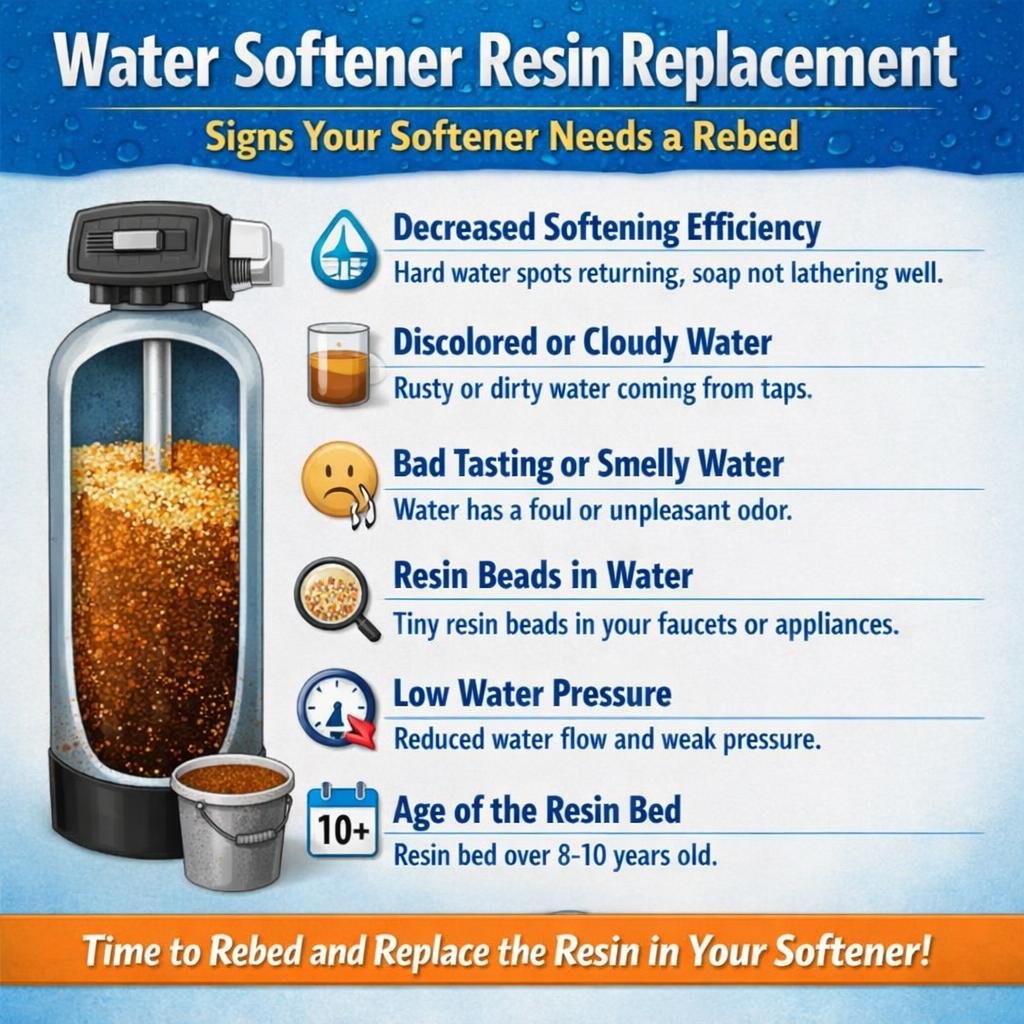
Signs Your Resin Needs Replacement
How do you know when your resin is dying? Here are the symptoms I look for:
Hard Water Symptoms Despite Salt and Regeneration
This is the classic sign. Your softener has salt. It's regenerating on schedule. But you're getting hard water anyway.
You might notice spots on dishes and shower doors, soap and shampoo that don't lather well, dry skin and stiff hair after showering, white scale forming on faucets, or laundry that feels stiff or scratchy.
If these symptoms appear while your softener appears to be functioning normally, exhausted resin is the likely culprit.
Increasing Salt Usage With Decreasing Performance
Worn resin often manifests as inefficiency. The softener uses more salt per regeneration but produces less soft water. You're refilling the brine tank more often, but the water quality is declining.
This happens because damaged resin can't hold as many ions per bead. The system regenerates more frequently (using more salt) but still can't keep up with demand.
Very Old System (10+ Years)
Age itself is a strong indicator. If your softener is more than 10-12 years old and you're noticing any performance issues, resin exhaustion should be high on the suspect list.
Even if you haven't noticed problems yet, a softener past the 12-year mark is likely operating with reduced efficiency. The resin is tired even if it hasn't completely failed.
Resin Beads in Your Water
This is a definitive sign. If you find small amber or brown beads in your faucet aerators, showerheads, or appliance screens, your resin is physically breaking apart and escaping the tank.
This happens when resin beads become so degraded that they fragment into pieces small enough to pass through the system's internal screens. Once resin is fragmenting, replacement is urgent—those particles are getting into your pipes, appliances, and fixtures.
Water Testing Confirms Hardness
The definitive test is measuring water hardness before and after the softener. If incoming water is 20 grains hard and outgoing water is also 15-20 grains hard, your softener isn't doing its job. With functional resin, output should be 0-3 grains regardless of input hardness.
I carry a hardness test kit to every service call. It takes 30 seconds and tells me immediately whether the resin is working.
Rebed vs. Replace: Making the Right Decision
When a softener stops working effectively, you have three options: repair/rebed, replace the entire softener, or abandon softening entirely (not recommended in South Florida). Here's how to think through the decision.
When a Rebed Makes Sense
The tank and valve are in good condition. If your softener's tank has no cracks, corrosion, or damage, and the control valve is functioning properly, there's no reason to throw away perfectly good equipment. A rebed gives you essentially a brand-new softener in your existing housing.
The system is appropriately sized. If your softener was properly sized for your household when installed, and your water usage hasn't dramatically increased, keeping the same tank size makes sense.
The softener is less than 15-20 years old. Modern softener tanks are durable and can last decades. If the tank is relatively young and the valve is working, a rebed extends the system's life by 10+ years at a fraction of replacement cost.
You're happy with the current system. If your softener has been reliable and meets your needs, why change? New resin in familiar equipment is a known quantity.
Budget is a concern. A rebed costs $250-450 depending on tank size. A new softener costs $1,500-2,500 installed. If the rebed will give you another decade of service, the math strongly favors rebedding.
When Full Replacement Makes More Sense
The control valve is failing. If the valve is stuck, leaking, not advancing through cycles, or showing electrical problems, you're looking at valve repair ($200-400) on top of the rebed. At that point, the total repair cost approaches replacement cost, and you might as well get new equipment with a fresh warranty.
The tank is damaged. Cracked tanks, corroded fittings, or structural damage mean the tank can't be reused. You need a new system.
The system is severely undersized. If you've added bathrooms, family members, or water-using appliances since installation, your current softener may be too small. Replacement with a properly sized system is smarter than rebedding undersized equipment.
Technology has improved significantly. If your softener is 20+ years old, modern systems are more efficient—using less salt and water per regeneration, offering smart monitoring, and providing better performance. Sometimes upgrading makes sense even when the old equipment could be repaired.
You want different features. Maybe you want a smart softener with app monitoring. Maybe you want to switch from timer-based to demand-based regeneration. If you're seeking functionality your current system can't provide, replacement is the path forward.
The Cost Comparison
Let me give you real numbers from our service work:
Rebed only (assuming good valve):
1.0 cubic foot resin tank: $250-325
1.5 cubic foot resin tank: $300-375
2.0 cubic foot resin tank: $350-450
Valve rebuild (if needed with rebed):
Basic valve rebuild: $200-350
Complete valve replacement: $400-700
Total rebed with valve work: $450-1,100
New softener installation:
Basic 32,000 grain: $1,400-1,800
Mid-range 48,000 grain: $1,800-2,200
Premium with smart features: $2,200-2,800
So you're looking at $250-450 for a rebed versus $1,400-2,800 for replacement. Even with valve work, the rebed is usually the better value if the tank is in good shape.
What Does a Rebed Involve?
If you decide to go the rebed route, here's what happens:
The Process
Bypass and drain. We put the softener in bypass mode and drain the water from the tank. The old resin and water are heavy—a 1.5 cubic foot tank holds about 100 pounds of wet resin.
Remove old resin. We vacuum or scoop out the old resin beads. They go into buckets for proper disposal (resin isn't toxic, but it shouldn't go down drains or into gardens).
Inspect the tank interior. With the resin out, we can see the tank's interior condition. We check for cracks, corrosion, and damage to the distribution tube and basket at the bottom. If there's a problem, we address it now.
Clean the tank. Any residue, sediment, or film inside the tank gets cleaned out before new resin goes in.
Install new resin. Fresh resin beads—the right amount for your tank size—go into the tank. We make sure the distribution tube stays centered and the resin level is correct.
Reassemble and rinse. We put everything back together, run water through the system to rinse the new resin and flush any dust or fines, and confirm proper flow.
Regenerate. We run a manual regeneration cycle to charge the new resin with sodium ions. After regeneration completes, your softener is ready for service.
Test. We test the output water to confirm hardness is at zero. If it's not, something else is wrong.
Time Required
A straightforward rebed takes 1-2 hours. If we're also rebuilding the valve or addressing other issues, figure 2-3 hours.
Mess and Disruption
Rebedding is messier than some repairs. We're dealing with wet resin, draining water, and working with heavy materials. We use drop cloths and clean up thoroughly, but expect some activity in your garage or utility room.
You'll be without soft water during the service and for a few hours afterward while regeneration completes. Plan to have soft water restored the same day.
Can You Rebed a Water Softener Yourself?
Technically, yes. Resin is available online and at some water treatment suppliers. The process isn't complicated if you're mechanically inclined.
But I'd recommend against DIY for several reasons:
Proper diagnosis matters. Is it really the resin? Or is it a valve problem, a programming issue, a clogged injector, or something else? Throwing new resin at a valve problem wastes money. A professional can diagnose correctly before replacing anything.
Resin selection matters. Different resins have different properties. Standard cation resin works for most applications, but fine mesh resin is better for iron-prone water, and some situations call for specialty resins. The wrong resin choice can cause problems.
Disposal is an issue. You'll have 50-100 pounds of wet resin to dispose of. It can't go down drains. Most garbage services won't take it. What's your plan?
It's heavy, awkward work. Wet resin is heavy. Working in a cramped garage space, manipulating a 100-pound tank, vacuuming or scooping wet beads—it's more physically demanding than it sounds.
You might find other problems. What if the distribution tube is cracked? What if the tank has internal damage you can't see until it's empty? A professional can address these issues; a DIYer might not know what they're looking at.
Warranty considerations. If you rebed yourself and have problems, there's no one to call. Professional work typically includes a warranty on both parts and labor.
The cost difference between DIY and professional service is maybe $100-150 (your resin cost versus our all-in price). For most people, the professional service is worth the modest premium.
How to Extend Your Resin's Life
Whether you've just had a rebed or you want to make your current resin last longer, here are proven ways to extend resin life:
Install Carbon Filtration Before the Softener
This is the single best thing you can do for resin longevity. A whole-house carbon filter removes chlorine before it reaches your softener. No chlorine exposure means dramatically longer resin life—potentially doubling it.
A quality whole-house carbon system costs $1,200-2,000 installed. If it saves you one rebed over the system's life, it's paid for itself. If it saves you two, you're ahead.
Keep Salt in the Tank
Running out of salt causes repeated "empty" regeneration cycles that stress resin without recharging it. Keep your salt level above one-quarter full at all times. Check it monthly.
If you repeatedly forget to add salt, consider a salt delivery service. The monthly cost is much less than the cost of premature resin failure.
Use the Right Salt
High-purity evaporated salt pellets leave less residue in your brine tank and dissolve more consistently than rock salt or lower-grade solar salt. The cost difference is maybe $3-5 per bag, but the impact on system cleanliness and performance is real.
Address Iron Issues
If you're on well water with iron, consider iron pre-treatment before the softener. An iron filter or oxidation system removes iron before it can foul the resin.
If iron pre-treatment isn't in the budget, at least use periodic iron-cleaning treatments. Products like Rust Out or Iron Out can be added to the brine tank to help clean iron deposits from resin. Follow manufacturer recommendations for frequency.
Don't Overwork the System
An undersized softener regenerates too frequently, wearing out resin faster. If your household has grown or water usage has increased significantly, consider upgrading to a larger softener rather than running your current one into the ground.
Annual Professional Inspection
Having a professional check your softener annually catches issues before they become expensive. We test output hardness, check resin condition, verify programming, and identify any developing problems. A $150 annual inspection can prevent a $400 emergency service call.
Questions to Ask Before Getting a Rebed
If you're considering resin replacement, here are questions to ask your water treatment company:
What's the condition of my valve? A honest technician will assess the valve before recommending a rebed. If the valve is also failing, you need to know that upfront.
What type of resin will you use? Standard 8% crosslink cation resin is fine for most situations. Fine mesh resin is better for iron-prone water. Make sure you're getting appropriate resin for your water conditions.
What's included in the price? Rebed pricing should include the resin itself, labor, disposal of old resin, tank inspection and cleaning, regeneration, and testing. Make sure there are no hidden charges.
What warranty do you provide? Reputable companies warranty their rebed work. Ours includes 90 days on labor and 1 year on the resin itself.
Will you test my water before and after? You should see documented proof that the rebed solved the problem. Before: X grains hardness. After: 0 grains hardness.
The Bottom Line on Resin Replacement
Water softener resin doesn't last forever, especially in South Florida's challenging water conditions. But resin failure doesn't mean you need a new softener.
A rebed—replacing the resin while keeping your existing tank and valve—is one of the most cost-effective repairs in water treatment. For $250-450, you get essentially a new softener with another 10+ years of service life.
The key is recognizing the symptoms: hard water despite salt and regeneration, declining performance with increasing salt usage, resin beads appearing in fixtures, or simply age (10+ years in South Florida conditions).
If your softener is showing these signs, get it tested. Measure the hardness before and after the softener. If the resin isn't removing hardness, you know what needs to happen.
And once you do rebed, protect your investment. Install carbon pre-filtration to remove chlorine. Keep salt in the tank. Use quality salt. Consider annual inspections. These steps can push your resin life from 8 years to 12 or beyond.
That homeowner in Boynton Beach I mentioned at the start? His rebedded softener is working perfectly now. Zero hardness. Clear water. Happy wife.
And he's got a reminder set to check his salt level every month. Lesson learned.
Think your water softener might need a rebed?
Call Water Wizards at 561-352-9989 or visit waterwizards.ai to schedule a water test and system evaluation.
We'll test your water, assess your equipment, and give you honest recommendations—whether that's a rebed, a repair, or just an adjustment to your current settings.
Water Wizards Filtration — Florida's Water Filtration Experts
Serving Delray Beach, Boca Raton, West Palm Beach, Jupiter, Wellington, Boynton Beach, Fort Lauderdale, and communities throughout Palm Beach and Broward counties.
Frequently Asked Questions: Water Softener Resin Replacement
How much does water softener resin replacement cost in South Florida?
Water softener resin replacement (rebed) typically costs $250-450 in Palm Beach and Broward counties, depending on tank size. A 1.0 cubic foot tank runs $250-325, a 1.5 cubic foot tank costs $300-375, and a 2.0 cubic foot tank runs $350-450. This includes the resin, labor, old resin disposal, tank cleaning, regeneration, and water testing. If your control valve also needs work, add $200-400 for valve rebuild or $400-700 for valve replacement. Compare this to $1,500-2,800 for complete softener replacement—a rebed costs roughly 15-25% of new equipment while providing 10+ additional years of service life.
How do I know if my water softener resin needs to be replaced?
The clearest sign is hard water symptoms (spots on dishes, soap not lathering, dry skin) despite having salt in the tank and the softener regenerating normally. Other indicators include increasing salt usage with declining performance, resin beads appearing in faucet aerators or showerheads, and system age over 10-12 years in South Florida conditions. The definitive test is measuring water hardness before and after your softener—if input is 20 grains and output is still 15-20 grains, your resin isn't working. Functional resin should reduce hardness to 0-3 grains regardless of input level. We test hardness at every service call to diagnose resin condition accurately.
How long does water softener resin last in Florida?
In South Florida's challenging water conditions, expect water softener resin to last 8-12 years with city water and 5-8 years with well water containing iron. Manufacturer claims of 15-20 years assume ideal conditions that don't exist here. Our aggressive chlorine and chloramine levels oxidize resin faster, iron in well water fouls resin surfaces, and high hardness levels (15-25 grains common in Palm Beach County) mean more regeneration cycles and faster wear. Installing a whole-house carbon filter before your softener can extend resin life significantly by removing chlorine before it reaches the resin—potentially adding 3-5 years to resin lifespan.
What's the difference between rebedding a water softener and replacing it entirely?
Rebedding means replacing only the resin inside your existing softener tank while keeping the tank, control valve, and all plumbing connections. It costs $250-450 and takes 1-2 hours. Full replacement means removing your entire softener and installing new equipment—new tank, new valve, new resin, new connections. It costs $1,500-2,800 and takes 3-4 hours. Rebedding makes sense when your tank and valve are in good condition (typically under 15-20 years old with no damage). Full replacement makes sense when the valve is failing, the tank is damaged, the system is severely undersized, or you want features your current system can't provide.
Can I replace water softener resin myself, or do I need a professional?
While DIY resin replacement is technically possible, we recommend professional service for several reasons. Proper diagnosis is critical—your hard water might be caused by a valve problem, programming issue, or clogged injector rather than bad resin. Replacing resin won't fix these issues. Additionally, wet resin is heavy (50-100 pounds per tank), disposal is problematic (most garbage services won't accept it), and you might discover other problems once the tank is empty. The cost difference between DIY and professional service is typically $100-150—worth it for proper diagnosis, warranty coverage, and avoiding the heavy lifting and disposal hassles.
Does chlorine in city water damage water softener resin?
Yes, chlorine significantly shortens water softener resin life. Chlorine is an oxidizer that attacks the polystyrene structure of resin beads, causing them to become brittle, crack, and fragment over time. South Florida municipal water is heavily chlorinated due to our warm climate, and many utilities use chloramines (chlorine bonded with ammonia) which are even more damaging to resin. High chlorine exposure can reduce resin life by 30-50% compared to chlorine-free water. The best protection is installing a whole-house carbon filter before your softener to remove chlorine before it reaches the resin. This can extend resin life from 8 years to 12+ years—a carbon filter essentially pays for itself in avoided resin replacements.
What type of resin should be used when rebedding a water softener?
Standard 8% crosslink cation exchange resin works well for most residential water softening applications. For well water with iron present (common in western Palm Beach County—Loxahatchee, The Acreage, Wellington), fine mesh resin provides better performance because the smaller bead size offers more surface area for ion exchange and resists iron fouling better. High-capacity 10% crosslink resin lasts longer but costs more—it's sometimes worthwhile for very hard water or high-usage households. We select resin based on your specific water conditions, which is one reason professional rebedding often produces better results than DIY with generic resin from Amazon.
How long does a water softener rebed take?
A straightforward resin replacement takes 1-2 hours from start to finish. This includes putting the softener in bypass, draining the tank, removing old resin, inspecting the tank interior, cleaning, installing new resin, reassembling, rinsing, running a manual regeneration cycle, and testing output water hardness. If we're also rebuilding the control valve or addressing other issues discovered during the service, expect 2-3 hours. You'll have soft water restored the same day—typically within 3-4 hours after we arrive, accounting for the regeneration cycle that charges the new resin.
Will rebedding fix low water pressure from my softener?
It depends on what's causing the low pressure. If degraded resin has fragmented and is clogging internal passages, a rebed will help. If the resin bed has become compacted with sediment and debris, new resin restores flow. However, low pressure can also be caused by clogged distributor tubes, failed valve seals, or undersized plumbing—issues that rebedding alone won't fix. We diagnose the actual cause before recommending a rebed. Sometimes the solution is cleaning rather than resin replacement. Sometimes valve work is needed. We'll tell you what's actually wrong, not just sell you a rebed you might not need.