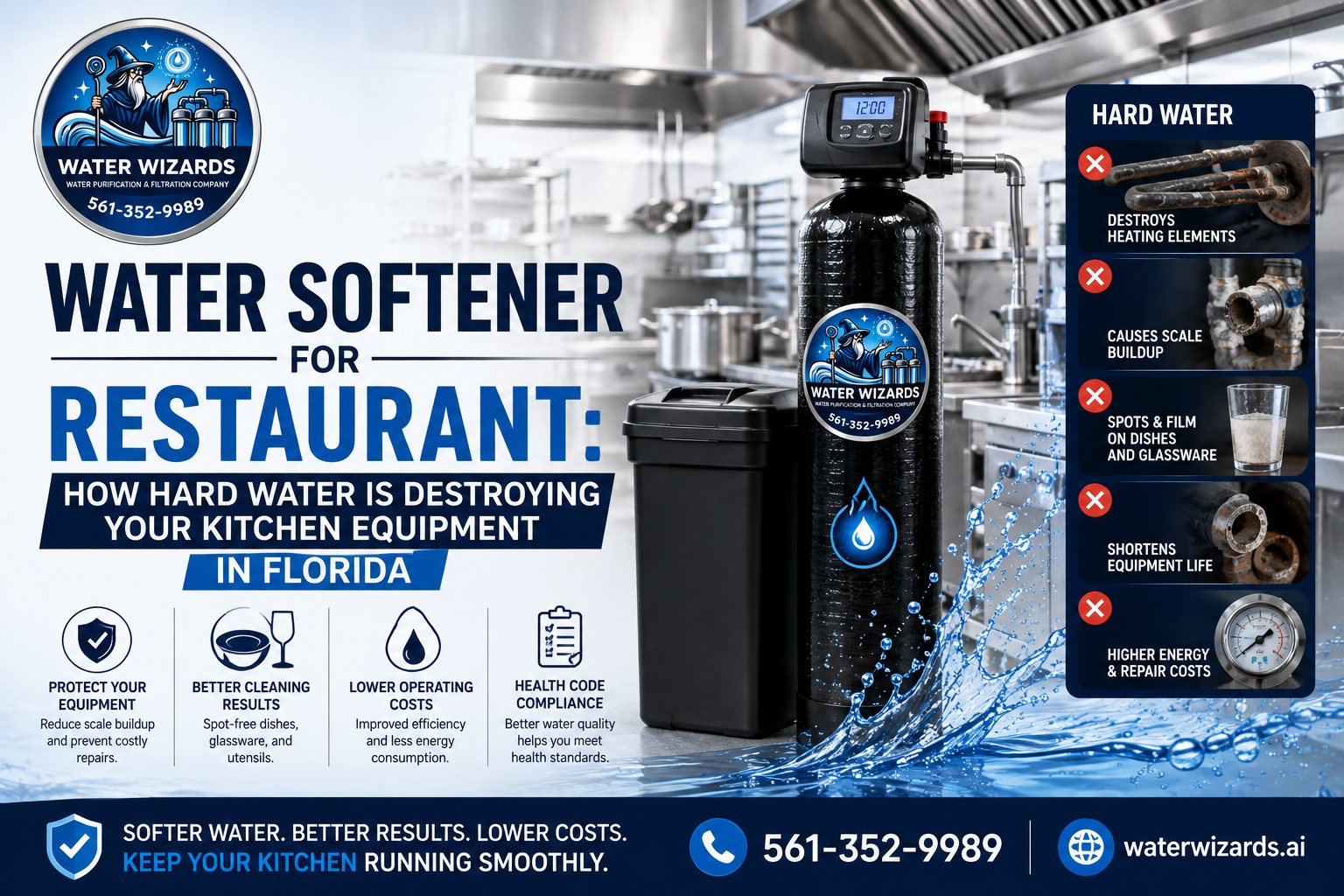
Water Softener for Restaurant: How Hard Water Is Destroying Your Kitchen Equipment in Florida
Published by Jared Beviano · Water Wizards Filtration
A kitchen manager at a seafood restaurant in Deerfield Beach showed me her dishwasher spray arms last spring. They were completely blocked — every hole clogged with white mineral deposits. She'd had the machine serviced twice in eight months. The technician kept telling her the spray arms needed replacing. She'd replaced them three times.
Nobody had told her that replacing spray arms on hard water without treating the water is like mopping the floor with the tap still running.
I tested the water. Broward County Water and Wastewater Services. 15 GPG. No softener. No filtration of any kind.
We installed a commercial water softener for $2,800. The spray arms she installed the week before are still working fine fourteen months later. The ones before that lasted six to eight weeks each.
Hard water in a commercial kitchen doesn't announce itself as a water problem. It shows up as an equipment problem, a maintenance problem, an energy problem, and eventually a replacement budget problem. Most restaurant owners treat the symptoms for years before anyone connects the cause to the water.
Hard Water in South Florida: The Numbers Behind the Damage
Before we get into what hard water does to your kitchen, it helps to understand just how hard South Florida water actually is.
Water hardness is measured in grains per gallon (GPG). Water is classified as:
Soft: 0–3 GPG
Slightly hard: 3–7 GPG
Moderately hard: 7–10 GPG
Hard: 10–14 GPG
Very hard: 14+ GPG
Miami-Dade WASD delivers water at 22.4 GPG — more than three times the "very hard" threshold and the hardest treated municipal water in all of South Florida. Palm Beach County Water Utilities runs 15–18 GPG. Broward County Water and Wastewater Services runs 14–16 GPG.
For comparison, the national average is approximately 6.3 GPG. The average restaurant in South Florida is running water through its equipment at two to three and a half times the national average hardness. Every piece of equipment that touches water is experiencing accelerated scale formation at a rate that most equipment manufacturers never anticipated when they set their service intervals.
The damage is not theoretical. It shows up in service calls, in energy bills, in shortened equipment life, and eventually in replacement costs that show up on the P&L as "equipment" when the real cause is water quality.
How Scale Actually Forms — and Why South Florida Is Different
When hard water is heated, calcium and magnesium ions react with carbonates in the water and precipitate as calcium carbonate — the white, chalky scale you see on shower heads, faucet aerators, and the inside of water-using equipment.
The rate of scale formation accelerates with temperature. Cold water forms scale slowly. Hot water forms scale fast. Water that cycles between cold and hot — like the water in a commercial dishwasher, a combi oven, or an espresso machine — creates ideal conditions for rapid scale accumulation.
At 22.4 GPG, scale forms at nearly four times the rate it forms at the national average hardness. An equipment manufacturer who rates a heating element for 5-year life under typical conditions has never tested it in Miami-Dade water. The same element in WASD water fails in 18 months to 2 years.
This is why the standard replacement intervals, warranty claims, and service recommendations from equipment manufacturers don't hold in South Florida — they were developed under different water conditions.
The Equipment That Suffers Most
Commercial Dishwasher
The commercial dishwasher is where hard water damage is most visible and most expensive.
Spray arms: Mineral deposits clog the spray holes unevenly, creating inconsistent water distribution across the rack. Dishes come out spotty, glasses show watermarks, and eventually the spray arms stop spraying effectively. The kitchen manager in Deerfield Beach was replacing spray arms every six to eight weeks. With soft water, they should last years.
Heating element: The dishwasher's heating element maintains water temperature through the wash and sanitize cycles. Scale on the element acts as insulation — it takes longer to reach temperature, consumes more energy, and eventually fails altogether. A scale-coated element uses 20–30% more electricity to achieve the same temperature. In a commercial dishwasher running 8–10 hours per day, that energy premium adds up.
Pumps and seals: Hard water mineral deposits accumulate in pump housings and on shaft seals, accelerating wear. Pump replacement in a commercial dishwasher runs $300–800. With soft water, pump life extends significantly.
Rinse aid consumption: Soft water dramatically reduces rinse aid requirements. Most operators running hard water use significantly more rinse aid than necessary — it's compensating for the water chemistry, not improving results. Operators who switch to soft water typically reduce rinse aid consumption by 30–50%.
Wash result quality: Scale deposits on the interior of the wash tank affect the chemistry of the wash cycle. Hard water reduces the effectiveness of detergent — more detergent is needed to achieve the same cleaning result. Chemical costs increase as water quality decreases.
Steam Oven and Combi Oven
This is the equipment failure I worry about most — steam generators are expensive to repair and difficult to replace without extended downtime.
A combi oven's steam generator boils water continuously during steam cooking. At 22.4 GPG, the steam generator accumulates scale at a rate that makes it one of the most scale-vulnerable pieces of equipment in a South Florida kitchen.
Scale in a steam generator doesn't degrade gradually — it accumulates until a critical point where the heating element can no longer function and the unit shuts down, often mid-service. The repair involves descaling or element replacement at $500–2,000 depending on the severity, plus the operational cost of a unit out of service during service hours.
With a water softener, steam generator descaling intervals extend from every 3–6 months to annually or less. The equipment life extends from 5–7 years to 10–15 years.
Commercial Water Heater
The water heater is the silent casualty of hard water in a commercial kitchen. It heats water for every piece of equipment in the building, runs continuously, and accumulates scale in the tank and on the heating elements throughout its service life.
In South Florida without a softener:
Tank water heaters: 4–6 year service life
Tankless water heaters: 5–8 years (heat exchangers scale heavily)
Annual energy premium from scale insulation: 15–25% of water heating cost
With a properly installed and sized water softener:
Tank water heaters: 10–15 year service life
Tankless water heaters: 12–18 years
Energy premium: essentially zero
A commercial water heater replacement runs $1,500–5,000 depending on capacity. In a restaurant without a softener, this cost comes up every 4–6 years. With a softener, every 12–15 years. The difference is $500–1,000 per year in amortized replacement cost alone.
Prep Sinks and Faucet Fixtures
Scale on faucet aerators restricts flow. Scale around base fixtures and under-sink connections accelerates corrosion. In a busy commercial kitchen, faucet maintenance is a recurring minor cost that becomes a recurring major cost at South Florida hardness levels.
More significantly: hard water on stainless steel prep surfaces and sinks leaves permanent scale deposits that look like damage and can create surface irregularities that trap bacteria. Soft water rinses clean from stainless steel without residue.
Coffee and Espresso Equipment
Covered in detail in the coffee shop article, but worth noting here: any restaurant running an espresso machine or commercial coffee brewer on unfiltered South Florida water is descaling machinery every 2–3 months at $150–300 per service call. With a water softener feeding the coffee station (and ideally an under-counter RO for espresso quality), descaling drops to annually or less.
The Energy Cost Nobody Talks About
Scale is an insulator. Scale on heating elements, heat exchangers, and boiler surfaces reduces thermal efficiency — the equipment has to work harder and longer to achieve the same output.
The Department of Energy has studied this extensively. The efficiency loss from scale at various thicknesses:
1/16 inch of scale: 12–13% energy loss
1/8 inch of scale: 25% energy loss
1/4 inch of scale: 40% energy loss
In a restaurant running a commercial dishwasher, steam oven, commercial water heater, and espresso machine on 18 GPG water for 12 months, scale accumulation across all equipment can represent $2,000–4,000 in annual energy waste — money that shows up in the electric bill as normal operating cost because there's no baseline to compare against.
A water softener eliminates scale formation. The energy savings alone can represent 30–50% of the softener's annual operating cost in a mid-size South Florida restaurant.
What a Commercial Water Softener for a Restaurant Actually Looks Like
A commercial water softener works through ion exchange — hard water passes through a resin bed that exchanges calcium and magnesium ions for sodium ions. The result is soft water with dramatically reduced mineral content. Periodically, the resin bed regenerates by flushing with a salt brine solution, restoring its ion exchange capacity.
The key specifications for a restaurant installation:
Grain capacity: How much hardness the softener can remove before regeneration is needed. Sized based on daily water usage multiplied by water hardness. For a 100-seat restaurant on 18 GPG PBCWU water, a 64,000–80,000 grain system is typically appropriate. For a hotel restaurant on 22.4 GPG WASD water with higher daily volume, 96,000–120,000 grain or larger.
Flow rate: The softener must handle peak flow demand without pressure drop. During lunch or dinner service, a commercial kitchen may need 25–40 GPM. Undersizing creates pressure drops at service peaks.
Regeneration timing: The softener regenerates on a schedule — it must be programmed to regenerate during off-hours (2–4 AM). During regeneration, it passes unsoftened water. Programming this correctly for a restaurant's operating schedule is essential.
Salt efficiency: Commercial softeners vary significantly in salt efficiency — how many grains of hardness they remove per pound of salt used. High-efficiency systems reduce operating costs significantly over the life of the equipment.
| Equipment | Expected life (soft / filtered) |
Expected life (15–18 GPG SFL) |
Expected life (22.4 GPG WASD) |
Annual damage cost (unfiltered SFL) |
Energy premium (scale insulation) |
|---|---|---|---|---|---|
| Commercial dishwasher | 10–12 yrs | 6–8 yrs | 4–6 yrs | $400–900/yr | 20–30% |
| Steam oven / combi oven | 10–15 yrs | 6–8 yrs | 4–6 yrs | $350–800/yr | 15–25% |
| Commercial water heater (tank) | 10–15 yrs | 6–8 yrs | 4–6 yrs | $250–600/yr | 15–25% |
| Commercial ice maker | 8–10 yrs | 4–5 yrs | 3–4 yrs | $500–1,200/yr | 10–20% |
| Espresso machine | 8–10 yrs | 5–6 yrs | 3–5 yrs | $600–1,800/yr | 10–15% |
| Faucets / spray valves | 5–8 yrs | 2–3 yrs | 1–2 yrs | $200–500/yr | N/A |
| Prep sink / hand sink fixtures | 8–12 yrs | 4–6 yrs | 2–4 yrs | $150–400/yr | N/A |
| Dishwasher spray arms | 2–3 yrs | 6–12 months | 4–8 weeks | $300–700/yr | N/A |
Sizing a Water Softener for Your Restaurant
| Restaurant type | Est. daily water use | Softener size (15–18 GPG) |
Softener size (22.4 GPG WASD) |
Peak flow needed | Salt use / month | Installed cost |
|---|---|---|---|---|---|---|
| Small café / coffee shop | 200–500 gal/day | 32K–48K grain | 48K–64K grain | 8–15 GPM | 40–80 lbs | $1,800–3,200 |
| Quick service (under 50 seats) | 300–700 gal/day | 48K–64K grain | 64K–80K grain | 15–25 GPM | 60–120 lbs | $2,200–4,000 |
| Full-service restaurant (50–120 seats) | 700–1,500 gal/day | 64K–80K grain | 80K–96K grain | 25–40 GPM | 100–180 lbs | $2,800–5,500 |
| High-volume restaurant (120–250 seats) | 1,500–3,000 gal/day | 80K–120K grain | 120K–150K grain | 35–60 GPM | 160–280 lbs | $4,500–8,000 |
| Hotel restaurant / banquet kitchen | 3,000–6,000+ gal/day | Duplex 150K+ grain | Duplex 200K+ grain | 60–100+ GPM | 300–500+ lbs | $8,000–18,000 |
| Ghost kitchen / commissary | 400–1,000 gal/day | 48K–64K grain | 64K–80K grain | 15–30 GPM | 60–140 lbs | $2,200–4,500 |
The Complete Cost Picture
| Dishwasher scale damage + spray arms | $500–900 |
| Combi oven / steam generator service | $400–800 |
| Ice machine scale + service calls | $500–1,200 |
| Water heater — accelerated replacement | $250–600 |
| Energy premium (scale insulation) | $800–2,000 |
| Plumber calls — scale-related | $300–600 |
| Chemical overconsumption (detergent / rinse aid) | $400–800 |
| Faucets, spray valves, fixture replacement | $200–500 |
| Total annual hard water cost | $3,350–7,400 |
| Softener salt (100–200 lbs/month) | $300–600 |
| Annual softener service | $150–300 |
| Carbon filter maintenance | $200–350 |
| Dishwasher maintenance (normal) | $100–200 |
| Equipment service (normal intervals) | $300–500 |
| Energy (no scale premium) | $0 |
| Chemicals at normal consumption | $200–400 |
| Fixtures (normal replacement) | $50–100 |
| Total annual cost with softener | $1,300–2,450 |
What to Look for in a Commercial Softener Installation
Proper sizing for your specific water hardness. A softener sized for the national average isn't sized for South Florida. Get a water test that establishes your actual GPG, then size accordingly.
Commercial-grade control valve. The control valve is the brain of the softener — it manages the service and regeneration cycles. Commercial installations require commercial-rated valves rated for continuous high-flow use, not residential units.
Bypass valve. Essential for any commercial installation. Allows you to isolate the softener for maintenance without shutting off water to the kitchen.
Salt delivery service. A commercial restaurant softener uses 100–200 pounds of salt per month depending on water usage and hardness. Either set up a regular salt delivery schedule or arrange a maintenance contract that includes salt.
Downstream carbon filtration. A water softener addresses hardness. It doesn't remove chloramine — the disinfectant South Florida utilities use that causes the chemical taste in water and beverages. A catalytic carbon filter downstream of the softener addresses chloramine and TTHMs throughout the building. For any restaurant with a beverage program, this pairing is standard.
Point-of-use RO for beverage stations. For espresso, filtered water service, and bar programs — add an under-counter RO at the specific stations where water quality is customer-facing.
Common Mistakes in Commercial Softener Installations
Installing a residential softener in a commercial kitchen. A residential 32,000-grain softener cannot handle the daily water volume of a restaurant kitchen. It regenerates too frequently, creates pressure drops during peak service, and exhausts its resin faster than designed. Commercial operations need commercial equipment.
Skipping the bypass valve. Without a bypass, maintenance requires shutting off water to the kitchen. During service hours, that's not acceptable.
Setting regeneration during business hours. If your softener regenerates at noon, your kitchen is running hard water through a softened-water system during lunch service. Set regeneration for 2–4 AM.
Not treating downstream for chloramine. A softener alone makes the water soft. It doesn't improve the taste or remove the disinfection byproducts that affect beverage quality. Pair with carbon filtration.
Buying on price without considering efficiency. A $1,500 commercial softener that uses twice as much salt as a $2,500 efficient unit costs more over its service life. Calculate total cost of ownership, not just purchase price.
The Payback Calculation
Every South Florida restaurant kitchen has a different equipment mix, a different daily water volume, and a different hardness level. But the general payback math for a commercial water softener in this region follows a consistent pattern.
A mid-size restaurant — 80–120 seats, full kitchen, commercial dishwasher, combi oven, water heater, coffee program — running on 15–18 GPG water without a softener spends approximately $3,500–6,500 per year in hard water damage: equipment repair, premature replacement, energy waste, chemical overconsumption, and service calls.
A commercial water softener installed for $2,500–5,000 with annual operating cost of $400–700 generates net annual savings of $2,800–5,800. Payback period: 8–18 months.
After payback, the softener generates net savings every year it runs. A properly maintained commercial softener lasts 10–15 years. Over that period, the accumulated savings dwarf the installation cost by a factor of 5–10x.
The kitchen manager in Deerfield Beach calculated this after we talked. She'd spent more on spray arm replacements and service calls in eight months than the softener cost to install. She called it the most obvious business decision she'd made that year.
Call 561-352-9989 for a free commercial water test
Water Wizards Filtration | Delray Beach, FL | Commercial water softeners, water filtration, and complete water treatment for restaurants and food service businesses throughout Palm Beach, Broward, and Miami-Dade counties.