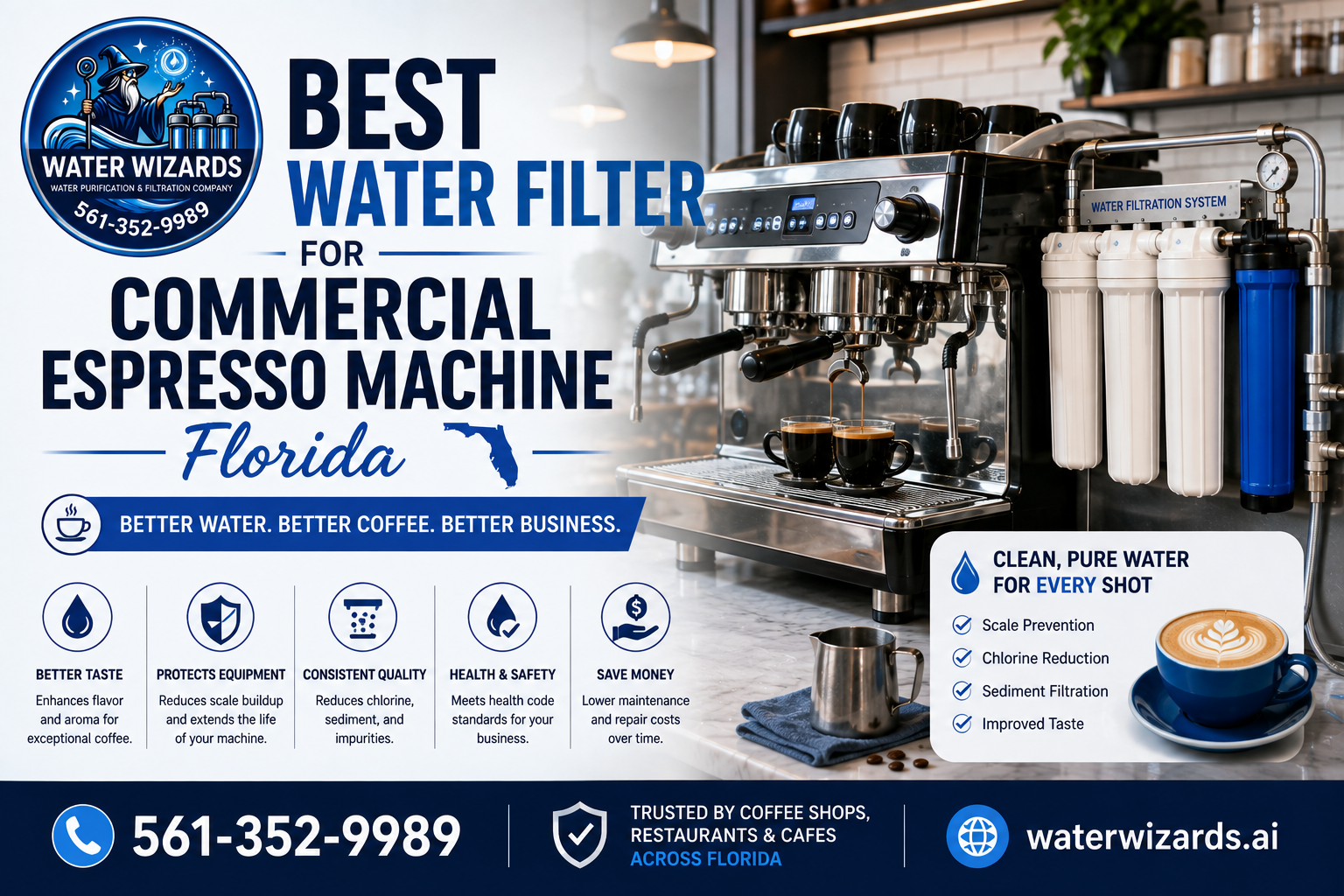
Best Water Filter for Commercial Espresso Machine Florida
Published by Jared Beviano · Water Wizards Filtration
A barista trainer I work with puts it this way: "The espresso machine gets all the credit. The water filter gets none of it. Until the machine breaks."
That's South Florida commercial espresso in a sentence. The equipment takes the blame. The water is the actual problem.
I've been testing water and installing filtration systems for commercial espresso operations across Palm Beach, Broward, and Miami-Dade for years. Every coffee shop owner I've worked with came to me after the machine — not before. After the scale buildup destroyed a group head. After the boiler element failed mid-service. After a barista spent six months adjusting grind and dose trying to fix a shot that couldn't be fixed because the water chemistry was wrong.
This article is the guide I wish every Florida coffee shop owner had before they bought their first commercial espresso machine. It covers why standard water filters fail at South Florida hardness levels, which systems actually work, and how to match a filter to your specific machine and water source.
Why Florida Is the Worst State for Commercial Espresso Machines
Commercial espresso machines are precision instruments. They're designed to operate within specific temperature, pressure, and water chemistry parameters. Water chemistry isn't a secondary concern — it's foundational.
South Florida water is chemically hostile to espresso machines in three specific ways:
Extreme hardness. Miami-Dade WASD delivers water at 22.4 GPG — more than three times the hardness threshold at which the Specialty Coffee Association says scale accumulates "rapidly." Palm Beach County Water Utilities runs 15–18 GPG. Broward County WWS runs 14–16 GPG. The national average is 6.3 GPG. Your Florida espresso machine is running on water two to three and a half times harder than what its manufacturer tested against.
Chloramine disinfection. Every major South Florida utility uses chloramine rather than free chlorine. Chloramine is more persistent, more corrosive to machine components over time, and significantly harder to remove than free chlorine. It requires catalytic carbon filtration, not standard activated carbon. Most cartridge filters sold at restaurant supply stores use standard carbon — they remove free chlorine but leave chloramine intact.
PFAS and other contaminants. Miami-Dade WASD has PFOS at 4.7 times the EPA's legal limit. These contaminants don't damage the machine, but they end up in every shot your customers drink. A commercial espresso filter system should address both the machine protection problem and the water quality problem simultaneously.
What Scale Does to a Commercial Espresso Machine
The scale problem in Florida is not gradual. At 22.4 GPG, scale accumulates inside your espresso machine at a rate that produces visible operational problems within weeks of installation on unfiltered water.
Boiler scale: The boiler maintains precise water temperature for extraction. At South Florida hardness levels, calcium carbonate deposits on the boiler heating element within months. Scale insulates the element — it takes longer to reach temperature, consumes more energy, and eventually fails. A scale-coated element uses 20–30% more electricity to achieve the same output. In an espresso machine running 8–10 hours per day, that's a meaningful energy cost premium.
Group head scale: Scale on the shower screen and dispersion block changes water flow distribution across the coffee puck. Water finds paths of least resistance rather than flowing evenly through the grounds. This channeling is one of the most common causes of inconsistent extraction in Florida espresso operations — and it's notoriously difficult to diagnose without knowing the water chemistry.
Heat exchanger scale: In HX machines, scale in the heat exchanger changes the temperature profile of water reaching the group. Shot temperature becomes inconsistent. Extraction becomes unpredictable.
Solenoid valves: Scale deposits on solenoid valve seats prevent complete closure. The valve starts dripping between shots, then stops functioning entirely. Solenoid replacement runs $150–400 depending on the machine.
Steam wand scale: Internal scale restricts steam flow. External scale hardens around the tip and creates hygiene issues. On machines running multiple milk drinks per hour, steam wand maintenance on hard water becomes a daily task.
The financial impact: a commercial espresso machine in South Florida on unfiltered water typically needs professional descaling every 6–8 weeks at $150–300 per service. With properly treated water: annually or less. Annual savings on descaling alone: $1,000–2,400 per machine.
The SCA Water Standard — Why It Matters for Your Machine
The Specialty Coffee Association publishes water quality standards for espresso. These aren't aesthetic preferences — they're the parameters within which the extraction chemistry works as designed and within which machines are engineered to operate.
SCA target ranges:
TDS: 75–150 ppm
Total hardness: 50–175 ppm (3–10 GPG)
pH: 6.5–7.5
Chlorine/chloramine: Zero
Sodium: Under 10 ppm
Every South Florida municipal water system fails every one of these criteria. Miami-Dade WASD at 383 ppm TDS and 22.4 GPG fails by a factor of 2–5x depending on the parameter.
The practical consequence: no filter that brings South Florida water into SCA compliance is a simple cartridge filter. It requires multi-stage treatment — at minimum hardness reduction and chloramine removal, and in most cases reverse osmosis followed by controlled remineralization.
The Four Types of Commercial Espresso Filters — and What Works in Florida
Type 1: Machine Cartridge Filters (Built-in or Inline Single-Stage)
These are the filters that come with most commercial espresso machines or are sold as compatible accessories — brands like Everpure, BWT, Purity, Omnipure. They typically combine a scale inhibitor (phosphate or template-assisted crystallization) with basic carbon filtration.
How they work: Scale inhibitors don't remove hardness — they modify calcium and magnesium ions so they form soft, powdery deposits rather than hard scale. The deposits still accumulate, but they're easier to flush out.
The Florida problem: Scale inhibitors are rated for specific hardness ranges. Most cartridges in this category are rated up to 15–18 GPG and tested at national average conditions. At 22.4 GPG WASD water, they exhaust rapidly — a cartridge rated for 6 months at 7 GPG may last 6–8 weeks at 22 GPG. The inhibitor chemistry stops working before the physical filtration media is exhausted. The machine scales. The filter looks fine. Nobody understands why.
Chloramine performance: Standard carbon block in these cartridges removes free chlorine. Most don't remove chloramine effectively. If you're on WASD, PBCWU, or Broward WWS — all of which use chloramine — a standard machine cartridge filter is not protecting your machine from chloramine corrosion or your shots from chloramine flavor suppression.
Verdict for Florida: Better than nothing. Not adequate as a sole treatment for most South Florida hardness levels. Appropriate as a final polishing stage after upstream treatment.
Type 2: Dedicated Softening + Carbon Systems (No RO)
A water softener upstream of the espresso machine plus catalytic carbon filtration addresses hardness and chloramine. The softener uses ion exchange to remove calcium and magnesium entirely. The catalytic carbon removes chloramine.
The result: Soft water (0–1 GPG) with no chloramine. This eliminates scale formation and chloramine damage. It does not bring TDS into the SCA target range — softened WASD water is still 383 ppm TDS, just sodium-rich rather than calcium-rich. It does not remove PFAS.
Flavor implications: Zero-hardness water from a softener extracts differently than the SCA target range. Espresso pulled on pure softened water can taste flat or harsh depending on the bean. For machine protection, this is excellent. For shot quality, it's incomplete without remineralization.
Best application: Food service operations where machine protection is the primary goal and shot quality optimization is secondary. High-volume QSR with espresso, hotel breakfast programs, catering operations.
Type 3: Reverse Osmosis Without Remineralization
An under-counter RO system strips water to 5–15 ppm TDS. Scale problem solved — there's essentially nothing in the water to scale. Chloramine removed. PFAS removed. Machine protection: excellent.
The problem: Zero-mineral water extracts espresso poorly. The flavor is flat, thin, and often sour. Without magnesium ions in particular, the extraction chemistry doesn't work properly. RO alone brings you to one end of the SCA range failure — instead of too many minerals, too few.
Some baristas and coffee shops run straight RO deliberately, arguing that starting from zero gives them control. They're not wrong — but "control" requires adding minerals back in controlled concentrations, which is the next category.
Best application: Not recommended as a standalone solution for specialty espresso. Appropriate for ice makers, steam tables, and non-espresso applications where TDS reduction is the goal and flavor complexity isn't.
Type 4: RO + Remineralization (The Correct Solution for Florida Specialty Espresso)
Reverse osmosis strips the water to a clean baseline. Remineralization adds back specific minerals — primarily magnesium and calcium — at concentrations targeted to the SCA range. The result is water at 75–150 ppm TDS with a controlled mineral profile, zero chloramine, and near-zero PFAS.
This is the only approach that simultaneously:
Brings TDS into the SCA target range
Eliminates scale formation
Removes chloramine
Removes PFAS
Gives the barista control over extraction chemistry
The remineralization stage can be implemented three ways, in increasing order of precision:
Blending valve: Mixes RO water with a percentage of bypass (pre-RO) water. Simple, inexpensive ($50–150 for the valve), and adjustable. TDS at the espresso station is set by adjusting the bypass ratio. Limitation: the mineral profile of the blend is whatever the source water contains — in South Florida, that means elevated sodium after a softener stage, or elevated calcium if bypassing the softener.
Remineralization cartridge: A cartridge containing food-grade magnesium and calcium compounds that dissolve into the RO water at controlled rates. More consistent than a blending valve. Better mineral profile control. Cost: $80–150 per cartridge every 6 months per station. Brands: Everpure Claris, BWT Bestmax, Third Wave Water Pro.
Mineral concentrate (Third Wave Water, Lotus Water): Pre-formulated mineral solutions added to RO water at a specific ratio per gallon. Maximum precision. Used by competition baristas and serious specialty operations. More complex to implement at commercial scale but delivers the most consistent results.
| System type | Removes scale? | Removes chloramine? | SCA compliant TDS? | Removes PFAS? | Shot quality | Installed cost | Best for |
|---|---|---|---|---|---|---|---|
| Machine cartridge only | ~ Partial | ✗ Usually not | ✗ No | ✗ No | Minimal improvement | $50–200/yr | Absolute minimum — not for SFL |
| Softener + catalytic carbon | ✓ Yes | ✓ Yes | ✗ No (still high TDS) | ✗ No | Good protection, flat shots | $2,800–5,000 | Machine protection priority |
| RO only (no remineralization) | ✓ Yes | ✓ Yes | ✗ Too low (5–15 ppm) | ✓ 95–99% | Flat, thin, sour | $1,200–2,500 | Ice makers, non-espresso use |
| RO + blending valve | ✓ Yes | ✓ Yes | ✓ Adjustable 75–150 ppm | ✓ 90–99% | Good — SCA compliant | $1,800–3,500 | Most Florida coffee shops |
| RO + remineralization cartridge ⭐ | ✓ Yes | ✓ Yes | ✓ Precise 85–130 ppm | ✓ 95–99% | Excellent — controlled profile | $2,000–4,500 | Specialty espresso — recommended |
| Full system: softener + carbon + RO + remineralization | ✓ Complete | ✓ Complete | ✓ Precise 85–130 ppm | ✓ 95–99% | Competition-level | $5,000–9,500 | WASD areas — complete protection |
Matching the Filter to Your Espresso Machine
Different machine types have different vulnerabilities and different flow requirements. Sizing matters — an undersized filtration system creates pressure drops that affect extraction consistency.
La Marzocca (Linea, Strada, GB5): Multi-boiler systems. High thermal mass means boiler scale has longer to accumulate before failure, but when it fails, repair is expensive. Recommend: RO + remineralization. La Marzocca specifically recommends 80–150 ppm TDS water.
Synesso: Known for precise temperature control. Scale on the heat exchanger directly affects temperature stability — the defining characteristic of the machine. Recommend: RO + remineralization.
Nuova Simonelli / Victoria Arduino: Popular in high-volume Florida operations. These machines have relatively tight flow paths in the group heads that are vulnerable to partial scale blockage. Recommend: softener + carbon at minimum, RO + remineralization for specialty applications.
Slayer: Single group, high-pressure pump profiling. Pressure consistency is critical — scale on the pump or solenoids affects profiling accuracy before thermal performance. Recommend: RO + remineralization.
Mahlkoenig grinder + any machine: Grinders don't touch water but are affected by it indirectly — when scale changes extraction, baristas compensate by adjusting grind, which shifts the grinder away from its optimal range. Solving the water problem often reveals that the grind was never the issue.
The Right Filter for Your Florida Water Source
Not all South Florida water is equally hard, and the right filter configuration depends on your specific utility.
If you're on Miami-Dade WASD (22.4 GPG, PFOS 4.7x EPA limit): You need RO. The hardness is too high for any scale inhibitor or softener-only approach to deliver SCA-compliant water economically. The PFAS situation makes RO a health and liability consideration, not just a quality one. Full system: whole-building softener + carbon + under-counter RO + remineralization cartridge.
If you're on Palm Beach County Water Utilities (15–18 GPG): Borderline for softener-only approaches. A high-capacity softener + catalytic carbon delivers machine protection. For specialty espresso quality, add RO + remineralization at the espresso station. Minimum viable: softener + carbon + blending valve.
If you're on Broward County WWS (14–16 GPG): Similar to PBCWU. Softener + carbon is viable for machine protection. RO + remineralization for shot quality. The chloramine issue is real — catalytic carbon is non-negotiable.
If you're on Seacoast Utilities (Palm Beach Gardens / Jupiter, 18–19 GPG): PFOA above EWG guidelines plus high hardness. RO recommended for both quality and water safety. Same full-system approach as WASD.
Maintenance Schedule for Florida Commercial Espresso Filtration
The most common failure mode in commercial espresso filtration is not equipment failure — it's neglected maintenance. A cartridge that's exhausted but hasn't been replaced provides no filtration while still restricting water pressure. Scale accumulates. The barista notices pressure drop. By the time anyone investigates, there's already scale in the group head.
Monthly:
TDS check at espresso station (target: 75–150 ppm). A $20 TDS meter takes 30 seconds.
Visual check on pressure gauges if installed
Every 3–4 months (South Florida hardness levels):
Sediment pre-filter cartridge replacement
Carbon pre-filter cartridge replacement
Every 6 months:
Remineralization cartridge replacement
System pressure check
Flush and sanitize filter housings
Annually:
RO membrane replacement (every 12–18 months)
Professional machine descaling inspection
Full system service
Immediately if:
TDS reading drifts above 150 ppm
Pressure drop at espresso station
Scale visible on shower screen after cleaning
Shot consistency changes without grinder or recipe adjustment
| Monthly TDS check at group head | $0 (meter) |
| 3 months Sediment pre-filter cartridge | $20–40 |
| 3 months Catalytic carbon cartridge | $30–55 |
| 6 months Remineralization cartridge | $80–150 |
| Annual RO membrane | $60–120 |
| Annual Machine descaling inspection | $150–250 |
| Annual System flush & sanitize | $0 (DIY) |
| Total annual filter maintenance | $500–900 |
| Monthly TDS check all stations | $0 (meter) |
| 3 months Pre-filter cartridges (×2) | $80–160 |
| 6 months Remineralization cartridges (×2) | $160–300 |
| Annual RO membranes (×2) | $120–240 |
| Annual Softener service + salt | $350–600 |
| Annual Machine descaling (×2) | $300–500 |
| Annual Pro system check | $150–250 |
| Total annual filter maintenance | $1,160–2,050 |
What to Tell Your Equipment Dealer
Most commercial espresso equipment dealers in South Florida don't proactively discuss water treatment. They sell you the machine, mention that "you'll want a filter," and move on. Here's what to ask:
"What water quality does this machine require?" Most manufacturers publish water quality specs. Get the document.
"What's the warranty position on scale damage?" Most commercial espresso machine warranties don't cover scale damage — it's classified as improper use or inadequate maintenance. Knowing this before the machine fails is more useful than knowing it after.
"What filter do you recommend for 15–22 GPG water with chloramine?" If the dealer recommends a single-cartridge solution for South Florida hardness without mentioning RO or at least a high-capacity softener, they're not accounting for your specific water conditions.
"Can you provide a water test?" A good equipment dealer or water treatment company should offer a water test before recommending a system. At Water Wizards, we test commercial espresso operations at no charge before recommending a configuration.
The Economics of Getting This Right
A commercial espresso machine in South Florida on unfiltered water has an expected service life of 4–6 years before scale damage necessitates major repair or replacement. With properly treated water: 10–12 years.
The difference in amortized annual equipment cost: $600–1,500 per year depending on machine value.
Add descaling service savings ($1,000–2,400 per year), energy premium from scale insulation (15–25% of espresso station energy cost), and the cost of inconsistent shot quality measured in customer retention — and the ROI on a properly designed South Florida commercial espresso filtration system is typically 8–14 months.
The coffee shop owner in Lake Worth I mentioned in the previous article — the one with the $14,000 La Marzocca and two years of sourcing training — calculated this after the fact. The filtration system that fixed her espresso cost $2,400 installed. She'd been running for eight months on unfiltered Seacoast water at 19 GPG. The scale was already forming.
She called it the best $2,400 she'd spent on the business. The second best was the machine. In that order.
Call 561-352-9989 for a free commercial water test
Water Wizards Filtration | Delray Beach, FL | Commercial espresso machine water filtration, water softeners, RO systems, and complete water treatment for coffee shops and specialty coffee operations throughout Palm Beach, Broward, and Miami-Dade counties.