Water Filtration for Coffee Shops in Florida: Why Your Espresso Tastes Wrong
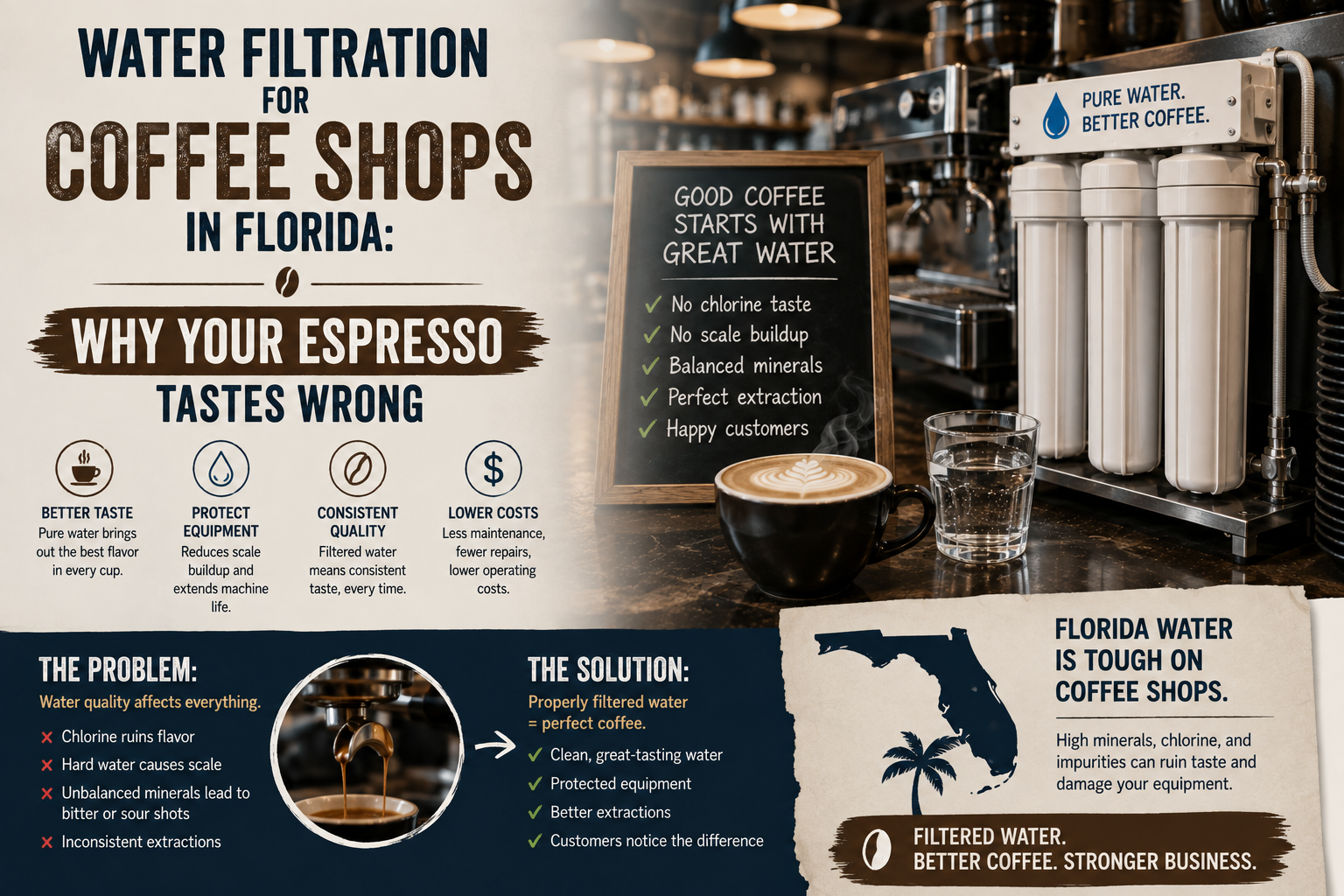
Published by Jared Beviano · Water Wizards Filtration
A specialty coffee shop owner in Lake Worth called me six months after opening. She'd spent two years sourcing beans. She'd trained with a roaster in Portland. She'd installed a $14,000 La Marzocca espresso machine. She was pulling shots that tasted nothing like what she'd trained on.
"The espresso is bitter and flat," she told me. "I've adjusted the grind a hundred times. I've changed the dose. I've changed the extraction time. Nothing works."
I drove out and tested her water before I looked at the machine.
Palm Beach County Water Utilities. 17 GPG hardness. TDS at 287 ppm. Chloramine present. pH at 7.8.
She'd built a world-class coffee program on water that was chemically incompatible with espresso extraction. Every shot she pulled was fighting the water. The beans couldn't win.
This is the most common and most expensive mistake I see in Florida coffee shops. The equipment is right. The beans are right. The training is right. The water is wrong — and nobody told them.
Why Water Is 98% of Your Espresso
Espresso is approximately 98% water by weight. The other 2% is extracted coffee solids — the oils, acids, sugars, and compounds that create the flavor. What that water contains, and what it doesn't, determines what gets extracted and what doesn't.
Water chemistry affects espresso extraction in three specific ways:
Mineral content drives extraction. Magnesium ions are particularly effective at binding to flavor compounds — they pull aromatics and fruity acids out of the coffee grounds. Calcium extracts differently, pulling more body and mouthfeel compounds. Zero-mineral water (like distilled water) extracts poorly and produces flat, thin espresso. Too much mineral content over-extracts and produces harsh, bitter shots.
Hardness causes scale that changes extraction. At South Florida hardness levels, scale builds inside espresso machine boilers, group heads, and heat exchangers within weeks of installation. Scale changes the thermal dynamics of extraction — the water temperature becomes inconsistent, and inconsistent temperature produces inconsistent shots. A machine running through descaling cycles is not running at spec.
Chloramine kills aroma. WASD and most South Florida utilities use chloramine for disinfection. Chloramine suppresses volatile aromatic compounds in coffee. The nose of an espresso — the floral, fruity, or chocolatey aromas that rise from the cup — is dramatically reduced in chloraminated water. You smell and taste less of what the bean is trying to express.
What South Florida Water Does to Your Coffee
Let me make this specific by utility.
If your coffee shop is in Miami-Dade County (WASD):
TDS: 350–420 ppm — more than double the SCA upper limit of 150 ppm
Hardness: 22.4 GPG (383 ppm) — more than double the SCA upper limit of 175 ppm
Chloramine: present throughout distribution
pH: typically 7.5–8.2 — above SCA's 7.5 upper limit
PFOS: 18.98 ppt — 4.7× the EPA's legal limit
Every single SCA water quality criterion fails. Every shot pulled from this water is fighting the chemistry before it ever gets to grind size or extraction time.
If your coffee shop is in Broward County (Broward County WWS):
TDS: 250–320 ppm — above SCA upper limit
Hardness: 14–16 GPG — above SCA upper limit
Chloramine: present
pH: 7.3–7.8
Most SCA criteria fail. Slightly better than WASD, but still incompatible with specialty espresso without treatment.
If your coffee shop is in Palm Beach County (PBCWU):
TDS: 230–300 ppm — above SCA upper limit
Hardness: 15–18 GPG — above SCA upper limit
Chloramine: present
pH: 7.4–8.0
Same situation as Broward. Better than WASD, still not usable for specialty coffee without treatment.
The SCA Water Standard — And Why Florida Fails All of Them
The Specialty Coffee Association publishes water quality standards for espresso based on peer-reviewed extraction chemistry research. These aren't suggestions. They're the parameters under which espresso extracts as designed.
| Parameter | SCA target range | Miami-Dade WASD | Broward County WWS | Palm Beach County PBCWU | After RO + remineralization |
|---|---|---|---|---|---|
| TDS (total dissolved solids) | 75–150 ppm | ✗ 350–420 ppm | ✗ 250–320 ppm | ✗ 230–300 ppm | ✓ 85–130 ppm |
| Total hardness | 50–175 ppm (3–10 GPG) | ✗ 383 ppm / 22.4 GPG | ✗ 240–275 ppm / 14–16 GPG | ✗ 255–310 ppm / 15–18 GPG | ✓ 75–130 ppm / 4–8 GPG |
| pH | 6.5–7.5 | ✗ 7.5–8.2 | ~ 7.3–7.8 | ~ 7.4–8.0 | ✓ 6.8–7.3 |
| Chlorine / chloramine | Zero | ✗ Chloramine present | ✗ Chloramine present | ✗ Chloramine present | ✓ Zero |
| Sodium | <10 ppm | ~ 15–25 ppm | ~ 12–20 ppm | ~ 10–18 ppm | ✓ <10 ppm |
| Magnesium | 10–30 ppm (ideal) | ~ Present but uncontrolled | ~ Present but uncontrolled | ~ Present but uncontrolled | ✓ 10–20 ppm (controlled) |
| Overall espresso compatibility | ✓ All criteria met | ✗ Fails all criteria | ✗ Fails 4 of 5 | ✗ Fails 4 of 5 | ✓ Meets all criteria |
What Happens to Your Espresso Machine
The flavor issue is real and immediate. The equipment damage is slower but more expensive.
At 22.4 GPG, scale accumulates inside your espresso machine at a rate that would take years in a low-hardness market. Here's what that means in practice:
Boiler scale: The boiler maintains precise water temperature for extraction. Scale on the boiler heating element acts as insulation — the element has to work harder to reach temperature, uses more energy, and eventually fails. Scale changes the thermal mass of the boiler, making temperature recovery slower and less consistent between shots.
Group head scale: Scale builds on the shower screen, dispersion block, and group head gaskets. It changes water flow distribution across the coffee puck, creating channeling — water finds paths of least resistance rather than flowing evenly through the grounds. Channeling is one of the most common causes of inconsistent extraction and is notoriously difficult to diagnose without knowing the water quality.
Heat exchanger scale: In heat exchanger machines (HX machines are common in commercial settings), scale in the heat exchanger changes the temperature profile of water reaching the group. This directly affects extraction temperature and produces shot-to-shot inconsistency.
Descaling frequency and cost: A commercial espresso machine in South Florida on unfiltered water typically needs professional descaling every 2–3 months at $150–300 per service. With properly treated RO water: once per year, sometimes less. Annual savings: $600–1,800 on a single machine.
The Right Water Treatment for a Florida Coffee Shop
The coffee shop water treatment challenge is different from a standard restaurant installation in one important way: you need water that's not just "clean" — you need water with a specific mineral profile.
Here's the mistake I see: coffee shop owners install a straight RO system and end up with water at 5–10 ppm TDS. Zero-mineral water extracts flat and sour. The RO removed everything, including the minerals that drive good extraction.
The right approach is RO plus remineralization — strip the water down and then add back the specific minerals at the specific concentrations the SCA standard requires.
Stage 1: Point-of-entry softening and carbon filtration Protects equipment building-wide. The softener addresses scale in dishwashers, sinks, and all non-espresso equipment. The catalytic carbon filter removes chloramine from every tap — important for all water in the shop, not just espresso.
Stage 2: Under-counter RO for espresso and brew station Takes the water from 250–380 ppm TDS down to 5–15 ppm. Removes PFAS, arsenic, chloramine residuals, and all dissolved minerals. This is the clean slate.
Stage 3: Remineralization Adds back magnesium and calcium at precise concentrations to hit the SCA target window. Two approaches:
Blending valve: Mixes RO water with a small percentage of bypass (pre-RO) water to add minerals back. Simple and inexpensive. The limitation is that the mineral profile of the blend is whatever the source water contains — you don't control what goes back in.
Remineralization cartridge: A cartridge containing food-grade magnesium and calcium compounds that dissolve into the RO water at controlled rates. More precise, higher cost ($80–150 per cartridge every 6 months).
Custom mineral concentrate: Used by third-wave coffee specialists — small volumes of a precisely formulated mineral solution added to RO water to hit an exact target profile. Maximum control, most complexity. Brands like Third Wave Water sell pre-formulated concentrates designed for espresso.
For most Florida specialty coffee shops, the blending valve approach or a remineralization cartridge delivers water in the SCA target range at reasonable cost and complexity.
| Option | How it works | SCA compliant? | Best for | Installed cost | Annual cost |
|---|---|---|---|---|---|
| Machine cartridge only | Basic softening or carbon block built into machine. Minimal treatment. | ~ Partial | Absolute minimum. Better than nothing. | $50–150/yr cartridge | $50–150 |
| Whole-shop softener + carbon | Softener removes hardness. Catalytic carbon removes chloramine. No RO. | ~ Partial | Equipment protection. Taste improvement. TDS still too high for SCA. | $2,800–4,500 | $300–500 |
| RO (no remineralization) | Strips water to 5–15 ppm TDS. Clean but mineral-free. | ~ Partial | Removes contaminants. TDS too low — extracts flat and sour without minerals added back. | $1,200–2,500 | $200–350 |
| RO + blending valve | RO water blended with small % bypass water to add minerals back. TDS adjustable. | ✓ Yes | Good for most Florida shops. Affordable. Mineral profile depends on source water composition. | $1,800–3,500 | $200–400 |
| RO + remineralization cartridge | RO water passes through food-grade mineral cartridge. Adds controlled Mg + Ca. | ✓ Yes | More precise than blending valve. Consistent regardless of source water changes. | $2,000–4,000 | $350–600 |
| RO + mineral concentrate (Third Wave Water) | RO water + pre-formulated mineral solution added per gallon. Maximum control. | ✓ Yes | Competition-level precision. Used by serious third-wave operators and competition baristas. | $1,500–3,000 | $400–700 |
| Full system: softener + carbon + RO + remineralization | Whole-shop softener/carbon for equipment protection. RO + remineralization for espresso station. | ✓ Yes — complete | The complete solution. Equipment protected building-wide. Espresso water dialed in precisely. | $5,000–9,000 | $500–900 |
Ice and Cold Brew
Everything above applies to your espresso. Your cold brew and iced drinks add another dimension.
Cold brew: Cold brew uses a long extraction time — 12–24 hours — which amplifies the effect of water chemistry. High-TDS South Florida water over-extracts cold brew, producing a harsh, bitter concentrate. RO water under-extracts, producing a weak, sour result. The sweet spot for cold brew is 100–150 ppm TDS — achievable with the same RO plus remineralization setup you're using for espresso.
Ice: Your ice is made of water. If your ice maker is running on unfiltered municipal water at 380 ppm TDS with chloramine, every iced drink in your shop is delivering that chemistry to the customer as the ice melts. A dedicated pre-filter on your ice maker at minimum — ideally RO water to the ice maker — makes a visible and tasteable difference. Clearer ice, no off-flavor as it melts.
Batch brew: For filter coffee — pour-over, batch brew, Chemex — the SCA standard is the same target window. The same RO plus remineralization setup that works for espresso works for filter brewing.
What Competitors Are Doing (And Not Doing)
In my experience across South Florida, the majority of coffee shops — including ones with excellent equipment and good training — are running on unfiltered or partially treated municipal water. This is a real competitive advantage for any shop willing to invest properly in water treatment.
The specialty coffee customer who can taste the difference between a well-extracted and poorly-extracted shot will absolutely notice the difference between a shop running SCA-compliant water and one running on 380 ppm TDS chloraminated municipal water. They may not articulate it as "the water chemistry is wrong" — they'll just know that their espresso is better at your shop.
In markets like Portland, Seattle, and New York — where the specialty coffee culture is most developed — serious operators treat water as part of their product. Florida is behind on this. Which means the shops that get it right now are differentiating on something most of their competition isn't even thinking about.
Common Questions from Florida Coffee Shop Owners
"My machine has a built-in water filter — isn't that enough?"
Most commercial espresso machines come with a basic softening cartridge or a simple carbon block filter. These are minimal — they reduce scale and improve taste somewhat, but they don't bring South Florida water into the SCA target range. They're better than nothing. They're not a water treatment system.
"Can I just use bottled water?"
For a low-volume operation, yes — some coffee shops use bottled spring water or purified water for their espresso. The economics don't scale: at $1–1.50 per gallon for commercial bottled water, a shop pulling 80 shots per day at 2 oz of water per shot plus waste uses roughly 1.5 gallons per day on espresso alone, before batch brew, cold brew, or ice. That's $500–750 per year in water for espresso — compared to $200–350 per year in RO maintenance. And bottled water consistency varies by brand and batch.
"What TDS should my espresso water be?"
SCA target: 75–150 ppm. My personal recommendation for most South Florida sourcing: aim for 90–120 ppm with a magnesium-forward mineral profile. Test with a $20 TDS meter at the espresso station. Adjust the blending valve or remineralization cartridge until you're in range.
"How often do I need to replace the RO membrane?"
For a typical coffee shop: every 18–24 months. Pre-filters (sediment and carbon) every 6 months. Remineralization cartridge every 6 months. Total annual maintenance cost for a single-station under-counter RO: $200–400.
| Monthly TDS check at espresso station | $0 (TDS meter) |
| 6 months Sediment pre-filter cartridge | $25–50 |
| 6 months Carbon pre-filter cartridge | $30–60 |
| 6 months Remineralization cartridge | $80–150 |
| Annual RO membrane replacement | $60–120 |
| Annual Softener service + salt | $200–350 |
| Annual Machine descaling (with RO) | $150–250 |
| Total annual maintenance | $545–980 |
| Monthly TDS check — all stations | $0 (TDS meter) |
| 6 months Pre-filter cartridges (×2) | $80–150 |
| 6 months Remineralization cartridges (×2) | $160–300 |
| Annual RO membranes | $120–240 |
| Annual Softener service + salt | $350–600 |
| Annual Machine descaling (×2, with RO) | $300–500 |
| Annual Professional system check | $150–250 |
| Total annual maintenance | $1,160–2,040 |
The Shot That Changed Her Mind
Back to the coffee shop owner in Lake Worth.
We installed an under-counter RO with a blending valve set to deliver 95 ppm TDS water to her La Marzocca. Catalytic carbon filter on the whole shop for chloramine. Water softener protecting the building equipment.
She called me two weeks later. "It tastes like what I trained on," she said. "I finally understand what the roaster was trying to tell me about the bean."
She hadn't changed her grind. She hadn't changed her dose. She hadn't changed her extraction time. She changed the water. Everything else followed.
Your espresso machine is not broken. Your beans are probably fine. Your technique is probably fine. Start at the water.
Call 561-352-9989 for a free commercial water test
Water Wizards Filtration | Delray Beach, FL | Water treatment for coffee shops, espresso bars, and specialty coffee operations throughout Palm Beach, Broward, and Miami-Dade counties.