Commercial Reverse Osmosis System for Restaurant: Is It Worth It in Florida?
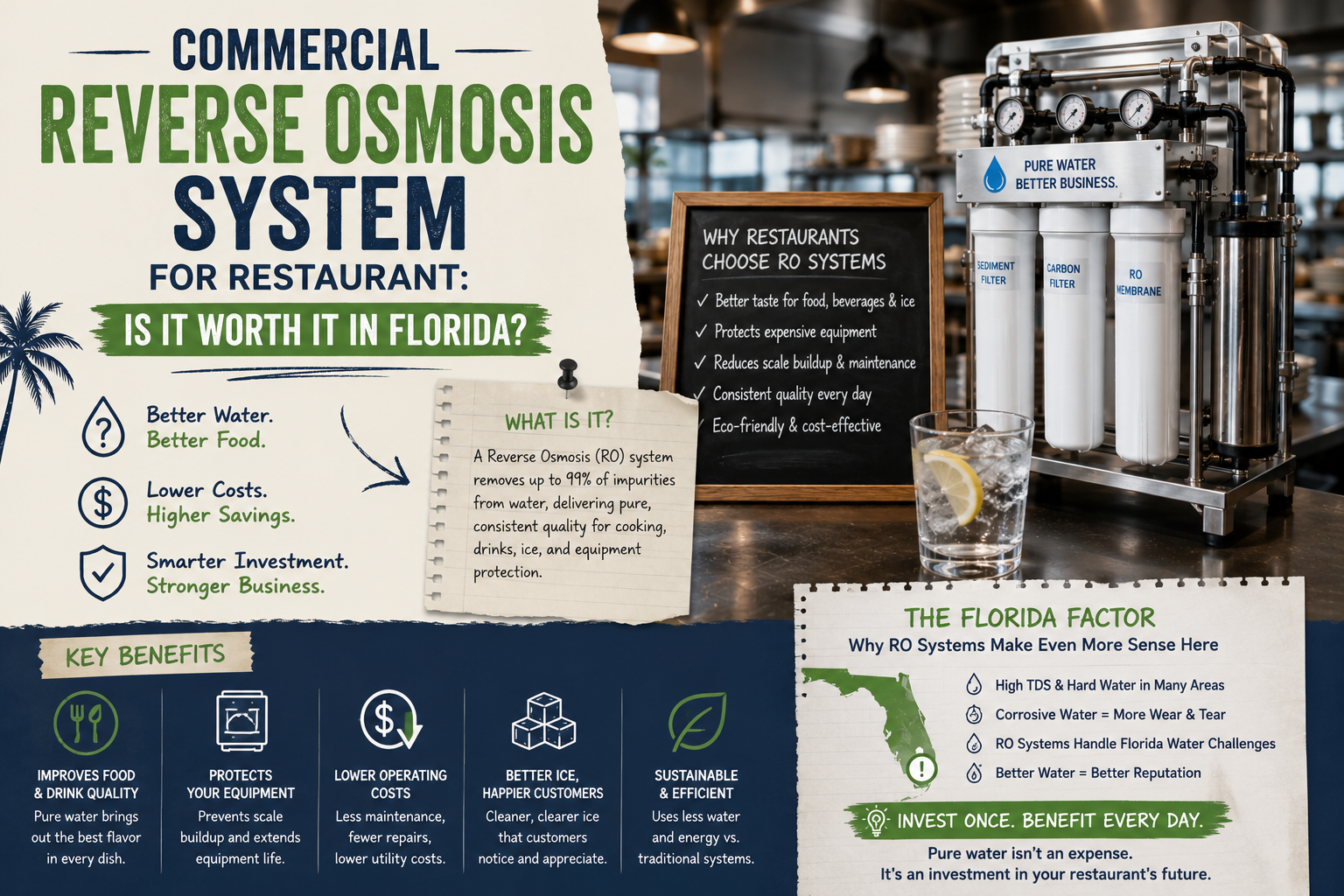
Published by Jared Beviano · Water Wizards Filtration
A bar manager in Wynwood called me last year. They'd just opened a craft cocktail bar — serious program, serious investment. Japanese whisky. Small-batch bourbon. Housemade syrups and shrubs. The kind of place where the water in your ice matters.
He'd done everything right except the water. His ice was cloudy. His cocktails tasted flat. His bartenders were complaining that the spirit profiles they'd trained on were coming out different at the bar than in tasting rooms. He'd already had the ice machine serviced twice.
Miami-Dade WASD water. 22.4 GPG. PFOS at 4.7× the EPA limit. TTHMs above EWG guidelines. TDS running around 380 ppm.
He asked me one question: "Do I need a commercial RO system, or is there something simpler?"
The honest answer is: it depends. And in South Florida, the answer leans toward yes more often than in most markets. Here's how to think through it.
What a Commercial RO System Actually Does
Reverse osmosis forces water through a semi-permeable membrane with pores at 0.0001 microns — small enough to block virtually everything except water molecules. What comes out is water stripped of 90–99% of dissolved solids, contaminants, and minerals.
For a restaurant, that means:
PFAS removed at 90–99%
Arsenic removed at 90–96%
Nitrates removed at 85–95%
Chromium-6 removed at 95–99%
Lead removed at 95–98%
Hardness reduced by 90–99%
TDS dropped from 300–450 ppm (typical South Florida municipal) to 20–50 ppm
Chloramine and TTHMs removed through pre-filters
Water that is chemically neutral and essentially pure
For comparison: bottled spring water typically runs 50–150 ppm TDS. RO water comes out cleaner than most bottled water, at a fraction of the cost per gallon, on demand.
The question isn't whether commercial RO produces better water. It does. The question is whether that level of water quality is worth the installation and operating cost for your specific operation — and which parts of your restaurant actually need it.
Where Commercial RO Makes an Undeniable Difference in Florida
Espresso and Specialty Coffee
This is the clearest case. The Specialty Coffee Association sets water quality standards for espresso extraction:
TDS: 75–150 ppm
Hardness: 50–175 ppm (4–10 GPG)
Zero chlorine or chloramine
pH: 6.5–7.5
South Florida municipal water fails every single criterion. Miami-Dade WASD runs 380+ ppm TDS and 22.4 GPG hardness. Palm Beach County Water Utilities runs 250–300 ppm TDS and 15–18 GPG. The chloramine in both systems kills aroma extraction and adds off-notes that no grind adjustment or extraction parameter can compensate for.
An espresso machine connected to properly treated RO water extracts differently — the chemistry of extraction changes when the mineral content and pH are correct. Baristas who've worked with RO water describe it as unlocking the coffee they knew was in the beans but couldn't find.
The practical side: RO also dramatically extends espresso machine life in South Florida. A commercial espresso machine running on unfiltered municipal water at 22.4 GPG needs descaling every 2–3 months at $150–300 per service. Connected to RO water: descaling once a year, maybe less. For a machine worth $8,000–25,000, that's not a minor point.
Craft Cocktails and Bar Programs
Water is the largest ingredient in every cocktail. Ice is water. The water used to rinse glassware is water. The water used in housemade syrups, shrubs, and infusions is water.
At 380 ppm TDS with chloramine, Miami-Dade water changes the flavor profile of spirits. High mineral content creates a heavier mouthfeel that works against delicate spirits. Chloramine suppresses aromatic compounds — the nose of a fine whisky or gin opens differently in neutral water versus chloraminated water.
Crystal-clear ice requires low-TDS water. Cloudy ice is air and dissolved solids trapped during freezing. RO water at 20–30 ppm TDS produces dramatically clearer ice than municipal water at 380 ppm — important for a cocktail program that's charging $18 a drink.
Filtered Water Service
Restaurants that serve filtered water — from a dedicated tap, a countertop unit, or a still/sparkling system — need RO as the backbone of that service. Serving municipal water as "filtered water" when it still contains PFAS at 4.7× the EPA's legal limit is a liability and a brand risk.
RO water at a customer-facing filtered water station delivers water that genuinely tastes different — cleaner, lighter, without the chemical aftertaste that South Florida municipal water carries. Customers notice.
Ice Program
If your ice program matters — and for any full-service restaurant it should — RO makes a visible difference. Clearer ice. Better mouthfeel. No chloramine off-flavor that accumulates as ice melts in a drink. Ice made from 380 ppm TDS water releases that mineral load into a cocktail or a glass of water as it melts. Ice made from RO water at 20 ppm TDS releases essentially nothing.
Where RO Is Overkill — And What to Use Instead
I'll be direct about this: commercial RO is not the right answer for every water point in a restaurant. A whole-building RO system for a 150-seat restaurant is expensive, produces significant wastewater, and provides more treatment than most applications actually need.
Your dishwasher doesn't need RO water. It needs soft water. A water softener addresses the scale problem in commercial dishwashers at a fraction of the cost of RO. RO water in a dishwasher is like using a Ferrari to do grocery runs — technically works, massively overbuilt for the application.
Your hand sinks don't need RO. They need soft, clean water — softener plus carbon filter handles this well.
Your steam oven needs soft water, not RO. The scale prevention in a steam generator comes from removing hardness. A softener addresses this. RO is more than necessary.
Your prep sinks need clean water, not RO. Carbon filtration and softening provide more than adequate water quality for food prep.
The right approach in South Florida is almost always a combination: a whole-building water softener and carbon filter for general use, plus point-of-use RO at the specific stations where output quality matters — espresso, filtered water service, bar program, ice.
This hybrid approach costs significantly less than whole-building RO, produces less wastewater, and delivers exactly the level of treatment each application actually needs.
Commercial RO System Options for Restaurants
Commercial RO systems for food service come in three main configurations.
Under-counter point-of-use RO (100–500 GPD) Designed for a single station — an espresso machine, a filtered water tap, a bar station. Sits under the counter, feeds a dedicated faucet or connects directly to equipment. This is the most common commercial RO application in South Florida restaurants. Cost: $800–2,500 installed per station.
Central RO with distribution to multiple points (500–2,000 GPD) A single central RO unit that feeds treated water to multiple stations throughout the kitchen and bar. More economical than multiple individual units when you have three or more RO points. Requires a distribution loop and storage tank. Cost: $3,500–8,000 installed.
High-volume commercial RO (2,000+ GPD) For high-volume operations — large restaurants, hotel restaurants, commissary kitchens. Typically stainless steel systems with multiple membrane elements, automatic flushing, and built-in monitoring. Cost: $8,000–20,000+ installed.
| System type | Capacity | Best for | Reject ratio | Installed cost | Annual maintenance |
|---|---|---|---|---|---|
| Under-counter point-of-use RO | 100–500 GPD | Single espresso station, bar tap, filtered water faucet | 2:1 – 4:1 | $800–2,500 | $150–300 |
| Central RO with distribution loop | 500–2,000 GPD | 3+ RO points in same restaurant — espresso + bar + filtered water | 1.5:1 – 3:1 | $3,500–8,000 | $400–700 |
| High-volume commercial RO | 2,000–5,000 GPD | Hotel restaurants, banquet kitchens, commissary operations | 1.5:1 – 2:1 | $8,000–20,000 | $800–1,500 |
| RO + remineralization | 100–2,000 GPD | Specialty coffee requiring specific mineral profile (SCA standard) | 2:1 – 3:1 | $1,500–6,000 | $300–600 |
| RO + still/sparkling system | 200–500 GPD | Fine dining filtered water service, tableside water program | 2:1 – 3:1 | $3,000–8,000 | $400–700 |
The Wastewater Question
Commercial RO produces reject water — water that carries the concentrated minerals and contaminants rejected by the membrane. Traditional RO systems produce 3–4 gallons of reject water per gallon of treated water (a 3:1 or 4:1 ratio).
For a restaurant, this wastewater goes down the drain. At a busy espresso bar producing 50 gallons per day of RO water, that's 150–200 gallons per day of reject water — real water cost and real drain load.
Modern high-efficiency commercial RO membranes have improved this significantly. Better systems now run 1.5:1 or 2:1 ratios — one gallon of reject for every gallon or two of treated water. Permeate pumps and pressure-assisted systems push efficiency further.
When evaluating commercial RO options for a South Florida restaurant, the reject ratio is a real cost consideration. Ask for the specific ratio on any system you're evaluating and calculate the annual water cost differential.
RO vs. Alternatives: The Honest Comparison
| Application | RO needed? | Softener alone? | Carbon + softener? | Recommendation |
|---|---|---|---|---|
| Commercial espresso machine | ✓ Yes | ✗ Not enough | ~ Better, not ideal | RO + remineralization |
| Filter coffee / pour-over bar | ✓ Yes | ✗ Not enough | ~ Better, not ideal | RO + remineralization |
| Craft cocktail ice program | ✓ Strongly | ~ Partial benefit | ~ Better, not ideal | RO for ice maker |
| Customer filtered water service | ✓ Yes | ✗ No | ✗ No | RO + still/sparkling |
| Commercial dishwasher | ✗ Overkill | ✓ Yes | ✓ Yes | Softener only |
| Steam oven / combi oven | ✗ Overkill | ✓ Yes | ✓ Yes | Softener only |
| Food prep / cooking water | ~ Optional | ✓ Yes | ✓ Yes | Carbon + softener |
| Hand sinks / restrooms | ✗ Not needed | ✓ Yes | ✓ Yes | Softener only |
| Ice maker (casual dining) | ~ Recommended | ~ Partial | ✓ Good | Carbon + softener minimum |
| Fountain drinks / soda guns | ~ Recommended | ✗ No | ~ Better | RO for best taste |
The Cost Picture
| Under-counter RO (installed) | $1,200–2,000 |
| Annual membrane + filters | $200–350 |
| Espresso descaling — before RO | $800–1,800/yr |
| Espresso descaling — after RO | $150–250/yr |
| Bottled water eliminated | –$400–800/yr |
| Net annual savings | $850–2,100/yr |
| Under-counter RO for bar (installed) | $1,500–2,500 |
| Annual membrane + filters | $250–400 |
| Ice machine service — before RO | $600–1,200/yr |
| Ice machine service — after RO | $100–200/yr |
| Ice machine life extended | $500–1,000/yr |
| Net annual savings | $750–1,600/yr |
| Central RO system (installed) | $4,000–7,000 |
| Annual maintenance | $500–800 |
| Bottled water service eliminated | –$2,400–4,800/yr |
| Equipment protection (ice + espresso) | $1,200–2,500/yr |
| Customer water complaints reduced | Immeasurable |
| Net annual savings | $3,100–6,500/yr |
| Central RO + still/sparkling (installed) | $10,000–20,000 |
| Annual maintenance | $1,000–1,800 |
| Bottled water service eliminated | –$8,000–18,000/yr |
| Equipment protection (full kitchen) | $2,000–4,000/yr |
| Brand / guest experience value | Significant |
| Net annual savings | $9,000–20,000/yr |
What I Actually Recommend for Most South Florida Restaurants
After testing and installing water treatment systems in restaurants across Palm Beach, Broward, and Miami-Dade counties, here's the honest answer to whether commercial RO is worth it:
For coffee shops and espresso-focused operations: Yes, unambiguously. The quality difference in the cup is immediate and significant. The equipment protection over time is substantial. Under-counter RO at your espresso station is the single highest-ROI water treatment investment you can make in a specialty coffee context.
For craft cocktail bars: Yes. Ice clarity, spirit expression, and the ability to control the water profile going into your program make RO standard for any serious bar operation. The investment pays back through product quality and reduced ice machine service.
For full-service restaurants with a filtered water program: Yes, for the customer-facing filtered water station. PFAS at 4.7× the EPA limit is not something you want to serve as "filtered water." RO at the water service point is both a quality and a liability decision.
For high-volume casual restaurants without a specialty beverage program: Probably not whole-building RO. A whole-building softener and carbon filter handles the equipment protection and taste issues at lower cost and complexity. Add point-of-use RO if and when you develop a program that benefits from it.
For any restaurant in Miami-Dade on WASD water: The PFAS situation makes under-sink RO at any customer-facing water point worth serious consideration. Serving water with PFOS at 4.7× the federal limit — whether in a glass of water, as ice, or as the base of a beverage — is a decision restaurants should make consciously, not by default.
The right answer for your operation starts with a water test. Know what you're working with. Build the system around your specific chemistry, your specific equipment, and your specific program.
We do commercial water testing at no charge throughout South Florida.
Call 561-352-9989 to schedule a free commercial water test
Water Wizards Filtration | Delray Beach, FL | Commercial RO systems, water softeners, and complete water treatment for restaurants, coffee shops, and food service businesses across Palm Beach, Broward, and Miami-Dade counties.