
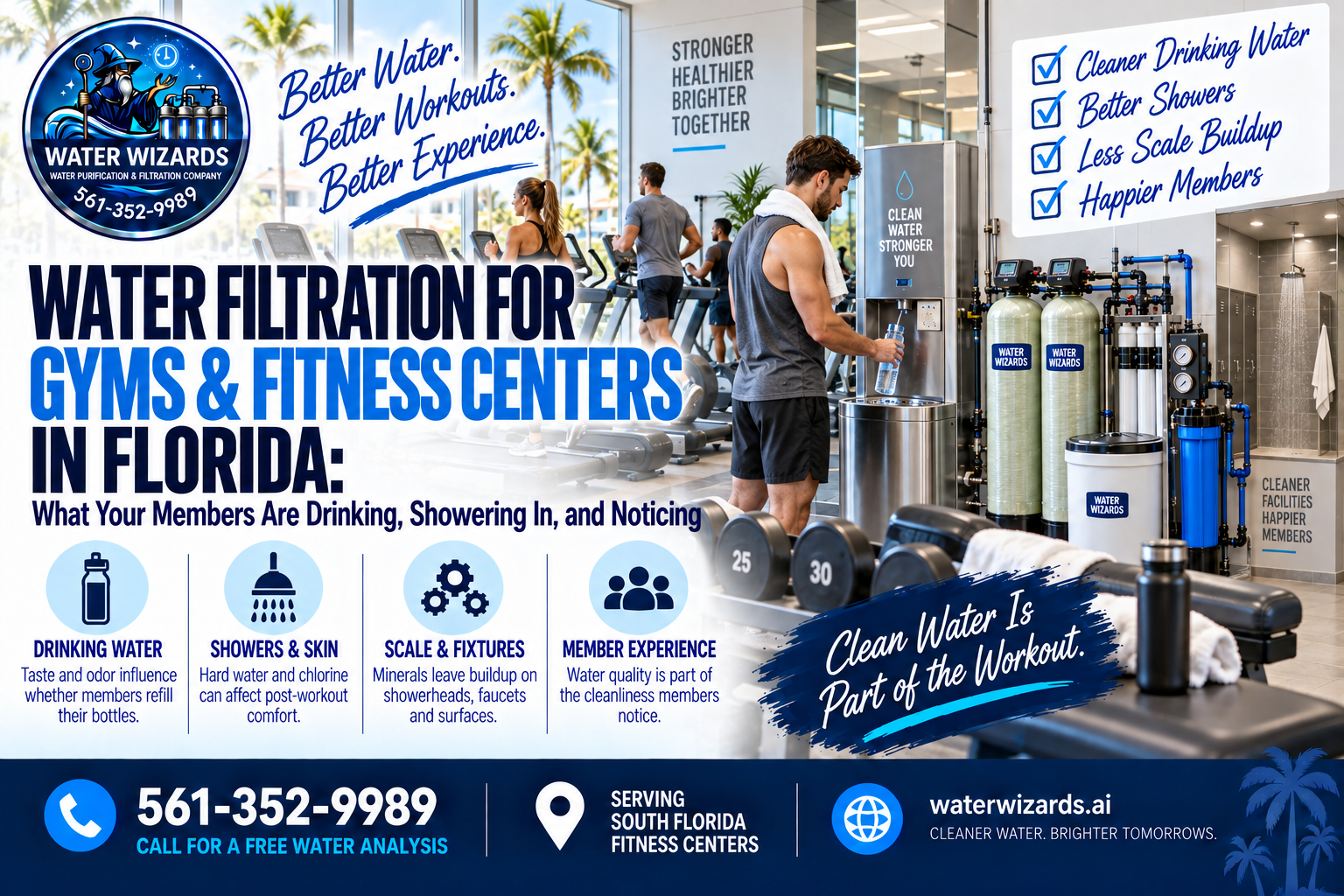
Water Filtration for Gym and Fitness Center Florida: What Your Members Are Drinking, Showering In, and Noticing
Published by Jared Beviano · Water Wizards Filtration
A gym owner in Coral Springs called me after losing three commercial water dispensers in two years. The machines kept failing — scale buildup on heating elements, clogged water lines, erratic temperature control. His equipment supplier told him the machines were fine and blamed the water. He'd been dismissing that as a sales pitch until the third dispenser failed and he started doing the math.
Three commercial water dispensers at $800–1,200 each. Two service calls per machine per year at $150–200 each. Staff time managing complaints about water quality and dispenser downtime. Members mentioning the water tasted off. One longtime member commenting that the showers left her skin feeling tight and dry after every workout.
He called me because a friend at another gym in the area had installed a water treatment system and stopped having equipment problems.
I tested his water. Broward County WWS at 15 GPG, 257 ppm TDS, chloramine throughout, chromium-6 and PFAS above EWG health guidelines. Then we walked his facility. The showerheads had visible mineral deposits. The steam room was running every other day because scale was blocking the steam generator. The commercial ice maker in the juice bar was two months overdue for descaling. His water dispensers were fighting the same chemistry as everything else in the building.
The water treatment system we installed cost $8,400. His third-year savings in equipment service, chemical reduction, and dispenser replacements exceeded $11,000. His member complaints about water quality stopped within the first week.
Why Gyms and Fitness Centers Have Unique Water Quality Challenges
A gym uses water differently than almost any other commercial facility. Members drink large quantities during workouts — often more than at any other point in their day. They shower immediately after exercise when their skin and pores are open and most receptive to absorption. Steam rooms and saunas use water directly in the environment members breathe. Ice from the juice bar goes directly into member drinks.
Every one of these applications is affected by South Florida water quality in ways that directly touch member experience and member retention.
Drinking water during workouts: A serious gym member doing a 60-90 minute training session drinks 16–32 ounces of water, often directly from a facility dispenser or fountain. If that water contains chloramine at levels that produce a chemical taste, PFAS above health guidelines, or chromium-6 above EWG cancer risk guidelines, the member is consuming that water in significant quantity during the period when their body is most metabolically active. The health concern is real. The taste concern is immediate — and a gym with bad-tasting water loses members to gyms with better water.
Showering post-workout: The post-workout shower is one of the most consistent member experiences in a fitness facility. A member who showers at your gym after every workout may take 300+ showers per year at your facility. Each shower is a chloramine exposure event — chloramine is absorbed through skin and inhaled in steam during a hot shower. Over 300 showers per year in an enclosed shower stall with chloramine-containing water, the cumulative exposure is meaningful.
Hard water in the shower also produces the tight, dry skin sensation after showering — the mineral film that hard water leaves on skin and hair. A gym member who feels clean at home but feels dry and stripped at the gym connects that experience to your facility's quality. It affects perception of cleanliness, which affects membership renewal decisions.
Steam rooms: A steam room heats water to produce steam that members breathe directly. Whatever is in that water — chloramine, dissolved minerals, disinfection byproducts — is aerosolized and inhaled at elevated concentrations compared to drinking. A steam room running on unfiltered Broward County or Miami-Dade water is delivering chloramine and disinfection byproducts to members' lungs at every session. Scale buildup in the steam generator from hard water is the most common cause of steam room downtime in South Florida fitness facilities.
Ice and water at juice bars: Ice made from unfiltered South Florida water contains the same contaminants as the source water, concentrated by the freezing process. For a juice bar or smoothie station serving members multiple times per week, the quality of the water and ice is a direct product quality issue — and a health and liability consideration when PFAS above EPA limits is in the source water.
Equipment and plumbing: At 14–22 GPG, every water-using piece of equipment in a fitness facility is at risk. Commercial dishwashers in the smoothie bar, water heaters serving multiple showers, steam generators, ice machines, water dispensers, and even the facility's HVAC humidification system all face premature failure from scale at South Florida hardness levels.
What Members Notice — and What They Don't Say
Member experience feedback about water quality is usually indirect. Members don't typically file a complaint saying "your water contains 15 GPG hardness and I noticed chloramine notes in the shower steam." They say things like:
"The showers here dry out my hair." "Something tastes off with the water from the fountain." "The steam room is always broken." "I feel cleaner after I shower at home." "I've been bringing my own water bottle."
These comments — heard individually, they seem like minor preferences. Heard together, they're a pattern that water treatment solves directly.
The members who don't say anything are more concerning. Research on gym member retention consistently identifies facility cleanliness and amenity quality as top factors in renewal decisions. Water quality is a component of facility cleanliness that members perceive physically — the feel of their skin after a shower, the taste of the drinking water, the functioning of the steam room — even when they can't articulate what the problem is.
A gym with a reputation for excellent facilities retains members. Water treatment is part of what makes facilities excellent. It's not visible — nobody walks in and sees the water softener — but members feel the difference within the first week of improved water quality.
| Member touchpoint | Water issue (unfiltered SFL) | Member experience | Health concern | Treatment solution |
|---|---|---|---|---|
| Drinking water / dispensers | PFAS above EPA MCL · Chromium-6 above EWG · Chloramine taste | Chemical taste · Members bring own water | PFAS bioaccumulation · Cancer risk guideline exceeded | Under-counter RO at each station |
| Showers (post-workout) | 14–22 GPG hardness · Chloramine throughout | Dry / tight skin · Scale on showerheads · "Not clean" feel | Dermal chloramine absorption · 300+ exposures/yr for regular members | Whole-building softener + carbon |
| Steam room | Hard water scale · Chloramine aerosolized in steam | Frequent downtime · Respiratory irritation · Off smell | Chloramine inhaled in enclosed steam environment | Dedicated RO on steam generator |
| Juice bar / smoothies / ice | PFAS · TDS 240–383 ppm · Chloramine flavor | Off flavor in drinks · Ice quality complaints | PFAS in ice and beverages — concentrated during freezing | RO at juice bar and ice machine |
| Towels / laundry | Hard water — mineral deposit in fibers | Rough, scratchy towels · Reduced absorbency over time | No direct health risk | Whole-building softener |
| Sauna / recovery rooms | Hard water deposits on surfaces | Scale buildup on benches and stones · Cleaning frequency | Minimal direct risk | Softener for facility water |
South Florida Specific Water Issues for Fitness Facilities
Miami-Dade WASD (22.4 GPG, PFOS 4.7× EPA limit): The highest-hardness and highest-PFAS situation in South Florida. At 22.4 GPG, scale accumulation in showers, steam rooms, water heaters, and equipment is aggressive — visible deposits form within weeks of installation without treatment. PFOS at 4.7 times the EPA's new MCL means that every member drinking facility water, showering in it, or breathing steam from it is exposed to PFAS at levels the EPA has determined are unsafe. This is the strongest case for comprehensive water treatment among all South Florida utilities.
Broward County WWS (14–16 GPG): High hardness, chloramine throughout, chromium-6 and PFAS above EWG health guidelines. The hard water problem in Broward facilities is significant — at 14–16 GPG, showerheads build scale within months, steam generators require quarterly descaling, and water heaters fail prematurely. Chloramine in the shower and steam room is a consistent exposure concern.
Palm Beach County PBCWUD (16–17 GPG): Similar profile to Broward — high hardness, chloramine, PFAS and chromium-6 above EWG guidelines. Palm Beach fitness facilities face the same equipment and member experience challenges.
Seacoast Utilities — Jupiter / Palm Beach Gardens (18–19 GPG): Among the highest hardness levels in the county. PFOA above EWG guidelines in addition to the standard contaminant profile. Facilities on Seacoast water see accelerated scale formation and higher-than-average equipment replacement rates.
The Right Water Treatment System for a Florida Fitness Facility
The correct approach for a gym or fitness center addresses water quality at multiple points — whole-facility treatment for equipment protection and shower quality, plus point-of-use treatment for drinking water and steam.
Small / boutique fitness studio (under 2,000 sq ft, limited equipment):
Priority 1 — Drinking water: Under-counter RO at water stations and juice bar. Members drinking your facility's water should be drinking water that's cleaner than most bottled water — not water with PFAS above EPA limits. A 4-stage RO system under each water station delivers sub-15 ppm TDS water at the tap. Cost: $600–1,200 per station installed.
Priority 2 — Shower quality: Whole-building water softener removes the hardness that causes dry skin, mineral film, and scale on showerheads. This is the change members feel most immediately. At 14–22 GPG, a properly sized softener transforms the shower experience. Cost: $2,500–4,500 installed.
Priority 3 — Chloramine removal: Catalytic carbon filtration removes chloramine from all water in the facility — showers, drinking, steam if applicable. Cost: $800–1,500 installed.
Mid-size gym (2,000–8,000 sq ft, full locker rooms, steam room, juice bar):
Whole-building softener + catalytic carbon: First priority — addresses hardness and chloramine throughout the facility. Protects showers, water heaters, steam generator, ice machine, and commercial dishwasher simultaneously. Size the softener for peak demand, not average daily use — morning rush at a gym can mean 20–40 showers in 30 minutes. Cost: $4,000–8,000 installed.
RO at juice bar and water stations: Point-of-use treatment for drinking water and ice. Separate RO circuits for the juice bar and water dispensers ensure member-consumed water meets the highest quality standard regardless of whole-building treatment. Cost: $1,200–2,500 for 2–3 stations.
Steam room treatment: A dedicated RO or polishing filter feeding the steam generator dramatically extends generator life and improves steam quality. At South Florida hardness levels, a steam generator running on softened-but-not-RO water still accumulates scale — the residual minerals after softening (primarily sodium) can still contribute to deposits. Sub-50 ppm TDS water for steam generation means annual descaling instead of quarterly. Cost: $800–1,500 for a dedicated line.
Shower filtration (optional enhancement): In-line shower filters at each showerhead or shared filtration per shower bank provides an additional layer of chloramine removal and can improve the tactile experience beyond what whole-building softening achieves. Cost: $100–300 per showerhead filter, replaced annually.
Large fitness center / health club (over 8,000 sq ft, multiple zones, pool):
Commercial-grade whole-building softener (twin-tank): Twin-tank configuration ensures continuous soft water supply during regeneration — no hard water breakthrough during morning peak hours. Sized for total facility water demand including laundry (towel service), commercial dishwashers, multiple water heaters, and peak shower demand. Cost: $6,000–14,000 installed.
Multi-stage carbon filtration: High-capacity catalytic carbon system sized for facility flow rate. Commercial carbon systems for large facilities typically use large-format housings with high-flow catalytic carbon blocks. Cost: $2,000–4,500.
Central RO for drinking water distribution: A central RO system feeding a dedicated drinking water loop throughout the facility — to water stations, juice bar, and staff kitchen — eliminates the need for individual point-of-use units at each location. Cost: $3,000–7,000 for central system and distribution.
Pool water management (separate discussion): Pool water chemistry — chlorine balance, pH, cyanuric acid — is a separate specialty from drinking water treatment and is outside the scope of this article, but hard water affects pool chemistry in ways that increase chemical consumption and reduce water clarity.
Equipment Maintenance: What Changes With Treated Water
Water heaters: Commercial water heaters in South Florida gyms serving multiple simultaneous showers run at 120–140°F — temperatures that accelerate scale formation dramatically at 14–22 GPG hardness. An unprotected 80-gallon commercial water heater in a South Florida gym loses 20–30% of its heating efficiency within 18 months from scale insulation. Water heater replacement runs $1,500–4,000 for commercial units. With softened water: full expected service life of 10–15 years.
Showerheads: South Florida showerheads without softened water need descaling every 3–6 months to maintain adequate flow. In a locker room with 10–20 showerheads, this is a recurring maintenance task that consumes staff time and cleaning chemicals. With softened water: annual cleaning is sufficient.
Steam generators: The most maintenance-intensive equipment in a South Florida gym. At 15–22 GPG, steam generators require professional descaling every 8–12 weeks without treatment. Cost: $300–600 per service. With softened and polished water: annual descaling. Annual savings: $900–2,400 per generator.
Commercial ice machines: Juice bar ice machines at South Florida hardness levels need monthly descaling to maintain production capacity. Scale on the evaporator plate reduces ice production by 20–40% before the unit actually fails. With treated water: quarterly descaling is typically adequate.
Commercial dishwashers: Gyms with towel service or a smoothie bar run commercial dishwashers through multiple cycles daily. At South Florida hardness, heating elements need replacement every 12–18 months. With softened water: 4–6 year element life.
The Member Retention Argument
Member retention is the financial engine of a fitness business. Acquiring a new member costs significantly more than retaining an existing one — industry estimates range from 5–10× the cost. The factors that drive member retention are facilities quality, staff quality, and programming — and facilities quality includes the physical experience of every touchpoint in the facility.
Water quality touches more member touchpoints than almost any other facility variable:
Every drink of water during a workout
Every shower after training
Every steam room session
Every smoothie or juice from the bar
The feel of skin and hair after leaving the facility
A member who reliably feels better leaving your facility than they feel leaving a competitor's — cleaner skin, better-tasting water, functional steam room — is a member who renews. This is the retention argument for water treatment that doesn't appear on an equipment ROI spreadsheet but is probably the most significant financial impact for a fitness business.
The Coral Springs gym owner I mentioned at the beginning told me his front desk staff stopped hearing water complaints within the first week of the system being installed. Six months later, he noticed his membership renewal rate had ticked up meaningfully. He attributed multiple factors to that — new equipment, facility refresh — but he's convinced the water quality improvement was part of it.
What a South Florida Gym Spends on Water-Related Problems Without Treatment
Steam generator descaling (8–12 week intervals): $300–600 per service, 4–6 times per year: $1,200–3,600/yr per generator.
Water dispenser replacement (2–3 year life vs 6–8 year life with treatment): $400–600/yr amortized.
Water heater premature replacement: $300–600/yr amortized.
Showerhead descaling and replacement: $500–1,500/yr for a 10–20 head locker room.
Ice machine descaling: $150–300 per service, monthly: $1,800–3,600/yr.
Commercial dishwasher element replacement: $300–500/yr.
Cleaning chemical overconsumption (scale on surfaces requires more aggressive products): $600–2,000/yr.
Member complaints and service recovery: Difficult to quantify — staff time, comp memberships, reputational impact.
Total annual cost of unfiltered water for a mid-size South Florida gym: $5,050–12,400/yr.
A complete water treatment system for the same facility: $8,000–14,000 installed, $1,500–2,800/yr maintenance.
Payback period: 10–20 months.
| Cost category (unfiltered SFL water) | Boutique studio | Mid-size gym | Large health club |
|---|---|---|---|
| Steam generator descaling (4–6× per year) | $0 (no steam room) | $1,200–3,600 | $2,400–7,200 |
| Water dispenser replacement / service | $400–800 | $800–1,600 | $1,600–3,200 |
| Water heater premature failure (amortized) | $200–500 | $600–1,500 | $1,500–4,000 |
| Showerhead descaling and replacement | $200–600 | $600–1,800 | $1,200–3,600 |
| Ice machine descaling (monthly) | $0–600 | $1,800–3,600 | $3,600–7,200 |
| Commercial dishwasher element replacement | $0–300 | $300–700 | $600–1,500 |
| Cleaning chemical overconsumption | $300–900 | $800–2,000 | $1,500–4,000 |
| Member complaints / service recovery / churn | $500–2,000 | $1,500–5,000 | $3,000–12,000 |
| Total annual cost of unfiltered water | $1,600–5,700 | $7,600–19,800 | $15,400–42,700 |
The Gym in Coral Springs
His third water dispenser was the one that made him call. Not the first, not the second — the third. By that point he'd spent more on dispenser replacements and service calls than the water treatment system cost to install.
That's the pattern I see repeatedly in fitness facilities. The equipment fails one at a time — a dispenser here, a steam generator there, a water heater the following year — and the connection to the common cause isn't obvious until the costs accumulate enough to demand an explanation.
The water treatment system we installed addressed all of it simultaneously. His dispensers are now in their third year without a service call. His steam room runs reliably. His showers leave members feeling clean. His ice machine hasn't been descaled in eight months.
He told me he wished he'd called after the first dispenser.
Call 561-352-9989 for a free water test and fitness facility assessment
Water Wizards Filtration | Delray Beach, FL | Commercial water treatment for gyms, fitness centers, and health clubs throughout Palm Beach, Broward, and Miami-Dade counties.
