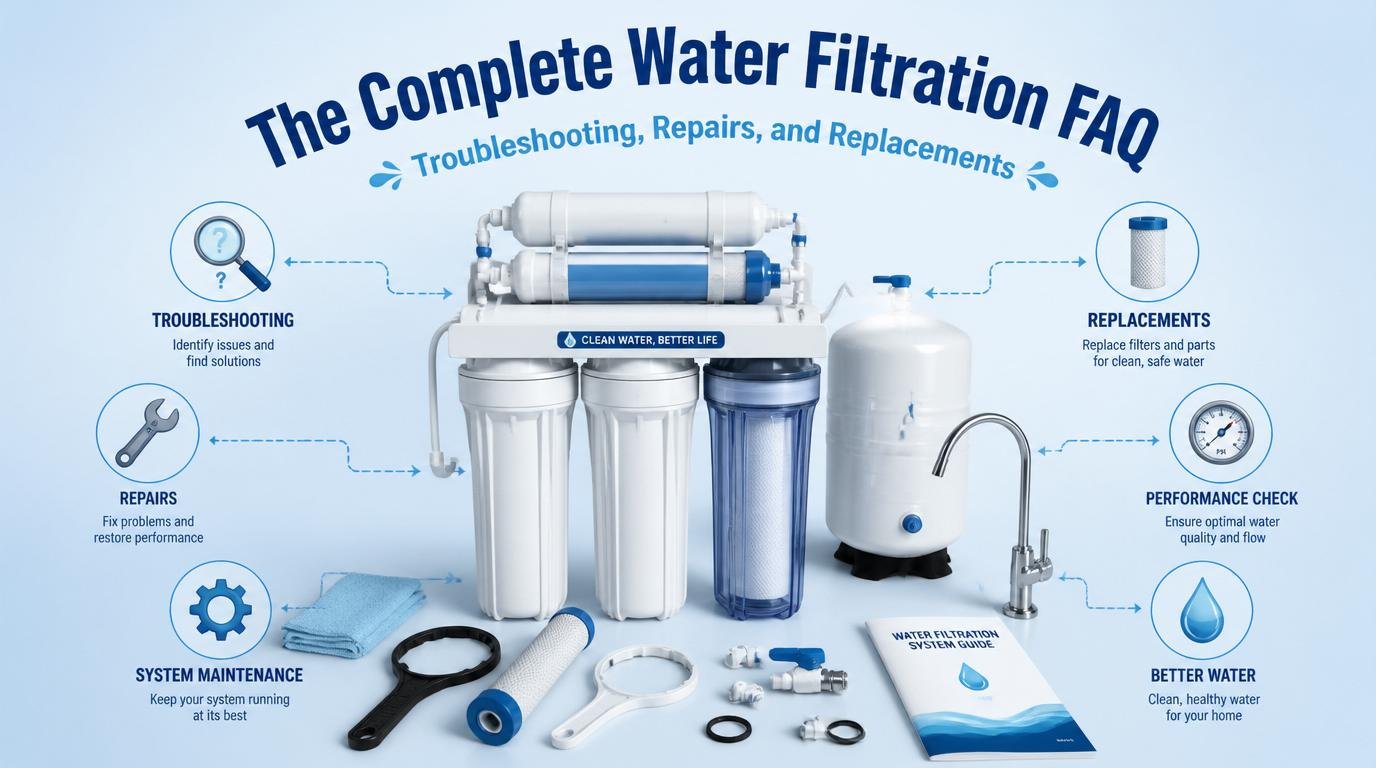
The Complete Water Filtration FAQ: Troubleshooting, Repairs, and Replacements
By Jared Beviano | Water Wizards Filtration | Delray Beach, FL
After twelve years of servicing water treatment systems across South Florida, I've heard just about every question imaginable. Most come up weekly. A few are memorable for different reasons.
My favorite was a man in Palm Beach Gardens who called because his tomato plants were dying. He was convinced something was wrong with his irrigation water. We ran through the usual diagnostics — pH, salinity, iron — before I asked the question I probably should have asked first: was the irrigation connected to his softened water line?
It was. Sodium-enriched softened water is genuinely terrible for most plants, particularly in South Florida's already sandy, low-nutrient soil. The softener was working perfectly. The plants were dying because of it. Moving the irrigation connection upstream of the softener fixed both problems in twenty minutes.
That story isn't in any troubleshooting guide. But it's exactly the kind of answer twelve years of field work produces — the difference between knowing how equipment is supposed to work and knowing how it actually behaves in South Florida homes, with our water, our climate, and the specific situations our residents find themselves in.
This FAQ covers everything I get asked regularly, organized by system type. Some answers will help you fix things yourself. Some will help you understand what's happening before you call for service. A few are just things that are good to know if you have a water treatment system in this region.
Quick Symptom Lookup
Before the full FAQ, a faster path if you have a specific problem right now:
🔍 What Problem Are You Seeing?
Whole-House Filter Systems
How often should I change my whole-house filter cartridges?
The honest answer involves two variables manufacturers don't account for: South Florida's specific water chemistry and your actual usage. Manufacturer recommendations are starting points calibrated for national average conditions. Our conditions aren't average.
Sediment pre-filters (5–20 micron) on city water: every 3–6 months. On well water: sometimes every 4–8 weeks during rainy season, when the shallow Biscayne Aquifer stirs up more particulates. The diagnostic isn't the calendar — it's your pressure gauge. A 5–7 PSI drop from clean baseline means change it now, regardless of what month it is.
Carbon block filters: every 6–9 months. Carbon exhausts chemically before it clogs physically. The filter looks fine while no longer removing chloramine. If you notice chemical taste returning before the scheduled change, that's the signal — not the schedule.
Specialty filters for iron and manganese: these vary dramatically. I've seen iron cartridges last a month on 4 ppm well water and six months on 0.5 ppm city water. Testing your water quarterly tells you what load your filter faces and lets you calibrate the replacement schedule to your specific situation.
Tank-based whole-house media systems (SpringWell, Pelican, Aquasana): the pre-filter cartridge every 3–6 months; the main media tank every 5–10 years depending on water quality.
My water pressure dropped noticeably after installing a whole-house filter. Is that normal?
Some pressure drop is expected — water passing through filter media creates resistance. Clean filter: 3–5 PSI drop maximum. More than that points to a sizing problem.
A 10" × 2.5" housing is adequate for a small apartment. A three-bathroom house with irrigation needs Big Blue (20" × 4.5") housings or multiple housings in parallel. Undersized filter housings are the most common DIY installation mistake I see — the restriction worsens as the cartridge loads up, producing 20–30 PSI drops that feel like a pressure failure rather than a filtration issue.
If sizing is correct and pressure is still low: check that the micron rating isn't too fine for your water. Starting with 1-micron on sediment-heavy well water clogs instantly. Use a dual-gradient filter (Pentek DGD-5005 or similar) that processes coarse particles on the outer layers and fine particles toward the center.
My filter water tastes like chlorine even though I just changed the cartridge. What's wrong?
Usually one of three things. First, wrong filter type: most South Florida municipalities use chloramine disinfection, not plain chlorine. Standard activated carbon handles chlorine but works poorly against chloramines. You need catalytic carbon specifically rated for chloramine removal — not just any carbon block.
Second, the filter may be installed backward. Many cartridges have flow direction arrows. Backward installation reduces contact time between water and carbon media, dramatically cutting effectiveness.
Third, check your bypass valve if you have one. Even a partial bypass opening routes unfiltered water into the system. The treated water gets diluted by untreated water and the chloramine taste returns even though the filter itself is working.
→ Why standard carbon fails on South Florida water:Reverse Osmosis vs. Carbon Filters: Which Water System Do You Actually Need?
How do I tell if my filter housing is cracked versus just needing a new O-ring?
Remove the housing completely, empty and dry it, and inspect under good light. Look for crazing (fine surface crack networks indicating UV or chemical damage), any visible cracks especially around thread areas and the O-ring groove, and plasticity changes — a housing that feels softer or more flexible than when new has compromised polymer structure.
O-ring: soft, flexible, springs back to original shape when released = good. Stiff, doesn't spring back, has flat spots or surface cracking = replace. The O-ring costs $2–5 and 10 minutes. A cracked housing costs $40–75 and prevents a flooding incident in your utility room. When in doubt between the two, replace the O-ring first — if the leak continues with a new lubricated O-ring, the housing has a crack.
Reverse Osmosis Systems
Why is my RO water flow so slow?
Start with the pre-filters — the sediment and carbon cartridges upstream of the membrane. If they haven't been changed in over six months, start there before any other diagnosis. A clogged pre-filter starves the membrane of water and is responsible for at least half of all slow-flow complaints.
If pre-filters are current, test the storage tank: turn off the supply valve, drain the tank completely through the RO faucet, then check air pressure at the Schrader valve (bottom of tank, looks like a tire valve) with a gauge. Should read 7–8 PSI. Below 5 PSI means the air charge has bled down — refill with a bicycle pump. No pressure at all means the bladder has separated and the tank needs replacement ($50–100 for a standard 4-gallon tank).
If pre-filters are current and tank pressure is correct, check for kinked tubing — the 1/4" lines connecting RO components kink easily when the system gets pushed back under the sink. Follow every tube run looking for pinch points.
Finally: low incoming water pressure. RO systems need minimum 40 PSI; 60 PSI is optimal. South Florida well systems can run low, especially during peak usage. An Aquatec booster pump solves this.
My RO water tastes bad. What's the most common cause?
The post-filter — the small carbon cartridge at the very end of the system, between the storage tank and the faucet — is responsible for most taste complaints. It's the last thing water touches before you drink it, and it removes any taste that accumulated while water sat in the storage tank. When it's exhausted, stored water tastes stale or musty. Replace it first — it's a $10–15 part.
If replacing the post-filter doesn't resolve it, drain the storage tank completely and flush the system. On South Florida summer heat, a tank left unused for several days can develop bacterial growth that smells musty or earthy. Full system sanitization with a dilute bleach solution, followed by thorough flushing, addresses this.
Chemical/chlorine taste from an RO faucet almost always means the carbon pre-filter is exhausted and chloramines are reaching the membrane — which can't fully remove them and passes them to the product water. Replace the pre-filter.
How do I know if my RO membrane needs replacement?
A $15 TDS meter gives you the answer in two minutes. Measure TDS of your source water (from the cold supply line before the RO). Then measure TDS of your product water (from the RO faucet). Calculate: (source TDS − product TDS) ÷ source TDS × 100 = rejection percentage.
Healthy membrane: 90–97% rejection. Degraded: 80–89%. Replace soon: below 80%. At below 75%, the membrane is passing enough dissolved contaminants that it's providing significantly less protection than you expect.
For South Florida specifically: plan membrane replacement at 18–24 months on city water, 12–18 months on well water. Chloramine in city water degrades membrane polymer over time — the pre-filters must be current to protect the membrane. A membrane that's been hit with chloramines from an exhausted pre-filter fails faster than one that's been properly protected.
→ Why refrigerator filters don't replace RO for PFAS:Refrigerator Filter vs. Reverse Osmosis: Which Actually Makes Your Water Safe?
My RO system runs water to drain constantly. Is that normal?
No. An RO system should run water to drain only while it's actively producing water to fill the tank. When the tank is full, the auto shut-off valve (ASO) senses the pressure and stops the system. Constant drain flow means the ASO has failed, allowing the system to run indefinitely.
This wastes significant water and should be addressed promptly. In the meantime, you can turn off the supply valve to the RO system when not in use as a temporary measure. A replacement ASO valve costs $8–15 and is a straightforward replacement for anyone comfortable with plumbing connections.
Does RO water need to be remineralized?
This is genuinely a personal decision, not a health requirement. RO removes virtually all dissolved minerals including calcium and magnesium. The World Health Organization has published guidance noting that long-term consumption of very low-mineral water may not provide the mineral contribution that harder water does. However, WHO also notes that humans get the vast majority of their mineral intake from food, not water.
The practical South Florida answer: if you're making coffee or tea and find RO water tastes flat or slightly acidic, a remineralization post-filter adds back a small amount of calcium and magnesium and raises pH slightly. It's a $15–30 add-on filter stage. Not medically necessary, but noticeably improves the taste of hot beverages for many people.
Water Softeners
My softener isn't producing soft water anymore. Where do I start?
The diagnostic sequence that works most of the time, in order:
First, look in the brine tank. Is there salt? Is the salt level adequate? Has a salt bridge formed — a hard crust that looks like salt filling the tank but is actually hollow underneath? Break up any bridge with a broom handle or similar tool. Salt bridges are extremely common in humid South Florida garages.
Second, manually initiate a regeneration cycle and watch it run. Most Fleck and Clack valves have a manual regeneration button. Start the cycle and watch for 60–90 minutes. You should see the brine draw step (water level in brine tank dropping) followed by the rinse steps. If the brine tank level doesn't change during the supposed brine draw, the injector is clogged or the valve isn't completing the cycle.
Third, check the output with a hardness test strip immediately after regeneration — the water exiting the softener right after a complete regeneration should read 0 grains. If it does, but hardness returns within a few hours, the resin is exhausted. If it still reads hard immediately after regeneration, the regeneration isn't completing or the resin is severely fouled.
My water softener makes a loud noise and runs at 2 AM. Is something wrong?
Probably not. Softeners regenerate on a timer — the default is usually 2:00 AM because that minimizes the inconvenience of the 60–90 minute cycle when the system is off service. During regeneration, you'll hear the motor advancing through cycle positions, water flowing to drain, and the brine tank refilling. This is entirely normal.
A grinding sound from the control head (rather than normal water flow sounds) indicates a motor or piston issue. A loud banging or hammering is water hammer in the drain line — adding a loop of drain tubing that hangs above the drain inlet usually fixes this. If regeneration seems to be happening multiple times daily rather than once every few days, the timer settings or demand-initiated settings may need adjustment.
Can a water softener damage my plumbing or appliances?
The softener itself doesn't damage plumbing. But there are scenarios to be aware of.
If your water heater has a sacrificial anode rod (most do), the anode rod will corrode faster in soft water because the chemistry that causes it to corrode instead of the tank is more active. Most plumbers recommend inspecting or replacing the anode rod more frequently (every 3–4 years instead of every 5–6 years) if you have a water softener. This is a small maintenance cost compared to the appliance protection a softener provides.
Plants and gardens: as the Palm Beach Gardens tomato story demonstrates, softened water is poor for most plants. Sodium replaces calcium and magnesium in the soil, disrupting water absorption. Keep outdoor irrigation connections upstream of the softener bypass.
Very old plumbing: soft water is slightly more aggressive toward lead soldering than hard water, because the mineral scale that hard water deposits in pipes actually seals old lead joints. In pre-1986 homes with lead solder, a whole-house softener can theoretically increase lead mobilization slightly. Adding an under-sink RO at the kitchen tap addresses this — the RO removes lead that soft water might have mobilized.
What does it mean when my brine tank has water standing in it?
Some water in the brine tank is normal — that's the brine solution the softener uses during regeneration. What's not normal is water filling the brine tank above the salt level, or the tank completely full of water with no air space.
If the brine tank is overflowing or water is standing above the normal level, the float assembly is stuck open — the valve that controls water refill into the brine tank after regeneration. Clean the float and float valve with vinegar to remove mineral scale, then check that the float moves freely. If the float assembly is corroded or the valve seat is damaged, replacement is typically $10–20.
→ Complete softener troubleshooting:Signs Your Water Softener Isn't Working (And What to Do About It)
UV Sterilization Systems
My UV light is still on but I haven't replaced the lamp in two years. Is it still working?
No — not reliably. This is the most important UV misconception to correct. UV lamps don't burn out like regular light bulbs — they fade gradually, losing germicidal output while continuing to produce visible light. At 18–24 months of continuous operation, a UV lamp typically retains 30–50% of its original germicidal output. The blue light is on; the bacteria protection may be largely gone.
Replace on schedule — every 12 months, regardless of whether the lamp appears to be working. This is not a conservative manufacturer suggestion. It's based on measured output curves that show UV-C intensity dropping below the EPA's recommended dose for reliable disinfection at approximately 9,000 hours of operation.
→ Full explanation of UV degradation:UV Bulb and Sleeve Replacement: Protecting Your Well Water Year After Year
My UV system shows an alarm light even after I replaced the lamp. What does that mean?
Several possibilities. First, confirm the lamp is fully seated — an improperly installed lamp that isn't making full contact with the socket can trigger an alarm even though it's new. Remove and reinstall the lamp, making sure both contact points are firmly engaged.
If the alarm persists with a properly installed new lamp, it may be a UV intensity sensor alarm (on systems equipped with monitoring sensors) indicating the quartz sleeve is too fouled to allow adequate UV transmission even with a new lamp. Clean the sleeve in citric acid solution — 1 cup citric acid per quart of water, 20–30 minute soak. If the sleeve appears pitted or permanently clouded after cleaning, it needs replacement.
A ballast failure can also trigger a false lamp alarm. If new lamp + clean sleeve doesn't clear the alarm, the ballast needs service.
Should UV come before or after my softener and carbon filter?
UV should be the last stage before water enters your home — the final point of treatment immediately before the distribution point. Specifically: sediment filter → iron/sulfur treatment (if applicable) → carbon filter → water softener → UV.
The reason: UV requires clear water. Sediment, iron particles, or turbidity in the water before UV creates shadows that protect microorganisms from the germicidal light. All filtration that removes particles must come before UV. The softener comes before UV because, while soft water and hard water both transmit UV similarly, you want the cleanest, clearest possible water entering the UV chamber.
Well Water Systems
After heavy rain, my well water smells and has a different taste. Is that normal?
Common in South Florida, and worth taking seriously. The Biscayne Aquifer is shallow — sometimes only 20–50 feet deep in western Palm Beach and Broward Counties. It's permeable. After significant rainfall, surface water carrying whatever it picked up on the way down — bacteria from septic systems or livestock areas, agricultural runoff, organic material — can infiltrate the aquifer relatively quickly and affect well water chemistry.
If you notice taste or odor changes after heavy rain, test your water for bacteria immediately. Don't assume it will clear on its own, and don't assume your UV system provides adequate protection if the lamp hasn't been replaced recently or the sleeve is fouled. This is one of the primary reasons we recommend well water testing twice per year in South Florida — before wet season (May) and after (November) — and immediately after flooding near the wellhead.
→ Well water safety in South Florida:Is South Florida Well Water Safe? A Complete Homeowner's Guide
My iron staining came back after a year without it. What happened?
Either the iron load in your well water has increased, or your iron removal system has degraded. The two need to be distinguished before deciding on a fix — replacing iron filter media when the actual problem is increased iron load just means you'll exhaust the new media faster.
Test your raw well iron level (before any treatment). If it's higher than when you first installed the system, adjust treatment capacity accordingly — a larger AIO tank, a higher-capacity cartridge, or an upstream chlorination injection for very high iron levels.
If iron level is similar to before, examine the treatment system: AIO (air injection oxidizing) systems need the air pocket to be functional and the media to be in good condition. If the media has been running for 6–8 years with high iron load, exhaustion is likely. Softener-based iron removal is only appropriate below 2 ppm iron — if yours has crept above that, a dedicated iron filter needs to be added upstream.
→ Complete iron problem guide:Orange and Brown Stains in Your Toilet and Sinks? It's Florida's Iron Problem
Can I drink my well water without any treatment?
Florida DOH recommends annual testing for bacteria and nitrates as a minimum. The answer to "can I drink it untreated" is: test it first. Well water in South Florida is not inherently unsafe, but it can contain bacteria (particularly after flooding), nitrates (in agricultural areas), iron, hydrogen sulfide, and increasingly PFAS from aquifer contamination — none of which are detectable by taste or appearance.
Many people drink untreated well water their entire lives without apparent harm. Many others have low-level bacterial exposure that causes periodic GI symptoms they attribute to other causes. Testing is $30–80 at a certified lab and is the only way to know what you're actually dealing with.
General Questions
How do I know when my water treatment system needs professional service vs. DIY maintenance?
The dividing line is usually diagnosis, not technical difficulty. If you know exactly what part has failed and have the correct replacement, most filter and UV maintenance is within DIY capability. Where professional service adds value is when the symptom has multiple possible causes — low flow from an RO system could be pre-filters, membrane, tank bladder, low incoming pressure, or a kinked line. Working through all those possibilities without a clear diagnosis wastes money on parts that may not be the problem.
If you've replaced the obvious part and the symptom persists, call for service. If you're not sure where to start, a 10-minute phone conversation with someone who knows these systems can often save you a frustrating afternoon.
My water treatment system is 10 years old. Should I replace it or repair it?
A general framework: if the system has been properly maintained (filters on schedule, softener resin in good condition, UV lamp annually), a 10-year-old system with a component failure is usually worth repairing. If maintenance has been irregular and multiple components are showing wear simultaneously, the economics shift toward replacement.
Specific benchmarks: control valves are typically the most expensive repair ($150–400 for parts and labor depending on the brand). At 10–12 years, if a valve fails on a system in otherwise good condition, repair. If the valve fails on a system with exhausted resin, degraded O-rings throughout, and an overdue UV lamp, consider whether the sum of all needed maintenance approaches the cost of a new system — because often it does.
→ Annual maintenance checklist:The Annual Water System Maintenance Checklist for Florida Homeowners → System costs and what drives them:How Much Does a Whole House Water Filtration System Cost in Florida?
Can I service my own water treatment system, or does it void the warranty?
This varies by manufacturer and installer. Most residential water treatment systems allow owner-performed cartridge and filter replacement without voiding warranty — these are designed as consumer-serviceable maintenance items. Control valve rebuilds, membrane replacement, and UV lamp replacement are more variable; some installers require their own service for warranty coverage, while others have no such requirement.
Review your installation documentation. If it's not clear, call the installer before doing the work. The cost of a voided warranty on a $2,000+ system is worth a 5-minute phone call.
Have a Question Not Answered Here? Call 561-352-9989 or Book a Free Water Test
Water Wizards Filtration | Delray Beach, FL | Palm Beach · Broward · Martin County
Sources: Fleck / Pentair Controls — Service Manual Series 5600, 5810, 7000; Viqua / Trojan Technologies — UV System Owner Manuals and Service Guides; NSF International — Standards 44, 55, 58 for Water Softeners, UV Systems, and RO; EPA — Residential Drinking Water Treatment Technologies; WQA — Water Treatment System Troubleshooting Technical Resources; Florida Department of Health — Private Well Testing and Water Quality; Dow DuPont — Molykote 111 Technical Data Sheet: NSF H1 Approved Food Grade Lubricant