Brita Filter vs. Reverse Osmosis: An Honest Comparison for South Florida Tap Water
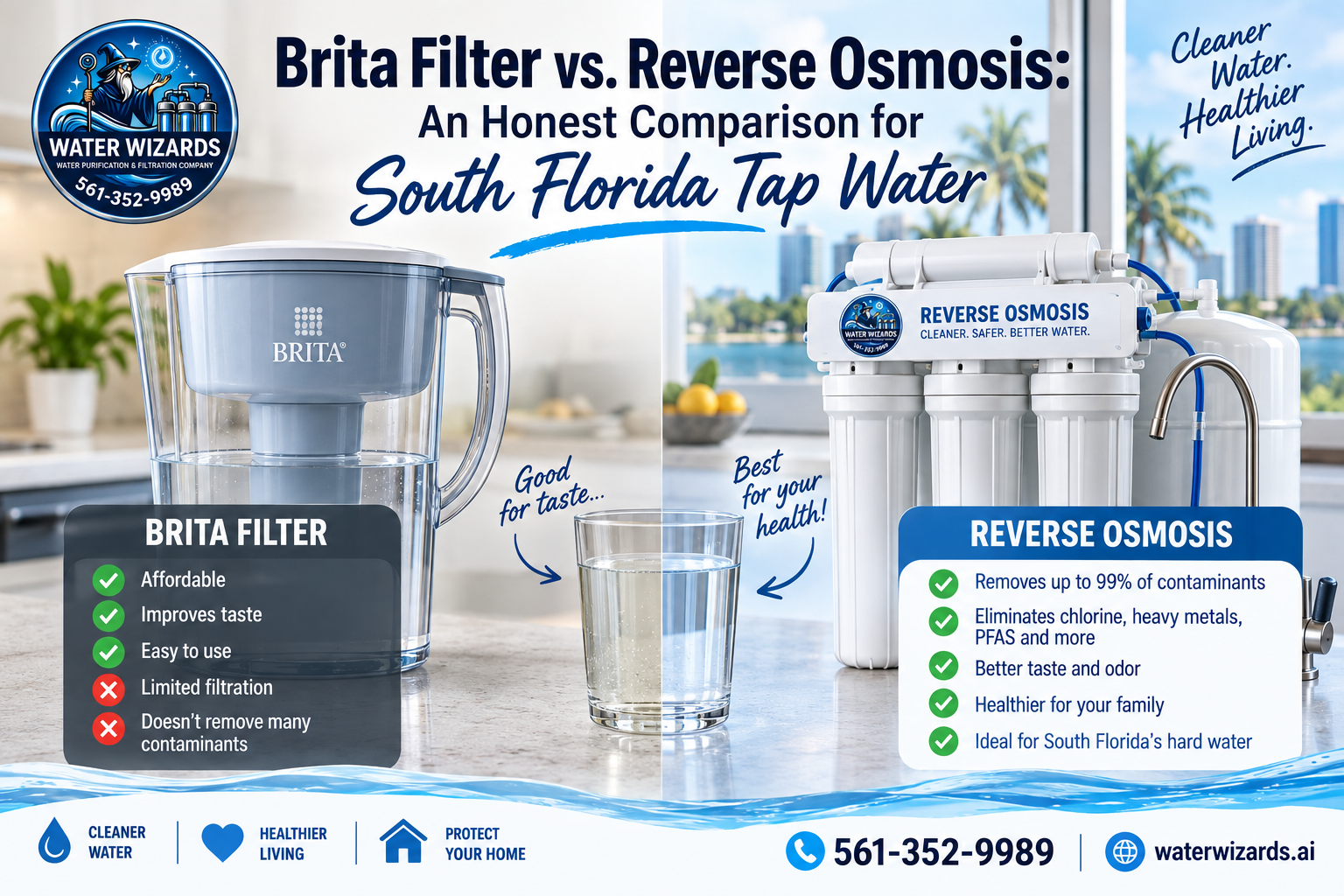
Published by Jared Beviano · Water Wizards Filtration
A customer in Boynton Beach called me last spring. She'd been buying Brita pitcher filters for three years — going through one every two months, spending about $180 a year on cartridges. She'd just read the EWG Tap Water Database entry for Palm Beach County Water Utilities and seen that her water contained chromium-6 at levels above the cancer guideline, chlorate above the thyroid guideline, and PFAS above health guidelines.
She asked me one question: "Does my Brita filter remove any of this?"
I had to tell her the truth. No. Not meaningfully.
She was quiet for a moment. Then: "So what have I been filtering for three years?"
Taste. Mostly taste. Some sediment. Some chlorine odor. That's what a Brita pitcher filter does. It was never designed to do what she thought it was doing.
This article is the honest comparison I gave her — what Brita actually removes, what reverse osmosis actually removes, when each makes sense, and when you're wasting money on the wrong solution.
What a Brita Filter Actually Does
Brita pitcher filters use activated carbon — usually a blend of coconut shell carbon and ion exchange resin. The water sits in the pitcher reservoir and gravity pulls it through the filter cartridge into the lower chamber. There's no pressure. No pump. Just gravity and time.
This filtration method is effective at specific things:
What Brita removes well:
Free chlorine (the disinfectant used by some utilities — not chloramine)
Chlorine taste and odor
Some sediment and particulates
Zinc, copper, and cadmium (from old plumbing)
Some mercury
What Brita removes partially or inconsistently:
Chloramine — Brita's standard filter performs poorly on chloramine. Their "Longlast" filter does better, but still not complete removal. South Florida utilities use chloramine, not free chlorine.
What Brita does not remove:
PFAS (forever chemicals) — not removed by activated carbon pitchers
Arsenic — not removed
Chromium-6 — not removed
Nitrates — not removed
Fluoride — not removed by standard Brita (their specialty filter removes some)
Pharmaceuticals — not removed
Heavy metals beyond zinc/copper/cadmium — not removed
Dissolved solids (TDS) — not significantly reduced
Hard water minerals — not removed
Brita is certified by NSF International under standards 42 and 53. Standard 42 covers aesthetic effects — taste, odor, chlorine. Standard 53 covers some health-related contaminants. Brita is NOT certified under NSF 58, which covers reverse osmosis systems and the full range of health contaminants including arsenic, fluoride, nitrates, and PFAS.
The certification tells you exactly what it was designed for. Brita was designed to make tap water taste better. It was never designed to make South Florida tap water safe from the contaminants that are actually above health guidelines here.
What Reverse Osmosis Actually Does
A reverse osmosis system forces water through a semi-permeable membrane under pressure. The membrane has pores small enough to block dissolved ions, molecules, and particles — including most contaminants that pass through activated carbon filters with ease.
A standard under-sink RO system has four to five stages:
Stage 1: Sediment pre-filter — removes particles, sediment, rust. Protects the membrane from physical damage.
Stage 2: Carbon pre-filter — removes chlorine and chloramine before the water reaches the membrane. Chlorine and chloramine damage RO membranes, so this stage is essential in South Florida.
Stage 3: RO membrane — the core filtration stage. Removes dissolved solids, heavy metals, nitrates, arsenic, chromium-6, fluoride, most PFAS, and other dissolved contaminants. Produces water at 5–30 ppm TDS from South Florida source water at 250–380 ppm TDS.
Stage 4: Post-carbon filter — final polishing stage. Removes any residual taste or odor before the water reaches the faucet.
Stage 5 (optional): Remineralization — adds back beneficial minerals (calcium, magnesium) that the RO process removes along with contaminants. Improves taste and adds health value.
What RO removes:
PFAS (PFOS, PFOA, PFBS, GenX): 90–99% removal
Arsenic: 92–98% removal
Chromium-6: 85–95% removal
Nitrates: 85–95% removal
Fluoride: 85–95% removal
Lead: 95–98% removal
Chloramine: removed by pre-carbon stage
Chlorine: removed by pre-carbon stage
Dissolved solids (TDS): 90–97% reduction
Pharmaceuticals: 90%+ removal for most compounds
Radium: 85–95% removal
Barium: 90–98% removal
Bacteria and viruses: 99%+ removal (membrane acts as physical barrier)
The RO membrane doesn't care whether a contaminant is on the EWG list or the EPA list or no list at all. If it's a dissolved molecule or ion larger than water molecules, it can't pass through the membrane. This is why RO is the technology recommended by health authorities for immunocompromised individuals, pregnant women, infants, and anyone with elevated health concerns about their drinking water.
The South Florida Comparison — Side by Side
This is where the honest conversation gets concrete. Let's look at Palm Beach County Water Utilities — the utility serving Boca Raton, Boynton Beach, West Palm Beach, and most of the county — and ask what each system actually does with their water.
| Contaminant / Parameter | Brita pitcher filter | Under-sink reverse osmosis |
|---|---|---|
| Health contaminants above guidelines in South Florida | ||
| PFAS (PFOS, PFOA, GenX) | ✗ Not removed | ✓ 90–99% removed |
| Chromium-6 | ✗ Not removed | ✓ 85–95% removed |
| Arsenic | ✗ Not removed | ✓ 92–98% removed |
| Chlorate | ✗ Not removed | ✓ 85–90% removed |
| Nitrates | ✗ Not removed | ✓ 85–95% removed |
| Lead | ~ Partial (NSF 53) | ✓ 95–98% removed |
| Disinfectants & byproducts | ||
| Chloramine (South Florida utilities) | ~ Poor removal | ✓ Removed by pre-carbon |
| Free chlorine | ✓ Removed well | ✓ Removed by pre-carbon |
| TTHMs / HAAs | ~ Partial | ✓ 85–95% removed |
| Aesthetic & physical parameters | ||
| Taste & odor improvement | ✓ Yes — primary benefit | ✓ Dramatic improvement |
| Hardness / TDS reduction | ✗ Not reduced | ✓ 90–97% reduction |
| Fluoride | ✗ Standard: not removed | ✓ 85–95% removed |
| Bacteria & viruses | ✗ Not removed | ✓ 99%+ (membrane barrier) |
| Practical comparison | ||
| Installation required | ✓ No installation | ~ Under-sink (2–3 hrs) |
| Upfront cost | $35–50 | $600–1,200 installed |
| Annual maintenance cost | $42–60/yr | $150–280/yr |
| Flow / convenience | Slow — fill, wait, refill | Full flow at dedicated faucet |
| NSF certification | NSF 42 & 53 (taste/odor/some metals) | NSF 58 (comprehensive contaminants) |
| Right for South Florida health contaminants? | ✗ No | ✓ Yes |
PBCWU water contains, among others:
Chlorate: above EWG thyroid health guideline
Chromium-6: above EWG cancer guideline
PFAS: above EWG health guidelines
Hardness: 274–291 ppm / 16–17 GPG
Chloramine: used for disinfection throughout distribution
Brita pitcher on PBCWU water:
Chromium-6: Not removed ✗
Chlorate: Not removed ✗
PFAS: Not removed ✗
Hardness: Not reduced ✗
Chloramine: Partially reduced at best ✗
Taste: Improved ✓
Chlorine odor: Improved ✓ (but PBCWU uses chloramine, which Brita handles less well than free chlorine)
Under-sink RO on PBCWU water:
Chromium-6: 85–95% removed ✓
Chlorate: 85–90% removed ✓
PFAS: 90–99% removed ✓
Hardness: 90–97% reduced ✓
Chloramine: Removed by pre-carbon stage ✓
Taste: Dramatically improved ✓
The honest answer for South Florida: a Brita pitcher does not address the contaminants that are actually above health guidelines in your water. It addresses taste and odor — which is a real and legitimate benefit, but it's not water safety.
Cost Comparison — The Real Numbers
This is where the Brita vs. RO conversation usually ends in favor of Brita — upfront cost. Let's look at the actual numbers over time.
Brita (standard pitcher + cartridges):
Pitcher: $35–50
Cartridge replacement: every 40 gallons or 2 months → approximately 6 per year
Cartridge cost: $7–10 each → $42–60 per year
Longlast cartridge (better performance, 120 gallons): $15–18 each → 2–3 per year → $30–54 per year
5-year total: $245–350 (standard) or $185–320 (Longlast)
Volume: limited to pitcher capacity — filling, waiting, refilling
No installation required
Under-sink RO (4–5 stage system):
System installed: $600–1,200 (basic to mid-range)
Annual filter maintenance: pre-filters every 6 months ($20–40 each), post-filter annually ($20–30), membrane every 2 years ($50–100)
Annual maintenance cost: $150–280
5-year total: $1,350–2,600 installed and maintained
Volume: unlimited — full flow rate at the faucet, no waiting
Dedicated faucet at sink
At first glance: Brita wins on cost. At second glance, it depends what you're measuring.
If you're filtering tap water that's genuinely low-risk — soft water, low TDS, no PFAS, no contaminants above health guidelines — Brita is a reasonable, inexpensive solution for taste improvement. That describes some parts of the US. It does not describe South Florida.
If you're filtering South Florida tap water with PFAS above EPA limits, chromium-6 above EWG guidelines, and arsenic above EWG guidelines — Brita is not doing the job regardless of cost. Spending $60 a year on cartridges that don't remove your actual contaminants is $60 a year of false assurance.
The relevant comparison for South Florida isn't Brita vs. RO. It's: what is the cost of actually filtering your water versus what you're currently spending on something that doesn't?
When Brita Makes Sense
I'm not here to sell RO to everyone. Brita makes sense in specific situations:
You're renting short-term and can't install anything. Brita requires no installation. If you're in a furnished rental for three months, it's a reasonable interim solution for taste — with the understanding that it's not addressing health contaminants.
Your source water has no significant health contaminants. If you have a private well that tests clean, or you're on a very small utility with consistently excellent water quality, a Brita pitcher for taste and the extra peace of mind is proportionate.
You want better-tasting water for cold brew or a specific application and you're already using an RO system for drinking water. Some people run their RO water through a Brita for additional polishing. This is overkill but harmless.
You travel and want portable filtration. Brita makes travel bottles with filters. Useful for situations where you're uncertain about water source. Not a substitute for point-of-use filtration at home.
When You Need RO
You need reverse osmosis — not a pitcher filter — if any of the following apply:
You're on Miami-Dade WASD. PFOS at 18.98 ppt — 4.7 times the EPA's legal limit. PFOA above EPA limit. No pitcher filter addresses this. RO removes 90–99% of PFAS.
You're on Palm Beach County Water Utilities, Broward County WWS, Seacoast Utilities, or any major South Florida utility. Chromium-6 above EWG cancer guidelines. PFAS above EWG health guidelines. Chlorate above EWG thyroid guidelines. None of these are addressed by activated carbon pitcher filters.
You have an infant, are pregnant, are immunocompromised, or have a family member with elevated health concerns. The EPA, the American Academy of Pediatrics, and multiple health authorities recommend point-of-use RO for these populations when contaminants are present above health guidelines.
You want to stop buying bottled water. RO water at the tap is equivalent to or better than most bottled water — the EPA's bottled water standards are not more stringent than tap water standards, and many bottled water brands are simply filtered municipal water. At $0.01 per gallon for RO vs. $1–2 per gallon for bottles, the economics are clear.
You cook with tap water. Boiling does not remove PFAS, chromium-6, arsenic, or nitrates. It concentrates them as water evaporates. If you're making pasta, rice, soups, or coffee with unfiltered South Florida tap water, you're consuming the contaminants in every meal.
A Note on Brita's Marketing
Brita's marketing is careful and technically accurate. They don't claim to remove PFAS. They don't claim to remove chromium-6. They certify their filters to NSF 42 and 53, which cover what their filters actually do.
The problem isn't Brita's marketing — it's the gap between what consumers assume a "water filter" does and what an activated carbon pitcher filter actually does. The word "filter" implies comprehensive filtration. The reality is selective filtration targeted at taste and odor.
When you see the phrase "filters tap water" on a Brita pitcher, it's accurate. It filters tap water. It doesn't purify tap water. It doesn't remove the contaminants that are above health guidelines in your specific water. Those are different things, and the difference matters in South Florida.
The Bottom Line
A Brita filter and a reverse osmosis system are not competing products. They solve different problems.
Brita solves: taste, odor, chlorine, some specific metals from old plumbing. It's an aesthetic improvement product. Cost: low. Contaminant removal: limited.
Reverse osmosis solves: PFAS, arsenic, chromium-6, nitrates, fluoride, lead, chloramine, dissolved solids, bacteria, viruses, and most other dissolved contaminants above health guidelines. It's a water safety product. Cost: moderate. Contaminant removal: comprehensive.
For the customer in Boynton Beach, the answer was clear. She switched to an under-sink RO system installed for $780. She now has water that actually addresses the contaminants in her water — not just the taste. Her annual maintenance cost is $180, roughly the same as she was spending on Brita cartridges. The difference is what she's getting for that $180.
She still has her Brita pitcher. She uses it on road trips.
Call 561-352-9989 for a free water test — we'll show you exactly what's in your water
Water Wizards Filtration | Delray Beach, FL | Under-sink reverse osmosis systems, whole-house water filtration, and water softeners throughout Palm Beach, Broward, and Miami-Dade counties.